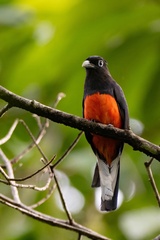
Baird's Trogon

Baird's Trogon

Trogon bairdii

Silhouette: Keith Murdock (photo), John E. McCormack, Michael G. Harvey, Brant C. Faircloth, Nicholas G. Crawford, Travis C. Glenn, Robb T. Brumfield & T. Michael Keesey · PhyloPic

LCNTNear ThreatenedVUENCR
Daily sighting probability ~20% · Possible
at Corcovado National Park

In 3 days ~50% in a week ~80%

759 Verified sightings at Corcovado National Park From 2019 to 2026
2,365 In all 5 parks
April Best month
☀️ Diurnal When it's spotted

About the Baird's Trogon

Baird's trogon (Trogon bairdii) is a bird species belonging to the family Trogonidae, which includes quetzals and trogons. It is native to Costa Rica and Panama. The species is named in honor of Spencer Fullerton Baird, a renowned naturalist of the 19th century who served as the first curator of the Smithsonian Institution.

Baird's trogon is sometimes treated as conspecific with one or both of green-backed trogon (T. viridis) and white-tailed trogon (T. chionurus). They do form a sister group with black-headed trogon (T. melanocephalus) and citreoline trogon (T. citreolus). Baird's trogon is monotypic.

Baird's trogon is 25 to 28 cm (9.8 to 11.0 in) long and weighs about 95 g (3.4 oz). The male's head and most of the breast are bluish black and the rest of the underparts a rich bright red. It has a stout light blue bill and ring around the eye. The upperparts are metallic blue-green and the wings mostly blackish with some white on the primary feathers. The upper side of the tail feathers are greenish- to violet-blue with black tips. Their underside is white with black tips. The female replaces the blue and green with dark slate above and... Wikipedia →

Sounds

Song0:35

Costa Rica · 2023

© Johan Chaves · XC805763 · CC BY-NC-SA 4.0

Call0:05

Costa Rica · 2010

© Peter Boesman · XC274302 · CC BY-NC-ND 4.0

Song0:31

Costa Rica · 2016

© Jelle Scharringa · XC607909 · CC BY-NC-SA 4.0

Global Distribution

Parks Where Found

# Park Country Daily sighting probability
1 Piedras Blancas National Park 🇨🇷 Costa Rica
~40%
2 Corcovado National Park 🇨🇷 Costa Rica
~20%
3 Carara National Park 🇨🇷 Costa Rica
~10%
4 Marino Ballena National Park 🇨🇷 Costa Rica
<5%
5 Manuel Antonio National Park 🇨🇷 Costa Rica
<5%

Before you go

What are the chances of seeing a Baird's Trogon in Corcovado National Park?

Possible

About 20% of wildlife watchers report a Baird's Trogon sighting in Corcovado National Park on a given day, based on 759 verified sightings from GBIF citizen-science data from 2019 to 2026. It is the 54th most-seen of the 332 birds we can rate there. Over three days the chance rises to about 50%, and over a week to about 80%, if each day is a fresh chance.

When is the best time to see a Baird's Trogon in Corcovado National Park?

April

In that month about 40% of wildlife watchers report a Baird's Trogon in Corcovado National Park on a given day, against about 10% in August to November, the lowest months.

What time of day is best to see a Baird's Trogon?

Between 7 and 10 am

Across all the parks we cover, that three-hour window holds the most Baird's Trogon sightings with a recorded time, and about 9 in 10 of them come between 6 am and 6 pm: it is a daytime animal.

Is Corcovado National Park the best place to see a Baird's Trogon?

2nd of 5

Of the 5 parks where we can rate Baird's Trogon sightings, Corcovado National Park ranks 2nd at about 20%. The best odds are in Piedras Blancas National Park (Costa Rica, about 40%).

Which relatives of the Baird's Trogon live in Corcovado National Park?

Same genus: Trogon

The closest relatives of the Baird's Trogon that you can see in Corcovado National Park (genus Trogon, New World Trogons) are Black-throated Trogon (about 40%), Slaty-tailed Trogon (about 30%) and Gartered Trogon (about 20%), with each one's daily chance of a sighting.

Where does the Baird's Trogon sighting chance come from?

GBIF citizen-science records

It is estimated from how often the Baird's Trogon is recorded against all the birds logged in Corcovado National Park (759 verified sightings from 2019 to 2026), calibrated against known sighting rates. Figures are rounded to the nearest 10% because citizen-science data supports honest approximations, not decimals, and months with records from fewer than five people show "—". How it works.

← Back to Corcovado National Park