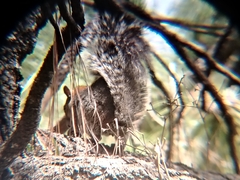
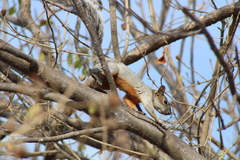

Red-bellied Squirrel

Red-bellied Squirrel

Sciurus aureogaster

Silhouette: Ferran Sayol · PhyloPic

LCLeast ConcernNTVUENCR
Daily sighting probability <5% · Rare
at Cumbres de Monterrey National Park

In 3 days ~10% in a week ~30%

6 Verified sightings at Cumbres de Monterrey National Park From 2019 to 2026
30 In all 2 parks
February Best month
☀️ Diurnal When it's spotted

About the Red-bellied Squirrel

The Mexican gray squirrel (Sciurus aureogaster, F. Cuvier), also known as the red-bellied squirrel, is known in Spanish as ardilla gris mexicana or ardilla vientre rojo. The species consists of two subspecies S. a. aureogaster and S.a. nigrescens, which are native to Mexico and Southern Guatemala. The Mexican gray squirrel was introduced to the Florida Keys in 1938 and is considered an invasive species.

Sciurus aureogaster was named in 1829 by Frédéric Cuvier. It is classified as part of the subgenus Sciurus within the broader Sciurus genus of tree squirrels, alongside several other North American and Eurasian species. Due to the species' considerable variety in fur color and patterns across its range, over sixty distinct scientific names have been applied to specimens since its original naming. Consequently, while the possibility that additional subspecies might be present within the species has been raised by taxonomists such as Guy Musser, at present only two subspecies are universally recognized:

Typically has orange to chestnut ventral fur, small postauricular patches, and a white tail accented with black or chestnut... Wikipedia →

Sounds

Recording0:22

Mexico · 2025

© David Doñez · iNaturalist · CC BY-NC 4.0

Recording0:13

Mexico · 2025

© Alicia Bastarrachea · iNaturalist · CC BY-NC 4.0

Recording0:27

Mexico · 2018

© Amalia Estrada · iNaturalist · CC BY-NC 4.0

Global Distribution

Parks Where Found

# Park Country Daily sighting probability
1 Cañón del Sumidero National Park 🇲🇽 Mexico
~20%
2 Cumbres de Monterrey National Park 🇲🇽 Mexico
<5%

Cities Where Found

# City Country Daily sighting probability
1 Mexico City 🇲🇽 México
~50%
2 Guadalajara 🇲🇽 México
~40%
3 Monterrey 🇲🇽 México
~30%
4 Puebla 🇲🇽 México
~20%
5 León 🇲🇽 México
~20%

Zoos & Centres Where Found

# Zoo / Centre Country
1 Chapultepec Zoo 🇲🇽 Mexico In captivity
2 Zoológico Los Coyotes 🇲🇽 Mexico In captivity
3 Palo Alto Junior Museum and Zoo 🇺🇸 United States In captivity

Before you go

What are the chances of seeing a Red-bellied Squirrel in Cumbres de Monterrey National Park?

Rare

Under 5% of wildlife watchers report a Red-bellied Squirrel sighting in Cumbres de Monterrey National Park on a given day, based on 6 verified sightings from GBIF citizen-science data from 2019 to 2026. It is the 15th most-seen of the 15 mammals we can rate there. Over three days the chance rises to about 10%, and over a week to about 30%, if each day is a fresh chance.

When is the best time to see a Red-bellied Squirrel in Cumbres de Monterrey National Park?

February, April–May and August

In those months about 10% of wildlife watchers report a Red-bellied Squirrel in Cumbres de Monterrey National Park on a given day, against under 5% in March, June–July and September–January, the lowest months.

What time of day is best to see a Red-bellied Squirrel?

Between 11 am and 2 pm

Across all the parks we cover, that three-hour window holds the most Red-bellied Squirrel sightings with a recorded time, and nearly all of them come between 6 am and 6 pm: it is a daytime animal.

Is Cumbres de Monterrey National Park the best place to see a Red-bellied Squirrel?

2nd of 2

Of the 2 parks where we can rate Red-bellied Squirrel sightings, Cumbres de Monterrey National Park ranks 2nd at under 5%. The best odds are in Cañón del Sumidero National Park (Mexico, about 20%).

Where does the Red-bellied Squirrel sighting chance come from?

GBIF citizen-science records

It is estimated from how often the Red-bellied Squirrel is recorded against all the mammals logged in Cumbres de Monterrey National Park (6 verified sightings from 2019 to 2026), calibrated against known sighting rates. Figures are rounded to the nearest 10% because citizen-science data supports honest approximations, not decimals, and months with records from fewer than five people show "—". How it works.

← Back to Cumbres de Monterrey National Park