Rock Squirrel

Rock Squirrel

Otospermophilus variegatus

Silhouette: Joseph Smit · PhyloPic

LCLeast ConcernNTVUENCR
Daily sighting probability ~30% · Possible
at Cumbres de Monterrey National Park

In 3 days ~70% in a week ~90%

191 Verified sightings at Cumbres de Monterrey National Park From 2019 to 2026
3,118 In all 6 parks
December Best month
☀️ Diurnal When it's spotted

About the Rock Squirrel

The rock squirrel (Otospermophilus variegatus) is a species of rodent in the family Sciuridae. It is native to Mexico and the Southwestern United States, including southern Nevada, Utah, Colorado, Arizona, New Mexico, Texas, and the panhandle of Oklahoma.

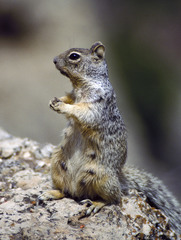
In Texas, they can be found in the western, central and Panhandle regions. They are especially common in the Texas Hill Country, a Subregion in central Texas. Rock squirrels are one of the largest members of the family Scuridae, with adults measuring up to 21 inches (53 cm) in length. In front and on top, the squirrel's coat is a speckled grayish brown; on the rear and bottom, the gray becomes a more mottled brownish-black tone. They have a marked light-colored ring around their eyes and pointed ears that project well above their heads. Rock squirrels have a long, bushy tail with white edges.

The female rock squirrel has two litters a year, with three to nine young in each litter. The first litter is typically born from April to June, while the second is born in August or September. They are active in the early morning and late afternoons when the weather is warm; when very hot, they... Wikipedia →

Sounds

Recording0:21

United States · 2025

© thorindhi · iNaturalist · CC BY-NC 4.0

Recording1:42

United States · 2022

© barbstout · iNaturalist · CC BY-NC 4.0

Recording0:21

United States · 2022

© ellen hildebrandt · iNaturalist · CC BY-NC 4.0

Global Distribution

Parks Where Found

# Park Country Daily sighting probability
1 Zion National Park 🇺🇸 United States
~90%
2 Grand Canyon National Park 🇺🇸 United States
~80%
3 Saguaro National Park 🇺🇸 United States
~40%
4 Big Bend National Park 🇺🇸 United States
~30%
5 Cumbres de Monterrey National Park 🇲🇽 Mexico
~30%
6 Guadalupe Mountains National Park 🇺🇸 United States
~20%

Cities Where Found

# City Country Daily sighting probability
1 Mesa 🇺🇸 United States
~50%
2 León 🇲🇽 México
~40%
3 Puebla 🇲🇽 México
~40%
4 San Luis Potosí 🇲🇽 México
~40%
5 Guadalajara 🇲🇽 México
~40%
6 Ciudad Juárez 🇲🇽 México
~30%
7 Mexico City 🇲🇽 México
~20%
8 Phoenix 🇺🇸 United States
~20%
9 San Antonio 🇺🇸 United States
~20%
10 Austin 🇺🇸 United States
~20%

Zoos & Centres Where Found

# Zoo / Centre Country
1 Prague Zoo 🇨🇿 Czechia In captivity
2 Ecological Center of Sonora 🇲🇽 Mexico In captivity
3 Parque Zoológico de León - Zooleón 🇲🇽 Mexico In captivity
4 Guadalajara Zoo 🇲🇽 Mexico In captivity
5 Arizona-Sonora Desert Museum 🇺🇸 United States In captivity
6 ABQ BioPark Zoo 🇺🇸 United States In captivity
7 Ménagerie du Jardin des Plantes 🇫🇷 France In captivity
8 Safari Masai Mara 🇲🇽 Mexico In captivity
9 Zoológico de Culiacán 🇲🇽 Mexico In captivity
10 Rákosův pavilon 🇨🇿 Czechia In captivity
11 Velemlokárium 🇨🇿 Czechia In captivity

Before you go

What are the chances of seeing a Rock Squirrel in Cumbres de Monterrey National Park?

Possible

About 30% of wildlife watchers report a Rock Squirrel sighting in Cumbres de Monterrey National Park on a given day, based on 191 verified sightings from GBIF citizen-science data from 2019 to 2026. It is the 3rd most-seen of the 15 mammals we can rate there. Over three days the chance rises to about 70%, and over a week to about 90%, if each day is a fresh chance.

When is the best time to see a Rock Squirrel in Cumbres de Monterrey National Park?

October to December

In those months about 40% of wildlife watchers report a Rock Squirrel in Cumbres de Monterrey National Park on a given day, against about 20% in January, the lowest month. Those are among Cumbres de Monterrey National Park's driest months, with about 55 mm of rain a month against 180 mm in September.

What time of day is best to see a Rock Squirrel?

Between 9 am and noon

Across all the parks we cover, that three-hour window holds the most Rock Squirrel sightings with a recorded time, and about 9 in 10 of them come between 6 am and 6 pm: it is a daytime animal.

Where does the Rock Squirrel sighting chance come from?

GBIF citizen-science records

It is estimated from how often the Rock Squirrel is recorded against all the mammals logged in Cumbres de Monterrey National Park (191 verified sightings from 2019 to 2026), calibrated against known sighting rates. Figures are rounded to the nearest 10% because citizen-science data supports honest approximations, not decimals, and months with records from fewer than five people show "—". How it works.

← Back to Cumbres de Monterrey National Park