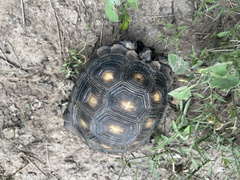
Texas Tortoise

Texas Tortoise

Gopherus berlandieri

Silhouette: Andrew A. Farke · PhyloPic

LCLeast ConcernNTVUENCR
Daily sighting probability ~10% · With luck
at Cumbres de Monterrey National Park

In 3 days ~20% in a week ~50%

126 Verified sightings at Cumbres de Monterrey National Park From 2019 to 2026
126 In 1 park
April Best month
🌅 Crepuscular When it's spotted

About the Texas Tortoise

The Texas tortoise (Gopherus berlandieri) is a species of tortoise in the family Testudinidae. The species G. berlandieri is one of six species of tortoises that are native to North America. G. berlandieri (Texas Tortoise) is found in the southern third of Texas (roughly parallel to Houston) southward into the Mexican states of Coahuila, Nuevo León, and Tamaulipas. Within its range, it inhabits semi-arid regions characterized by mesquite shrub and cactus dominated landscapes.

The specific epithet, berlandieri, is in honor of naturalist Jean Louis Berlandier, who worked for the Mexican government on one of the first biological surveys of Texas.[1] As such, some sources refer to it as Berlandier's tortoise.

The Texas tortoise, unlike other species of gopher tortoise, is not an adept burrower. It uses the thick vegetation for cover and thermoregulation. Succulent plants, a preferred food of the Texas tortoise, are common in these areas. It especially likes the fruit of cacti such as the prickly pear. The Texas Tortoise is oviparous. Female clutch sizes typically range anywhere from 1 to 5 eggs. The success of these clutches dramatically... Wikipedia →

Global Distribution

Parks Where Found

# Park Country Daily sighting probability
1 Cumbres de Monterrey National Park 🇲🇽 Mexico
~10%

More parks will be added in future updates.

Zoos & Centres Where Found

# Zoo / Centre Country
1 Prague Zoo 🇨🇿 Czechia In captivity
2 Zoo Pilsen 🇨🇿 Czechia In captivity
3 Bioparque Estrella 🇲🇽 Mexico In captivity
4 Living Desert Zoo and Gardens 🇺🇸 United States In captivity
5 Zoológico de San Juan de Aragón 🇲🇽 Mexico In captivity
6 Zoológico Benito Juárez 🇲🇽 Mexico In captivity
7 Zoológico la pastroa 🇲🇽 Mexico In captivity
8 Austin Zoo 🇺🇸 United States In captivity
9 Bayou Safari Wildlife Park 🇺🇸 United States In captivity
10 Akron Zoo 🇺🇸 United States In captivity
11 Zoológico del Altiplano 🇲🇽 Mexico In captivity
12 Zoológico Los Coyotes 🇲🇽 Mexico In captivity
13 Ecoparque Municipal 🇲🇽 Mexico In captivity
14 Gladys Porter Zoo 🇺🇸 United States In captivity
15 Parque del pueblo 🇲🇽 Mexico In captivity
16 Salisbury Zoo 🇺🇸 United States In captivity
17 Xenpal 🇲🇽 Mexico In captivity
18 Zoologico Caliente 🇲🇽 Mexico In captivity
19 Zoológico Tamatán 🇲🇽 Mexico In captivity
20 Recreativo San Jorge 🇲🇽 Mexico In captivity
21 Zoológico y Acuario de Nuevo Laredo 🇲🇽 Mexico In captivity
22 Texas Zoo 🇺🇸 United States In captivity
23 Unidad de Manejo Ambiental 🇲🇽 Mexico In captivity
24 Children's Aquarium at Fair Park 🇺🇸 United States In captivity
25 Acuario Inbursa 🇲🇽 Mexico In captivity
26 Rákosův pavilon 🇨🇿 Czechia In captivity
27 Texas Sealife Center 🇺🇸 United States In captivity
28 Velemlokárium 🇨🇿 Czechia In captivity
29 Austin Aquarium 🇺🇸 United States In captivity
30 Dream Catcher Stables 🇺🇸 United States In captivity

Closest Relatives at Cumbres de Monterrey National Park

No species of the same family or order lives in Cumbres de Monterrey National Park, so these are its closest relatives here: other reptiles.

Before you go

What are the chances of seeing a Texas Tortoise in Cumbres de Monterrey National Park?

With luck

About 10% of wildlife watchers report a Texas Tortoise sighting in Cumbres de Monterrey National Park on a given day, based on 126 verified sightings from GBIF citizen-science data from 2019 to 2026. It is the 17th most-seen of the 43 reptiles we can rate there. Over three days the chance rises to about 20%, and over a week to about 50%, if each day is a fresh chance.

When is the best time to see a Texas Tortoise in Cumbres de Monterrey National Park?

April and June

In those months about 20% of wildlife watchers report a Texas Tortoise in Cumbres de Monterrey National Park on a given day, against under 5% in March, July and October–December, the lowest months. Those are among Cumbres de Monterrey National Park's wettest months, with about 130 mm of rain a month against 20 mm in December.

What time of day is best to see a Texas Tortoise?

Between 8 and 11 am

Across all the parks we cover, that three-hour window holds the most Texas Tortoise sightings with a recorded time, and about 7 in 10 of them come between 6 am and 6 pm: it is most active around dawn and dusk.

Where else can you see a Texas Tortoise?

Only Cumbres de Monterrey National Park, in our data

Cumbres de Monterrey National Park is the only park on Wallace's Line with enough records to rate Texas Tortoise sightings: about 10% of wildlife watchers there report one on a given day.

Where does the Texas Tortoise sighting chance come from?

GBIF citizen-science records

It is estimated from how often the Texas Tortoise is recorded against all the reptiles logged in Cumbres de Monterrey National Park (126 verified sightings from 2019 to 2026), calibrated against known sighting rates. Figures are rounded to the nearest 10% because citizen-science data supports honest approximations, not decimals, and months with records from fewer than five people show "—". How it works.

← Back to Cumbres de Monterrey National Park