
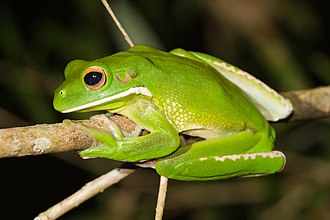
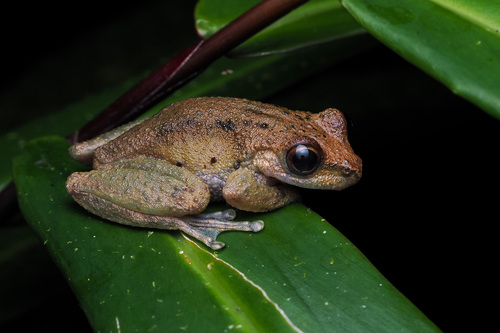
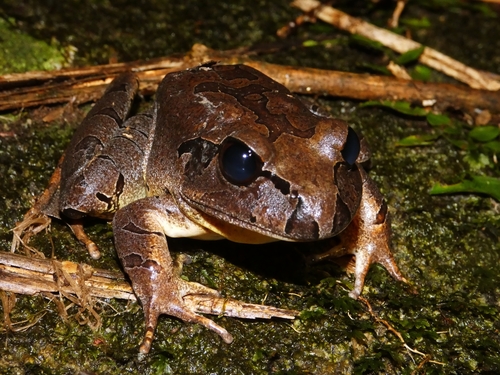
Australian Wood Frog

Australian Wood Frog

Papurana daemeli

Silhouette: Michael Scroggie, from original photograph by John Bettaso, USFWS (original photograph in public domain). · PhyloPic

LCLeast ConcernNTVUENCR
Daily sighting probability ~50% · Likely
at Daintree National Park

In 3 days ~90% in a week >90%

216 Verified sightings at Daintree National Park From 2019 to 2026
216 In 1 park
September Best month
☀️ Diurnal When it's spotted

About the Australian Wood Frog

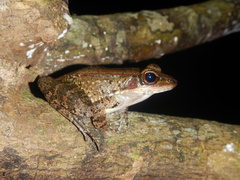
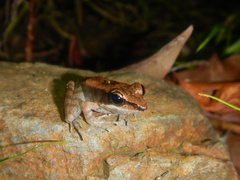
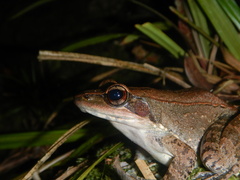
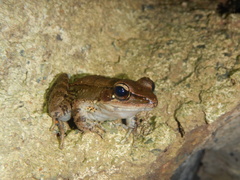
Papurana daemeli is a species of "true frog", family Ranidae. It is found in New Guinea, northern Australia, and some smaller islands (Yapen, New Hanover Island, New Britain). It is the only ranid frog found in Australia. In Australia, the species is restricted to the rainforest of northern Queensland and the eastern border of Arnhem Land, in the Northern Territory. In Australia, it is usually known as wood frog (though in North America this would refer to Lithobates sylvaticus) or sometimes as water frog. Other vernacular names are Australian wood frog, Australian bullfrog, and Arnhem rana.

Males can grow to 64 mm (2.5 in) and females to 81 mm (3.2 in) in snout–vent length; typical size for Australia are 43–58 mm (1.7–2.3 in) in males and 58–81 mm (2.3–3.2 in) in females. The body is elongated and the limbs are long and muscular. The tympanum is distinct and relatively larger in males than in females. A dorso-lateral skin fold runs from behind the eye to the hindlimb. Skin is smooth or weakly granular. The face mask is not prominent; the dark loreal stripe is often incomplete and the post-ocular stripe is discontinuous and not clearly defined. The dorsum is dark brown... Wikipedia →

Sounds

Recording0:20

Australia · 2026

© Sarah Helfand · iNaturalist · CC BY-NC 4.0

Recording0:06

Australia · 2021

© Tim · iNaturalist · CC BY 4.0

Recording0:09

Australia · 2025

© Rosa Geurtzen · iNaturalist · CC BY-NC 4.0

Global Distribution

Parks Where Found

# Park Country Daily sighting probability
1 Daintree National Park 🇦🇺 Australia
~50%

More parks will be added in future updates.

Before you go

What are the chances of seeing an Australian Wood Frog in Daintree National Park?

Likely

About 50% of wildlife watchers report an Australian Wood Frog sighting in Daintree National Park on a given day, based on 216 verified sightings from GBIF citizen-science data from 2019 to 2026. It is the 3rd most-seen of the 8 amphibians we can rate there. Over three days the chance rises to about 90%, and over a week to over 90%, if each day is a fresh chance.

When is the best time to see an Australian Wood Frog in Daintree National Park?

September

In that month about 70% of wildlife watchers report an Australian Wood Frog in Daintree National Park on a given day, against about 30% in July and December, the lowest months. That is one of Daintree National Park's driest months, with about 50 mm of rain against 380 mm in January.

What time of day is best to see an Australian Wood Frog?

Between 11 am and 2 pm

Across all the parks we cover, that three-hour window holds the most Australian Wood Frog sightings with a recorded time, and about 9 in 10 of them come between 6 am and 6 pm: it is a daytime animal.

Where else can you see an Australian Wood Frog?

Only Daintree National Park, in our data

Daintree National Park is the only park on Wallace's Line with enough records to rate Australian Wood Frog sightings: about 50% of wildlife watchers there report one on a given day.

Which relatives of the Australian Wood Frog live in Daintree National Park?

Same order: Anura

The closest relatives of the Australian Wood Frog that you can see in Daintree National Park (order Anura, Frogs and Toads) are White-lipped Treefrog (about 70%), Eastern Cane Toad (about 60%) and Common Mist Frog (about 30%), with each one's daily chance of a sighting.

Where does the Australian Wood Frog sighting chance come from?

GBIF citizen-science records

It is estimated from how often the Australian Wood Frog is recorded against all the amphibians logged in Daintree National Park (216 verified sightings from 2019 to 2026), calibrated against known sighting rates. Figures are rounded to the nearest 10% because citizen-science data supports honest approximations, not decimals, and months with records from fewer than five people show "—". How it works.

← Back to Daintree National Park