
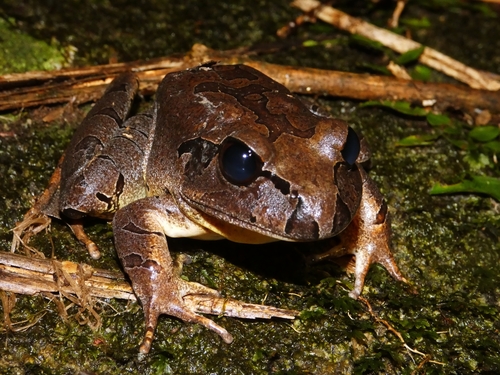
Common Mist Frog

Common Mist Frog

Ranoidea rheocola

Silhouette: Vijay Karthick · PhyloPic

Daily sighting probability ~30% · Possible
at Daintree National Park

In 3 days ~70% in a week ~90%

109 Verified sightings at Daintree National Park From 2019 to 2026
109 In 1 park
September Best month
☀️ Diurnal When it's spotted

About the Common Mist Frog

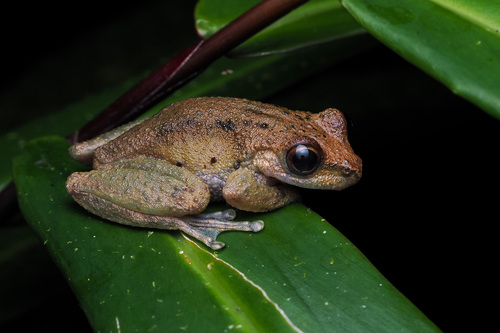
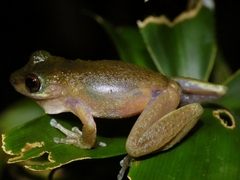
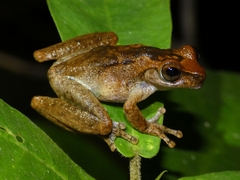
The common mist frog (Mosleyia rheocola) is a species of tree frog native to north-eastern Queensland, Australia. It is a medium-sized frog and a member of the Australian torrent treefrog group. The common mist frog is found in remote, mountainous areas, and near rocky, fast-flowing rainforest streams such as those in north-eastern Queensland, Australia. They are generally sedentary frogs, and remain in the stream environments that they are born into, preferring sections of the stream with riffles, many rocks, and overhanging vegetation.

The common mist frog is one of the four species of Australian torrent treefrogs that comprise the Mosleyia nannotis species group. The other species are the mountain mist frog, waterfall frog, and armoured mist frog. Fully grown common mist frogs can measure anywhere from 27 to 41 millimetres (1.1 to 1.6 in) in length and often weigh between 1.2 and 4.5 grams. The common mist frog displays sexual dimorphism, meaning that one sex is larger in size than the other, in this case, the females are larger than males. Whereas males measure at around 31 mm (1.2 in) in length, the female mist frog is on average 36 mm (1.4 in)... Wikipedia →

Sounds

Advertisement call0:18

Australia · 2014

© Chris Harrison · XC892882 · CC BY-NC-SA 4.0

Recording0:02

Australia · 2016

© probreviceps · iNaturalist · CC BY-NC 4.0

Recording1:00

Australia · 2022

© Tony Eales · iNaturalist · CC BY-NC 4.0

Global Distribution

Parks Where Found

# Park Country Daily sighting probability
1 Daintree National Park 🇦🇺 Australia
~30%

More parks will be added in future updates.

Before you go

What are the chances of seeing a Common Mist Frog in Daintree National Park?

Possible

About 30% of wildlife watchers report a Common Mist Frog sighting in Daintree National Park on a given day, based on 109 verified sightings from GBIF citizen-science data from 2019 to 2026. It is the 4th most-seen of the 8 amphibians we can rate there. Over three days the chance rises to about 70%, and over a week to about 90%, if each day is a fresh chance.

When is the best time to see a Common Mist Frog in Daintree National Park?

September

In that month about 50% of wildlife watchers report a Common Mist Frog in Daintree National Park on a given day, against under 5% in January and March, the lowest months. That is one of Daintree National Park's driest months, with about 50 mm of rain against 380 mm in January.

What time of day is best to see a Common Mist Frog?

Between 11 am and 2 pm

Across all the parks we cover, that three-hour window holds the most Common Mist Frog sightings with a recorded time, and about 9 in 10 of them come between 6 am and 6 pm: it is a daytime animal.

Where else can you see a Common Mist Frog?

Only Daintree National Park, in our data

Daintree National Park is the only park on Wallace's Line with enough records to rate Common Mist Frog sightings: about 30% of wildlife watchers there report one on a given day.

Which relatives of the Common Mist Frog live in Daintree National Park?

Same family: Pelodryadidae

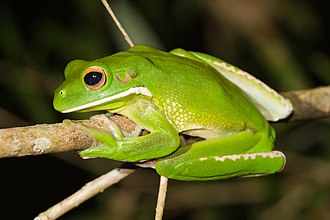
The closest relatives of the Common Mist Frog that you can see in Daintree National Park (family Pelodryadidae, Australasian Tree Frogs) are White-lipped Treefrog (about 70%) and Australian Rocket Frog (about 10%), with each one's daily chance of a sighting.

Where does the Common Mist Frog sighting chance come from?

GBIF citizen-science records

It is estimated from how often the Common Mist Frog is recorded against all the amphibians logged in Daintree National Park (109 verified sightings from 2019 to 2026), calibrated against known sighting rates. Figures are rounded to the nearest 10% because citizen-science data supports honest approximations, not decimals, and months with records from fewer than five people show "—". How it works.

← Back to Daintree National Park