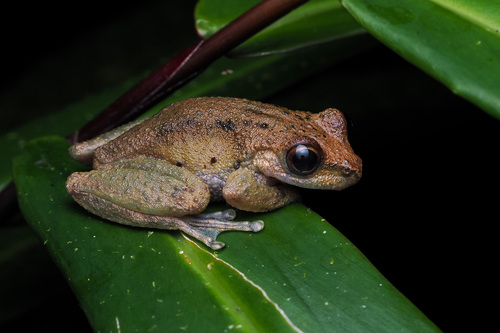
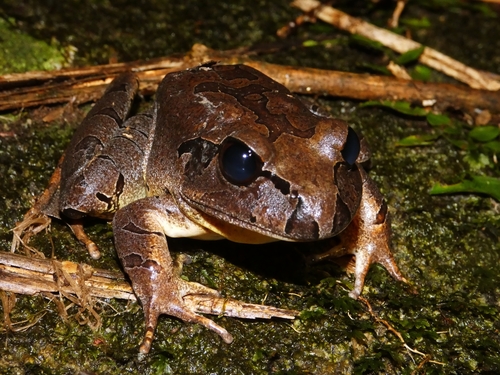
White-lipped Treefrog

White-lipped Treefrog

Nyctimystes infrafrenatus

Silhouette: Dmitry Bogdanov (vectorized by T. Michael Keesey) · PhyloPic

Daily sighting probability ~70% · Very likely
at Daintree National Park

In 3 days >90%

316 Verified sightings at Daintree National Park From 2019 to 2026
392 In all 2 parks
March Best month
☀️ Diurnal When it's spotted

About the White-lipped Treefrog

The white-lipped tree frog (Sandyrana infrafrenata) is a species of frog in the family Pelodryadidae. It is the world's largest tree frog (the Cuban tree frog reaches a similar maximum size) and is found in Australia, Indonesia, Papua New Guinea, the Solomon Islands and Timor-Leste. Other common names include the New Guinea treefrog, giant tree frog, and Australian giant treefrog.

The white-lipped tree frog reaches 11–14 cm (4.3–5.5 in) in length. Its weight is typically 30–60 g (1.1–2.1 oz). Females are larger than males, and have thicker skin in correlation with the difference in body size. Its dorsal surface is usually bright green, although the colour changes depending on the temperature and background, and can be brown. The ventral surface is off-white. The lower lip has a distinctive white stripe (giving this species its name), which continues to the shoulder. The white stripes on the trailing edges of the lower leg may turn pink in the breeding male. The white-lipped tree frog has large toe pads, which aid it to climb. The toes are completely webbed, and the hands are partially webbed.

The white-lipped tree frog is found along the... Wikipedia →

Sounds

Advertisement call1:17

Australia · 2017

© Marc Anderson · XC1103862 · CC BY-NC-ND 4.0

Uncertain1:00

Australia · 2022

© nick talbot · XC899937 · CC BY-NC-SA 4.0

Recording0:09

Australia · 2026

© carrasquiyo · iNaturalist · CC BY-NC 4.0

Global Distribution

Parks Where Found

# Park Country Daily sighting probability
1 Daintree National Park 🇦🇺 Australia
~70%
2 Raja Ampat 🇮🇩 Indonesia
~50%

Before you go

What are the chances of seeing a White-lipped Treefrog in Daintree National Park?

Very likely

About 70% of wildlife watchers report a White-lipped Treefrog sighting in Daintree National Park on a given day, based on 316 verified sightings from GBIF citizen-science data from 2019 to 2026. It is the most-seen of the 8 amphibians we can rate there. Over three days the chance rises to over 90%, if each day is a fresh chance.

When is the best time to see a White-lipped Treefrog in Daintree National Park?

February–March and November

In those months about 80% of wildlife watchers report a White-lipped Treefrog in Daintree National Park on a given day, against about 50% in July, the lowest month.

What time of day is best to see a White-lipped Treefrog?

Between 11 am and 2 pm

Across all the parks we cover, that three-hour window holds the most White-lipped Treefrog sightings with a recorded time, and about 7 in 10 of them come between 6 am and 6 pm: it is a daytime animal.

Is Daintree National Park the best place to see a White-lipped Treefrog?

Yes

Of the 2 parks where we can rate White-lipped Treefrog sightings, Daintree National Park has the highest daily chance: about 70%. Next come Raja Ampat (Indonesia, about 50%).

Which relatives of the White-lipped Treefrog live in Daintree National Park?

Same family: Pelodryadidae

The closest relatives of the White-lipped Treefrog that you can see in Daintree National Park (family Pelodryadidae, Australasian Tree Frogs) are Common Mist Frog (about 30%) and Australian Rocket Frog (about 10%), with each one's daily chance of a sighting.

Where does the White-lipped Treefrog sighting chance come from?

GBIF citizen-science records

It is estimated from how often the White-lipped Treefrog is recorded against all the amphibians logged in Daintree National Park (316 verified sightings from 2019 to 2026), calibrated against known sighting rates. Figures are rounded to the nearest 10% because citizen-science data supports honest approximations, not decimals, and months with records from fewer than five people show "—". How it works.

← Back to Daintree National Park