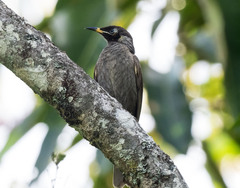
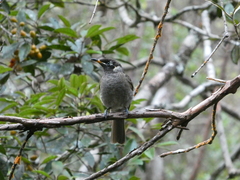
Bridled Honeyeater

Bridled Honeyeater

Bolemoreus frenatus

Silhouette: Rachael Joakim · PhyloPic

LCLeast ConcernNTVUENCR Endemic
Daily sighting probability ~20% · Possible
at Daintree National Park

In 3 days ~40% in a week ~70%

384 Verified sightings at Daintree National Park From 2019 to 2026
384 In 1 park
August Best month
☀️ Diurnal When it's spotted

About the Bridled Honeyeater

The bridled honeyeater (Bolemoreus frenatus) is a species of bird in the family Meliphagidae with distinctive rein-like markings on its face that is endemic to northeastern Queensland. It is found in subtropical or tropical moist upland forests and subtropical or tropical rainforests, usually above 300 meters. In winter, it descends to lower forests including mangroves, and can sometimes be seen in more open habitats.

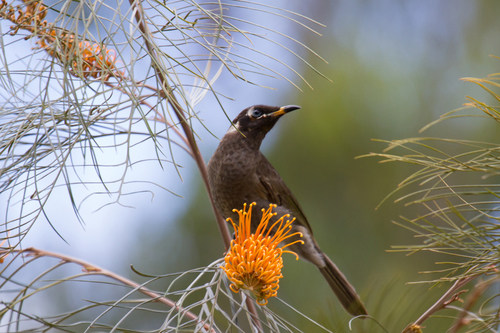
The bridled honeyeater is a medium to large dusky honeyeater with a white gape and bicoloured bill. It has a blue eye with a yellow line below and white line behind, a yellow tuft on ear and a large, white-grey patch on the side of the neck.

The scientific name for the bridled honeyeater is Bolemoreus frenatus (Ramsay, 1874). Initially designated Ptilotis frenata Ramsay, E.P. 1874, then Lichenostomus frenatus and lastly Bolemoreus frenatus. The bird was also called Dorothina frenata when it was placed in the family melithreptide by Gregory Mathews in Volume XI of Birds of Australia p.478.

Both the bridled honeyeater and Eungella honeyeater were previously placed in the genus Lichenostomus, but were moved to Bolemoreus after... Wikipedia →
Sounds

Recording0:35

Australia · 2024

© Andrew McCafferty · XC980660 · CC BY-NC-SA 4.0

Call1:01

Australia · 2022

© Marc Anderson · XC816154 · CC BY-NC-ND 4.0

Song0:11

Australia · 2015

© Andrew Spencer · XC328673 · CC BY-NC-ND 4.0

Global Distribution

Parks Where Found

# Park Country Daily sighting probability
1 Daintree National Park 🇦🇺 Australia
~20%

More parks will be added in future updates.

Before you go

What are the chances of seeing a Bridled Honeyeater in Daintree National Park?

Possible

About 20% of wildlife watchers report a Bridled Honeyeater sighting in Daintree National Park on a given day, based on 384 verified sightings from GBIF citizen-science data from 2019 to 2026. It is the 58th most-seen of the 208 birds we can rate there. Over three days the chance rises to about 40%, and over a week to about 70%, if each day is a fresh chance.

When is the best time to see a Bridled Honeyeater in Daintree National Park?

August

In that month about 40% of wildlife watchers report a Bridled Honeyeater in Daintree National Park on a given day, against under 5% in November, the lowest month. That is one of Daintree National Park's driest months, with about 60 mm of rain against 380 mm in January.

What time of day is best to see a Bridled Honeyeater?

Between noon and 3 pm

Across all the parks we cover, that three-hour window holds the most Bridled Honeyeater sightings with a recorded time, and about 8 in 10 of them come between 6 am and 6 pm: it is a daytime animal.

Where else can you see a Bridled Honeyeater?

Only Daintree National Park, in our data

Daintree National Park is the only park on Wallace's Line with enough records to rate Bridled Honeyeater sightings: about 20% of wildlife watchers there report one on a given day.

Which relatives of the Bridled Honeyeater live in Daintree National Park?

Same family: Meliphagidae

The closest relatives of the Bridled Honeyeater that you can see in Daintree National Park (family Meliphagidae, Honeyeaters) are Helmeted Friarbird (about 50%), Yellow-spotted Honeyeater (about 50%) and Hornbill Friarbird (about 30%), with each one's daily chance of a sighting.

Where does the Bridled Honeyeater sighting chance come from?

GBIF citizen-science records

It is estimated from how often the Bridled Honeyeater is recorded against all the birds logged in Daintree National Park (384 verified sightings from 2019 to 2026), calibrated against known sighting rates. Figures are rounded to the nearest 10% because citizen-science data supports honest approximations, not decimals, and months with records from fewer than five people show "—". How it works.

← Back to Daintree National Park