Noisy Friarbird

Noisy Friarbird

Philemon corniculatus

Silhouette: James Klarevas · PhyloPic

LCLeast ConcernNTVUENCR
Daily sighting probability <5% · Rare
at Daintree National Park

In 3 days ~10%

33 Verified sightings at Daintree National Park From 2019 to 2026
1,867 In all 9 parks
February Best month
☀️ Diurnal When it's spotted

About the Noisy Friarbird

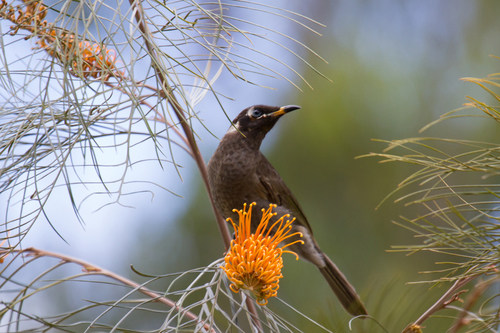
The noisy friarbird (Philemon corniculatus) is a passerine bird of the honeyeater family Meliphagidae native to southern New Guinea and eastern Australia. It is one of several species known as friarbirds whose heads are bare of feathers. It is brown-grey in colour, with a prominent knob on its bare black-skinned head. It feeds on insects and nectar.

The noisy friarbird was first described by ornithologist John Latham in 1790. The generic name is from the Ancient Greek philēmōn 'affectionate, kissing'. Its specific epithet is derived from the Latin corniculum '(having a) little horn'. It is sometimes known as a leatherhead. Wirgan was a name used by the local Eora and Darug inhabitants of the Sydney basin.

Molecular study shows its closest relative to be the silver-crowned friarbird within the genus Philemon. DNA analysis has shown honeyeaters to be related to the Pardalotidae (pardalotes), Acanthizidae (Australian warblers, scrubwrens, thornbills, etc.), and Maluridae (Australian fairy-wrens) in the large superfamily Meliphagoidea.

Measuring 31–36 cm (12–14 in) in length, the noisy friarbird is a large honeyeater with dull brownish grey upperparts and... Wikipedia →

Sounds

Call0:06

Australia · 2023

© Romuald Mikusek · XC1169841 · CC BY-NC-SA 4.0

Song0:16

Australia · 2026

© Marc Anderson · XC1084977 · CC BY-NC-ND 4.0

Alarm call1:14

Australia · 2020

© James Lambert · XC599377 · CC BY-NC-SA 4.0

Global Distribution

Parks Where Found

# Park Country Daily sighting probability
1 Noosa National Park 🇦🇺 Australia
~60%
2 Springbrook National Park 🇦🇺 Australia
~20%
3 Kosciuszko National Park 🇦🇺 Australia
~20%
4 Booderee National Park 🇦🇺 Australia
~10%
5 Blue Mountains National Park 🇦🇺 Australia
~10%
6 Royal National Park 🇦🇺 Australia
~10%
7 Lamington National Park 🇦🇺 Australia
~10%
8 Daintree National Park 🇦🇺 Australia
<5%
9 Grampians National Park 🇦🇺 Australia
<5%

Cities Where Found

# City Country Daily sighting probability
1 Brisbane 🇦🇺 Australia
~20%
2 Sydney 🇦🇺 Australia
<5%

Zoos & Centres Where Found

# Zoo / Centre Country
1 Gorge Wildlife Park 🇦🇺 Australia In captivity
2 Featherdale Sydney Wildlife Park 🇦🇺 Australia In captivity

Before you go

What are the chances of seeing a Noisy Friarbird in Daintree National Park?

Rare

Under 5% of wildlife watchers report a Noisy Friarbird sighting in Daintree National Park on a given day, based on 33 verified sightings from GBIF citizen-science data from 2019 to 2026. It is the 130th most-seen of the 208 birds we can rate there. Over three days the chance rises to about 10%, if each day is a fresh chance.

When is the best time to see a Noisy Friarbird in Daintree National Park?

February

In that month about 10% of wildlife watchers report a Noisy Friarbird in Daintree National Park on a given day, against under 5% in March to January, the lowest months. That is one of Daintree National Park's wettest months, with about 240 mm of rain against 50 mm in September.

What time of day is best to see a Noisy Friarbird?

Between 8 and 11 am

Across all the parks we cover, that three-hour window holds the most Noisy Friarbird sightings with a recorded time, and nearly all of them come between 6 am and 6 pm: it is a daytime animal.

Is Daintree National Park the best place to see a Noisy Friarbird?

8th of 9

Of the 9 parks where we can rate Noisy Friarbird sightings, Daintree National Park ranks 8th at under 5%. The best odds are in Noosa National Park (Australia, about 60%), Springbrook National Park (Australia, about 20%) and Kosciuszko National Park (Australia, about 20%).

Which relatives of the Noisy Friarbird live in Daintree National Park?

Same genus: Philemon

The closest relatives of the Noisy Friarbird that you can see in Daintree National Park (genus Philemon, Typical Friarbirds) are Helmeted Friarbird (about 50%) and Hornbill Friarbird (about 30%), with each one's daily chance of a sighting.

Where does the Noisy Friarbird sighting chance come from?

GBIF citizen-science records

It is estimated from how often the Noisy Friarbird is recorded against all the birds logged in Daintree National Park (33 verified sightings from 2019 to 2026), calibrated against known sighting rates. Figures are rounded to the nearest 10% because citizen-science data supports honest approximations, not decimals, and months with records from fewer than five people show "—". How it works.

← Back to Daintree National Park