Brown-backed Honeyeater

Brown-backed Honeyeater

Ramsayornis modestus

Silhouette: Rachael Joakim · PhyloPic

LCLeast ConcernNTVUENCR
Daily sighting probability ~20% · Possible
at Daintree National Park

In 3 days ~50% in a week ~80%

338 Verified sightings at Daintree National Park From 2019 to 2026
338 In 1 park
November Best month
🌙 Nocturnal When it's spotted

About the Brown-backed Honeyeater

The brown-backed honeyeater (Ramsayornis modestus) is a species of bird in the family Meliphagidae. It is found in New Guinea and Cape York Peninsula in Queensland, Australia. Its natural habitat is subtropical or tropical mangrove forests.

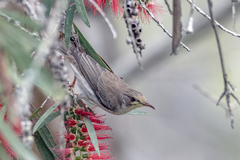
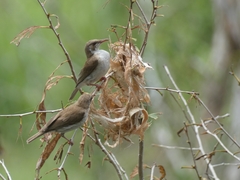
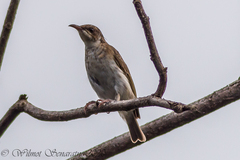
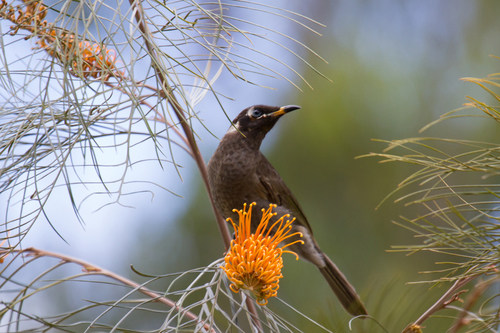
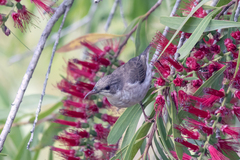
The Brown-backed honeyeater is small in size, measuring around 11–12cm in length with a weight of 11–14 g. The average wingspan is 6.2–7 cm (2.4 to 2.7 in), and the bill is 1.5–1.8 cm in length. Like the name suggests, it has a brown back with brown streaks across an otherwise white chest and belly, and a red bill. Similar in appearance to the Bar-breasted Honeyeater, but with a differing facial pattern.

Calls include a rapid mick, mick, and a chattering shee-shee. The Brown-backed honeyeater is found along the coast of Far North Queensland, particularly around the Cape York Peninsula. Its range extends across the islands of the Torres Strait and into New Guinea.

Unlike similar birds that migrate across the Torres Strait, the Brown-backed honeyeater is partly resident and nomadic, meaning it tends to stay in the same area year-round but will travel depending on environmental factors, such as food availability... Wikipedia →

Sounds

Song0:23

Indonesia · 2026

© Ding Li Yong · XC1164390 · CC BY-NC-ND 4.0

Call0:11

Australia · 2025

© Étienne Leroy · XC1074076 · CC BY-NC-SA 4.0

Call0:35

Australia · 2025

© Peter Boesman · XC1066919 · CC BY-NC-ND 4.0

Global Distribution

Parks Where Found

# Park Country Daily sighting probability
1 Daintree National Park 🇦🇺 Australia
~20%

More parks will be added in future updates.

Before you go

What are the chances of seeing a Brown-backed Honeyeater in Daintree National Park?

Possible

About 20% of wildlife watchers report a Brown-backed Honeyeater sighting in Daintree National Park on a given day, based on 338 verified sightings from GBIF citizen-science data from 2019 to 2026. It is the 53rd most-seen of the 208 birds we can rate there. Over three days the chance rises to about 50%, and over a week to about 80%, if each day is a fresh chance.

When is the best time to see a Brown-backed Honeyeater in Daintree National Park?

November

In that month about 40% of wildlife watchers report a Brown-backed Honeyeater in Daintree National Park on a given day, against under 5% in May and June, the lowest months. That is one of Daintree National Park's driest months, with about 65 mm of rain against 380 mm in January.

What time of day is best to see a Brown-backed Honeyeater?

Between midnight and 3 am

Across all the parks we cover, that three-hour window holds the most Brown-backed Honeyeater sightings with a recorded time, and about 7 in 10 of them come between 6 pm and 6 am: it is mostly seen at night.

Where else can you see a Brown-backed Honeyeater?

Only Daintree National Park, in our data

Daintree National Park is the only park on Wallace's Line with enough records to rate Brown-backed Honeyeater sightings: about 20% of wildlife watchers there report one on a given day.

Which relatives of the Brown-backed Honeyeater live in Daintree National Park?

Same family: Meliphagidae

The closest relatives of the Brown-backed Honeyeater that you can see in Daintree National Park (family Meliphagidae, Honeyeaters) are Helmeted Friarbird (about 50%), Yellow-spotted Honeyeater (about 50%) and Hornbill Friarbird (about 30%), with each one's daily chance of a sighting.

Where does the Brown-backed Honeyeater sighting chance come from?

GBIF citizen-science records

It is estimated from how often the Brown-backed Honeyeater is recorded against all the birds logged in Daintree National Park (338 verified sightings from 2019 to 2026), calibrated against known sighting rates. Figures are rounded to the nearest 10% because citizen-science data supports honest approximations, not decimals, and months with records from fewer than five people show "—". How it works.

← Back to Daintree National Park