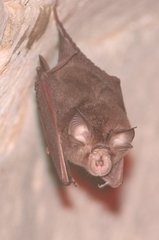
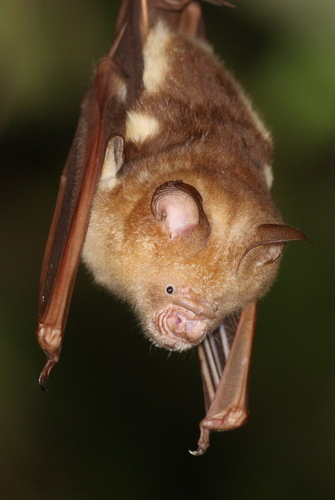
Smaller Horseshoe Bat

Smaller Horseshoe Bat

Rhinolophus megaphyllus

Silhouette: Margot Michaud · PhyloPic

LCLeast ConcernNTVUENCR
Daily sighting probability ~10% · With luck
at Daintree National Park

In 3 days ~30% in a week ~60%

11 Verified sightings at Daintree National Park From 2019 to 2026
19 In all 2 parks
September Best month
☀️🌙 Day & Night When it's spotted

About the Smaller Horseshoe Bat

The smaller horseshoe bat (Rhinolophus megaphyllus) is a species of bat in the family Rhinolophidae. It is found in Australia and Papua New Guinea. A species was first described by John Edward Gray in 1834, using a specimen provided by George Bennett that had been collected in a cave near the Murrimbidgee River.

Noted as the megaphyllus-species group, subsuming earlier taxa ranked as species and separating other these previously allied to the species complex. Five subspecies were recognised by Mammal Species of the World (Simmons, 2005)

Rhinolophus megaphyllus J. E. Gray 1834 Rhinolophus megaphyllus megaphyllus Rhinolophus megaphyllus fallax K. Andersen, 1906 Rhinolophus megaphyllus ignifer Allen, 1933 Rhinolophus megaphyllus monachus K. Andersen, 1905 Rhinolophus megaphyllus vandeuseni Koopman, 1982

The common names assigned to the species include the smaller and eastern horseshoe bat. Rhinolophus megaphyllus is a small rhinolophid bat that has a combined head and body length of 44–53 millimetres, with a measurement of the forearm an approximately equal length at 44–52 mm. The mass is in a range of 7 to 13 grams. They have simple and large ears, measuring... Wikipedia →

Sounds

Recording1:11

Australia · 2022

© Andrew Rock · iNaturalist · CC BY-NC 4.0

Global Distribution

Parks Where Found

# Park Country Daily sighting probability
1 Daintree National Park 🇦🇺 Australia
~10%
2 Springbrook National Park 🇦🇺 Australia
~10%

Before you go

What are the chances of seeing a Smaller Horseshoe Bat in Daintree National Park?

With luck

About 10% of wildlife watchers report a Smaller Horseshoe Bat sighting in Daintree National Park on a given day, based on 11 verified sightings from GBIF citizen-science data from 2019 to 2026. It is the 12th most-seen of the 19 mammals we can rate there. Over three days the chance rises to about 30%, and over a week to about 60%, if each day is a fresh chance.

When is the best time to see a Smaller Horseshoe Bat in Daintree National Park?

January, March, September and November

In those months about 20% of wildlife watchers report a Smaller Horseshoe Bat in Daintree National Park on a given day, against under 5% in February, April–May, July–August and December, the lowest months.

What time of day is best to see a Smaller Horseshoe Bat?

Between 7 and 10 pm

Across all the parks we cover, that three-hour window holds the most Smaller Horseshoe Bat sightings with a recorded time, and about half of them come between 6 pm and 6 am: it is seen both by day and at night.

Is Daintree National Park the best place to see a Smaller Horseshoe Bat?

Yes

Of the 2 parks where we can rate Smaller Horseshoe Bat sightings, Daintree National Park has the highest daily chance: about 10%. Next come Springbrook National Park (Australia, about 10%).

Where does the Smaller Horseshoe Bat sighting chance come from?

GBIF citizen-science records

It is estimated from how often the Smaller Horseshoe Bat is recorded against all the mammals logged in Daintree National Park (11 verified sightings from 2019 to 2026), calibrated against known sighting rates. Figures are rounded to the nearest 10% because citizen-science data supports honest approximations, not decimals, and months with records from fewer than five people show "—". How it works.

← Back to Daintree National Park