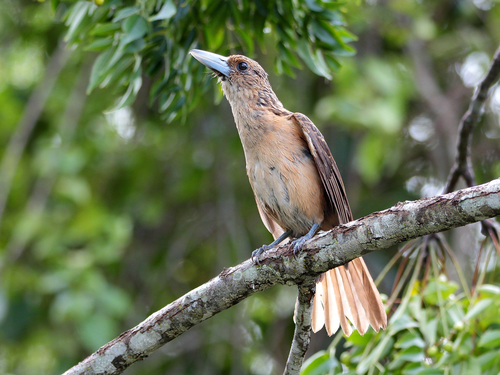
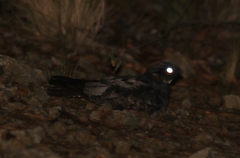
White-throated Nightjar

White-throated Nightjar

Eurostopodus mystacalis

Silhouette: Sheatherius · PhyloPic

LCLeast ConcernNTVUENCR
Daily sighting probability <5% · Rare
at Daintree National Park

In 3 days <5% in a week ~10%

36 Verified sightings at Daintree National Park From 2019 to 2026
85 In all 3 parks
May Best month
☀️🌙 Day & Night When it's spotted

About the White-throated Nightjar

The white-throated nightjar or white-throated eared nightjar (Eurostopodus mystacalis) is a species of nightjar in the family Caprimulgidae. It is endemic to eastern Australia; it is a non-breeding winter visitor in Papua New Guinea. Its natural habitat is subtropical or tropical dry forests.

The white-throated nightjar was formerly known as Eurostopodus albogularis but was later reclassified to E. mystacalis. Some texts may still refer to this species as Eurostopodus mystacalis albogularis. Before 2002, this species was regarded as conspecific with New Caledonian nightjar Eurostopodus exul and Solomons nightjar Eurostopodus nigripennis. However, later research separated the three into their own species based on differences in calls and song, and morphology. Since then, E. mystacalis has remained monotypic.

The genus name Eurostopodus is derived from the Greek words eurostos meaning 'strong' and podos or pous meaning 'foot', while the species name mystacalis is derived from Latin and means 'moustache'. E. mystacalis is the largest Australian nightjar species and measures around 30–37 cm. Males and females are very similar in appearance... Wikipedia →

Sounds

Call0:06

Australia · 2020

© Mike FitzGerald · XC541976 · CC BY-NC-SA 4.0

Song0:23

Australia · 2017

© Marc Anderson · XC390583 · CC BY-NC-ND 4.0

Song0:09

Australia · 2010

© Tom Tarrant · XC67087 · CC BY-NC-ND 2.5

Global Distribution

Parks Where Found

# Park Country Daily sighting probability
1 Daintree National Park 🇦🇺 Australia
<5%
2 Blue Mountains National Park 🇦🇺 Australia
<5%
3 Lamington National Park 🇦🇺 Australia
<5%

Cities Where Found

# City Country Daily sighting probability
1 Brisbane 🇦🇺 Australia
<5%

Before you go

What are the chances of seeing a White-throated Nightjar in Daintree National Park?

Rare

Under 5% of wildlife watchers report a White-throated Nightjar sighting in Daintree National Park on a given day, based on 36 verified sightings from GBIF citizen-science data from 2019 to 2026. It is the 147th most-seen of the 208 birds we can rate there. Over three days the chance rises to under 5%, and over a week to about 10%, if each day is a fresh chance.

When is the best time to see a White-throated Nightjar in Daintree National Park?

May

In that month about 10% of wildlife watchers report a White-throated Nightjar in Daintree National Park on a given day, against under 5% in June to April, the lowest months.

What time of day is best to see a White-throated Nightjar?

Between 7 and 10 pm

Across all the parks we cover, that three-hour window holds the most White-throated Nightjar sightings with a recorded time, and about 6 in 10 of them come between 6 pm and 6 am: it is seen both by day and at night.

Is Daintree National Park the best place to see a White-throated Nightjar?

Yes

Of the 3 parks where we can rate White-throated Nightjar sightings, Daintree National Park has the highest daily chance: under 5%. Next come Blue Mountains National Park (Australia, under 5%) and Lamington National Park (Australia, under 5%).

Where does the White-throated Nightjar sighting chance come from?

GBIF citizen-science records

It is estimated from how often the White-throated Nightjar is recorded against all the birds logged in Daintree National Park (36 verified sightings from 2019 to 2026), calibrated against known sighting rates. Figures are rounded to the nearest 10% because citizen-science data supports honest approximations, not decimals, and months with records from fewer than five people show "—". How it works.

← Back to Daintree National Park