Banded Civet

Banded Civet

Hemigalus derbyanus

Silhouette: Margot Michaud · PhyloPic

LCNTNear ThreatenedVUENCR
Daily sighting probability ~20% · Possible
at Danum Valley Conservation Area

In 3 days ~50% in a week ~80%

13 Verified sightings at Danum Valley Conservation Area From 2019 to 2026
47 In all 2 parks
October Best month
☀️ Diurnal When it's spotted

About the Banded Civet

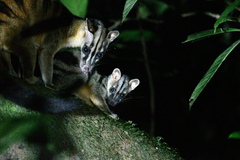
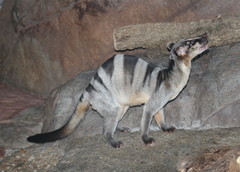
The banded palm civet (Hemigalus derbyanus), also called the banded civet, is a viverrid native to Indomalaya. They primarily inhabit lowland conifer habitat, which is under threat from encroaching human activity. It is estimated the population of the banded palm civet has decreased by around 30% in just three generations. Banded palm civets are usually approximately the size of a domestic cat; their fur is pale but with dark bands on the back. They are believed to be closely related to Hose's palm civets, which are similar in appearance and distribution.

The banded palm civet is the only species in its genus, first scientifically described in 1837. The species comprises four subspecies, distributed across Indonesia and Southeast Asia. Two of the subspecies diverged from each other as long ago as 2.7 million years.

Banded palm civets are affected by a variety of parasites, such as nematodes, and are primarily carnivorous, eating small animals such as rodents and bugs. They have sensitive hairs on their paws which help them to detect potential prey.

The genus Hemigalus was named and first described in 1837 by Claude Jourdan who had a skin and skeleton of one zoological... Wikipedia →

Global Distribution

Parks Where Found

# Park Country Daily sighting probability
1 Danum Valley Conservation Area 🇲🇾 Malaysia
~20%
2 Kinabatangan Wildlife Sanctuary 🇲🇾 Malaysia
~20%

Zoos & Centres Where Found

# Zoo / Centre Country
1 Nashville Zoo at Grassmere 🇺🇸 United States In captivity
2 Memphis Zoo 🇺🇸 United States In captivity
3 Bangkok Aquarium 🇹🇭 Thailand In captivity

Before you go

What are the chances of seeing a Banded Civet in Danum Valley Conservation Area?

Possible

About 20% of wildlife watchers report a Banded Civet sighting in Danum Valley Conservation Area on a given day, based on 13 verified sightings from GBIF citizen-science data from 2019 to 2026. It is the 20th most-seen of the 26 mammals we can rate there. Over three days the chance rises to about 50%, and over a week to about 80%, if each day is a fresh chance.

When is the best time to see a Banded Civet in Danum Valley Conservation Area?

October

In that month about 40% of wildlife watchers report a Banded Civet in Danum Valley Conservation Area on a given day, against under 5% in April, July–August and December–February, the lowest months.

What time of day is best to see a Banded Civet?

Between 1 and 4 pm

Across all the parks we cover, that three-hour window holds the most Banded Civet sightings with a recorded time, and about 8 in 10 of them come between 6 am and 6 pm: it is a daytime animal.

Is Danum Valley Conservation Area the best place to see a Banded Civet?

Yes

Of the 2 parks where we can rate Banded Civet sightings, Danum Valley Conservation Area has the highest daily chance: about 20%. Next come Kinabatangan Wildlife Sanctuary (Malaysia, about 20%).

Which relatives of the Banded Civet live in Danum Valley Conservation Area?

Same family: Viverridae

The closest relatives of the Banded Civet that you can see in Danum Valley Conservation Area (family Viverridae, Civets, Genets, and Oyans) are Malay Civet (about 40%), Small-toothed Palm Civet (about 40%) and Common Palm Civet (about 40%), with each one's daily chance of a sighting.

Where does the Banded Civet sighting chance come from?

GBIF citizen-science records

It is estimated from how often the Banded Civet is recorded against all the mammals logged in Danum Valley Conservation Area (13 verified sightings from 2019 to 2026), calibrated against known sighting rates. Figures are rounded to the nearest 10% because citizen-science data supports honest approximations, not decimals, and months with records from fewer than five people show "—". How it works.

← Back to Danum Valley Conservation Area