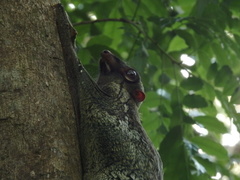
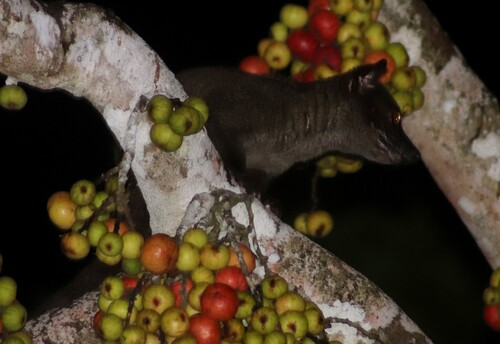
Sunda Flying Lemur

Sunda Flying Lemur

Galeopterus variegatus

Silhouette: Yan Wong · PhyloPic

LCLeast ConcernNTVUENCR
Daily sighting probability ~40% · Likely
at Danum Valley Conservation Area

In 3 days ~80% in a week >90%

35 Verified sightings at Danum Valley Conservation Area From 2019 to 2026
298 In all 6 parks
March Best month
🌅 Crepuscular When it's spotted

About the Sunda Flying Lemur

The Sunda flying lemur (Galeopterus variegatus), also called Malayan flying lemur and Malayan colugo, is the sole colugo species of the genus Galeopterus. It is native to Southeast Asia from southern Myanmar, Thailand, southern Vietnam, Malaysia to Singapore and Indonesia and listed as Least Concern on the IUCN Red List.

Although it is called "flying lemur", it cannot fly but glides among trees and is strictly arboreal. It is active at night, and feeds on soft plant parts such as young leaves, shoots, flowers, and fruits. It is a forest-dependent species.

The Sunda flying lemur is protected by national legislation. The Sunda flying lemurs are often hunted by local people with spears or other lethal equipment for various reasons such as food and fur. Habitat loss is known to occur intermittently, particularly in developing countries such as Malaysia.

The Sunda flying lemurs' two forms are not morphologically distinct from one another; the large form occurs on the mainland of the Sunda Shelf area and the mainland of Southeast Asia, while the dwarf form occurs in central Laos and some other adjacent islands. The Laos specimen is smaller (about 20%) than the... Wikipedia →

Global Distribution

Parks Where Found

# Park Country Daily sighting probability
1 Bako National Park 🇲🇾 Malaysia
~90%
2 Danum Valley Conservation Area 🇲🇾 Malaysia
~40%
3 Kinabatangan Wildlife Sanctuary 🇲🇾 Malaysia
~40%
4 Sepilok 🇲🇾 Malaysia
~30%
5 Taman Negara National Park 🇲🇾 Malaysia
~20%
6 Gunung Leuser National Park 🇮🇩 Indonesia
~10%

Cities Where Found

# City Country Daily sighting probability
1 Singapore 🇸🇬 Singapore
~30%

Zoos & Centres Where Found

# Zoo / Centre Country
1 Night Safari 🇸🇬 Singapore In captivity
2 Singapore Zoo 🇸🇬 Singapore In captivity
3 Bird Paradise 🇸🇬 Singapore In captivity
4 Rainforest Wild Asia 🇸🇬 Singapore In captivity

Closest Relatives at Danum Valley Conservation Area

No species of the same family or order lives in Danum Valley Conservation Area, so these are its closest relatives here: other mammals.

Before you go

What are the chances of seeing a Sunda Flying Lemur in Danum Valley Conservation Area?

Likely

About 40% of wildlife watchers report a Sunda Flying Lemur sighting in Danum Valley Conservation Area on a given day, based on 35 verified sightings from GBIF citizen-science data from 2019 to 2026. It is the 5th most-seen of the 26 mammals we can rate there. Over three days the chance rises to about 80%, and over a week to over 90%, if each day is a fresh chance.

When is the best time to see a Sunda Flying Lemur in Danum Valley Conservation Area?

January and March

In those months about 60% of wildlife watchers report a Sunda Flying Lemur in Danum Valley Conservation Area on a given day, against about 20% in September, the lowest month.

What time of day is best to see a Sunda Flying Lemur?

Between 4 and 7 am

Across all the parks we cover, that three-hour window holds the most Sunda Flying Lemur sightings with a recorded time, and about 7 in 10 of them come between 6 am and 6 pm: it is most active around dawn and dusk.

Is Danum Valley Conservation Area the best place to see a Sunda Flying Lemur?

2nd of 6

Of the 6 parks where we can rate Sunda Flying Lemur sightings, Danum Valley Conservation Area ranks 2nd at about 40%. The best odds are in Bako National Park (Malaysia, about 90%). All parks ranked.

Where does the Sunda Flying Lemur sighting chance come from?

GBIF citizen-science records

It is estimated from how often the Sunda Flying Lemur is recorded against all the mammals logged in Danum Valley Conservation Area (35 verified sightings from 2019 to 2026), calibrated against known sighting rates. Figures are rounded to the nearest 10% because citizen-science data supports honest approximations, not decimals, and months with records from fewer than five people show "—". How it works.

← Back to Danum Valley Conservation Area