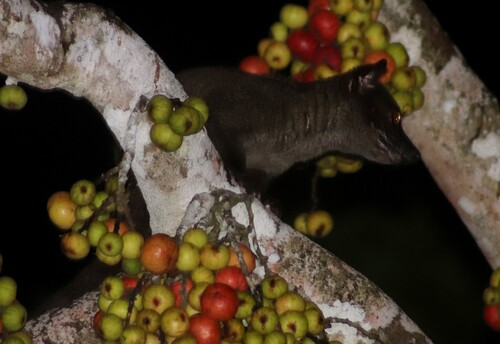
Malay Civet

Malay Civet

Viverra tangalunga

Silhouette: Margot Michaud · PhyloPic

LCLeast ConcernNTVUENCR
Daily sighting probability ~40% · Likely
at Danum Valley Conservation Area

In 3 days ~80% in a week >90%

39 Verified sightings at Danum Valley Conservation Area From 2019 to 2026
97 In all 2 parks
February Best month
☀️ Diurnal When it's spotted

About the Malay Civet

The Malayan civet (Viverra tangalunga), also known as the Malay civet and Oriental civet, is a viverrid native to the Malay Peninsula and the islands of Sumatra, Bangka, Borneo, the Riau Archipelago, and the Philippines. It is listed as "Least Concern" by IUCN as it is a relatively widely distributed, appears to be tolerant of degraded habitats, and occurs in a number of protected areas.

Viverra tangalunga was the scientific name proposed by John Edward Gray in 1832 for a spotted zoological specimen. The Malay civet's tail is black above and ringed on the lower side. The historical range of the Malay civet includes Indonesia, Malaysia, Brunei, the Philippines and Singapore. In Malaysia, it occurs in Borneo, Banggi Island, Langkawi Island, Penang Island and in Peninsular Malaysia.

It also occurs in Sumatra. It was introduced to Sulawesi and the Maluku Islands. Museum records indicate that the Malay civet also occurred on the Indonesian islands of Java, Bawal and Telok Pai, and on the Philippine island Leyte. In 2012, an individual was photographed in Singapore.

The Malay civet population in the Philippines may have... Wikipedia →

Global Distribution

Parks Where Found

# Park Country Daily sighting probability
1 Danum Valley Conservation Area 🇲🇾 Malaysia
~40%
2 Kinabatangan Wildlife Sanctuary 🇲🇾 Malaysia
~40%

Zoos & Centres Where Found

# Zoo / Centre Country
1 Ninoy Aquino Parks & Wildlife Center 🇵🇭 Philippines In captivity
2 Albay Park and Wildlife 🇵🇭 Philippines In captivity

Before you go

What are the chances of seeing a Malay Civet in Danum Valley Conservation Area?

Likely

About 40% of wildlife watchers report a Malay Civet sighting in Danum Valley Conservation Area on a given day, based on 39 verified sightings from GBIF citizen-science data from 2019 to 2026. It is the 3rd most-seen of the 26 mammals we can rate there. Over three days the chance rises to about 80%, and over a week to over 90%, if each day is a fresh chance.

When is the best time to see a Malay Civet in Danum Valley Conservation Area?

February

In that month about 70% of wildlife watchers report a Malay Civet in Danum Valley Conservation Area on a given day, against under 5% in April, the lowest month. That is one of Danum Valley Conservation Area's driest months, with about 140 mm of rain against 290 mm in May.

What time of day is best to see a Malay Civet?

Between 1 and 4 pm

Across all the parks we cover, that three-hour window holds the most Malay Civet sightings with a recorded time, and about 8 in 10 of them come between 6 am and 6 pm: it is a daytime animal.

Is Danum Valley Conservation Area the best place to see a Malay Civet?

Yes

Of the 2 parks where we can rate Malay Civet sightings, Danum Valley Conservation Area has the highest daily chance: about 40%. Next come Kinabatangan Wildlife Sanctuary (Malaysia, about 40%).

Which relatives of the Malay Civet live in Danum Valley Conservation Area?

Same family: Viverridae

The closest relatives of the Malay Civet that you can see in Danum Valley Conservation Area (family Viverridae, Civets, Genets, and Oyans) are Small-toothed Palm Civet (about 40%), Common Palm Civet (about 40%) and Banded Civet (about 20%), with each one's daily chance of a sighting.

Where does the Malay Civet sighting chance come from?

GBIF citizen-science records

It is estimated from how often the Malay Civet is recorded against all the mammals logged in Danum Valley Conservation Area (39 verified sightings from 2019 to 2026), calibrated against known sighting rates. Figures are rounded to the nearest 10% because citizen-science data supports honest approximations, not decimals, and months with records from fewer than five people show "—". How it works.

← Back to Danum Valley Conservation Area