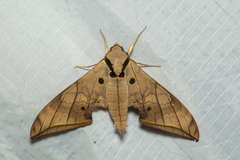
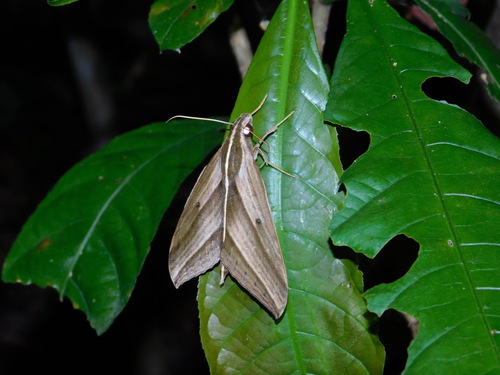
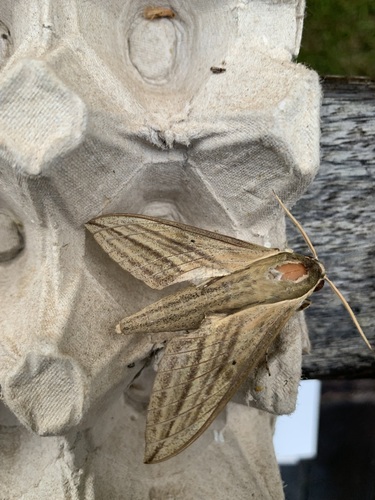
Dark-Based Gliding Hawkmoth

Dark-Based Gliding Hawkmoth

Ambulyx substrigilis

Daily sighting probability ~10% · With luck
at Danum Valley Conservation Area

In 3 days ~40% in a week ~70%

7 Verified sightings at Danum Valley Conservation Area From 2019 to 2026
21 In all 3 parks
April Best month
🌅 Crepuscular When it's spotted

About the Dark-Based Gliding Hawkmoth

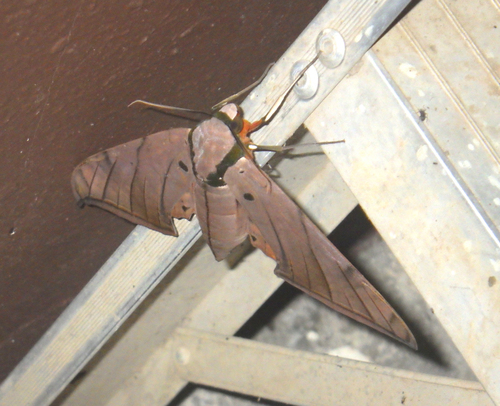
Ambulyx substrigilis, the dark-based gliding hawkmoth, is a species of moth of the family Sphingidae. It was described by John O. Westwood in 1847. It is known from Sri Lanka, India, Nepal, Bangladesh, the Andaman Islands, the Nicobar Islands, Thailand, Vietnam, China (Hainan Island), Malaysia (Peninsular, Sarawak), Indonesia (Sumatra, Kalimantan) and the Philippines.

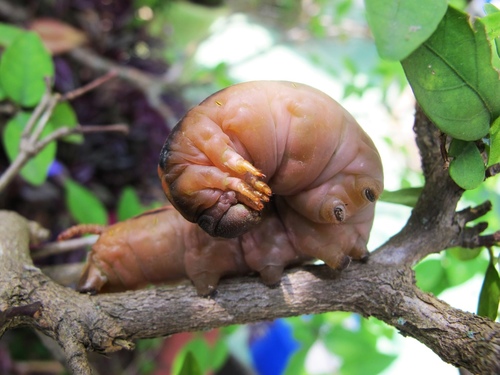
The wingspan is 96–120 mm. The larvae have been recorded feeding on Aglaia littoralis in India. Ambulyx substrigilis substrigilis (Sri Lanka, India, Nepal, Bangladesh, Andaman and Nicobar Islands, Thailand, Vietnam, China (Hainan Island), Malaysia (Peninsular, Sarawak), Indonesia (Sumatra, Kalimantan), Philippines)

Ambulyx substrigilis aglaia (Jordan, 1923) (India) In The Fauna of British India, Including Ceylon and Burma: Moths Volume I, the species is described as follows: The hind wing crenulate. Pale ochreous or greyish brown to purplish brown in color; an olive-green band between the antennae; lateral olive-green bands on the thorax meeting on metathorax; abdomen with two olive blotches on the fifth segment, and one on the seventh in some specimens... Wikipedia →
Global Distribution

Parks Where Found

# Park Country Daily sighting probability
1 Danum Valley Conservation Area 🇲🇾 Malaysia
~10%
2 Sinharaja Forest Reserve 🇱🇰 Sri Lanka
~10%
3 Kinabalu Park 🇲🇾 Malaysia
~10%

Before you go

What are the chances of seeing a Dark-Based Gliding Hawkmoth in Danum Valley Conservation Area?

With luck

About 10% of wildlife watchers report a Dark-Based Gliding Hawkmoth sighting in Danum Valley Conservation Area on a given day, based on 7 verified sightings from GBIF citizen-science data from 2019 to 2026. It is the 68th most-seen of the 102 insects we can rate there. Over three days the chance rises to about 40%, and over a week to about 70%, if each day is a fresh chance.

When is the best time to see a Dark-Based Gliding Hawkmoth in Danum Valley Conservation Area?

April

In that month about 40% of wildlife watchers report a Dark-Based Gliding Hawkmoth in Danum Valley Conservation Area on a given day, against under 5% in May, July–September and November–February, the lowest months.

What time of day is best to see a Dark-Based Gliding Hawkmoth?

Between 6 and 9 pm

Across all the parks we cover, that three-hour window holds the most Dark-Based Gliding Hawkmoth sightings with a recorded time, and about 6 in 10 of them come between 6 pm and 6 am: it is most active around dawn and dusk.

Is Danum Valley Conservation Area the best place to see a Dark-Based Gliding Hawkmoth?

Yes

Of the 3 parks where we can rate Dark-Based Gliding Hawkmoth sightings, Danum Valley Conservation Area has the highest daily chance: about 10%. Next come Sinharaja Forest Reserve (Sri Lanka, about 10%) and Kinabalu Park (Malaysia, about 10%).

Which relatives of the Dark-Based Gliding Hawkmoth live in Danum Valley Conservation Area?

Same family: Sphingidae

The closest relatives of the Dark-Based Gliding Hawkmoth that you can see in Danum Valley Conservation Area (family Sphingidae, Sphinx Moths) are Large Banded Hawkmoth (about 30%), Jade Hawkmoth (about 20%) and Durian Hawkmoth (about 20%), with each one's daily chance of a sighting.

Where does the Dark-Based Gliding Hawkmoth sighting chance come from?

GBIF citizen-science records

It is estimated from how often the Dark-Based Gliding Hawkmoth is recorded against all the insects logged in Danum Valley Conservation Area (7 verified sightings from 2019 to 2026), calibrated against known sighting rates. Figures are rounded to the nearest 10% because citizen-science data supports honest approximations, not decimals, and months with records from fewer than five people show "—". How it works.

← Back to Danum Valley Conservation Area