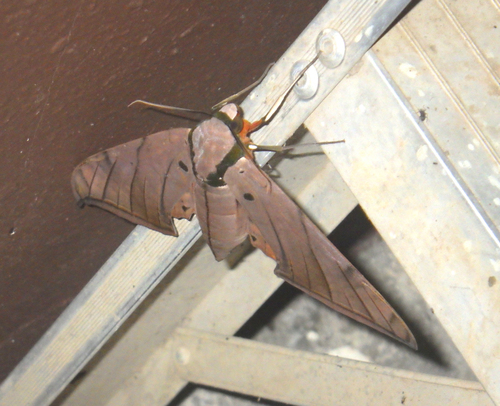
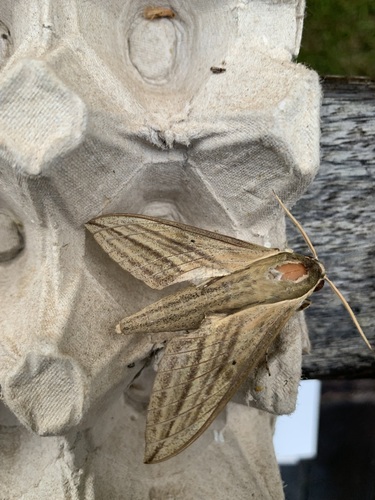
Jade Hawkmoth

Jade Hawkmoth

Daphnis hypothous

Daily sighting probability ~20% · Possible
at Danum Valley Conservation Area

In 3 days ~60% in a week ~80%

14 Verified sightings at Danum Valley Conservation Area From 2019 to 2026
55 In all 4 parks
July Best month
☀️🌙 Day & Night When it's spotted

About the Jade Hawkmoth

Daphnis hypothous, the jade hawkmoth, is a species of moth in the family Sphingidae described by Pieter Cramer in 1780. It is known from Sri Lanka, India, Nepal, Myanmar, southern China, Taiwan, Thailand, Malaysia, and Indonesia. It is a rare vagrant to the Western Palaearctic realm. During the last hundred years a number have been discovered within the Middle East and one was even found in Scotland late in the 20th century but this was probably imported as a pupa with cargo.

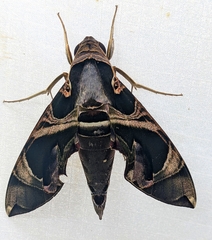
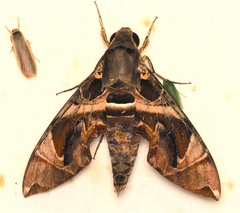
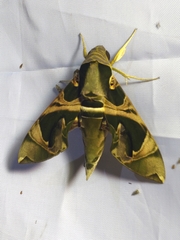
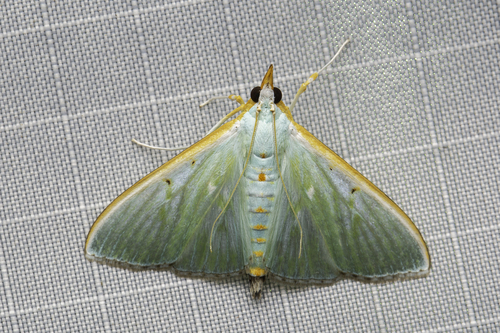
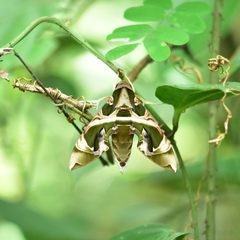
The wingspan is 86–120 mm. It is a very fast flyer and is attracted to both sweet-smelling flowers and light. It differs from Daphnis nerii in having the head and collar uniformly dark purplish brown. Thorax and first two abdominal segments are dark green with a white fringe to the first segment. Other abdominal segments are dark olive green with the streaks and spots as in D. nerii.

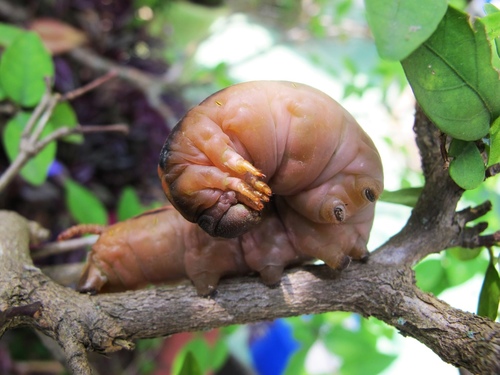
Wings are similar to D. nerii but very much darker on both dorsal and ventral side. A white spot is present at the apex of forewing and at the end of cell of forewing ventral side. Larva is green with yellow dots at its sides. There is a dark dorsal line, a subdorsal purple-red band, edged with yellow on thoracic... Wikipedia →
Global Distribution

Parks Where Found

# Park Country Daily sighting probability
1 Danum Valley Conservation Area 🇲🇾 Malaysia
~20%
2 Sinharaja Forest Reserve 🇱🇰 Sri Lanka
~20%
3 Khao Yai National Park 🇹🇭 Thailand
~20%
4 Kinabalu Park 🇲🇾 Malaysia
~10%

Cities Where Found

# City Country Daily sighting probability
1 Singapore 🇸🇬 Singapore
<5%
2 Bangkok 🇹🇭 Thailand
<5%
3 Hong Kong 🇨🇳 China
<5%

Before you go

What are the chances of seeing a Jade Hawkmoth in Danum Valley Conservation Area?

Possible

About 20% of wildlife watchers report a Jade Hawkmoth sighting in Danum Valley Conservation Area on a given day, based on 14 verified sightings from GBIF citizen-science data from 2019 to 2026. It is the 20th most-seen of the 102 insects we can rate there. Over three days the chance rises to about 60%, and over a week to about 80%, if each day is a fresh chance.

When is the best time to see a Jade Hawkmoth in Danum Valley Conservation Area?

July

In that month about 50% of wildlife watchers report a Jade Hawkmoth in Danum Valley Conservation Area on a given day, against under 5% in October and December–January, the lowest months.

What time of day is best to see a Jade Hawkmoth?

Between 7 and 10 am

Across all the parks we cover, that three-hour window holds the most Jade Hawkmoth sightings with a recorded time, and about 6 in 10 of them come between 6 am and 6 pm: it is seen both by day and at night.

Is Danum Valley Conservation Area the best place to see a Jade Hawkmoth?

Yes

Of the 4 parks where we can rate Jade Hawkmoth sightings, Danum Valley Conservation Area has the highest daily chance: about 20%. Next come Sinharaja Forest Reserve (Sri Lanka, about 20%) and Khao Yai National Park (Thailand, about 20%).

Which relatives of the Jade Hawkmoth live in Danum Valley Conservation Area?

Same family: Sphingidae

The closest relatives of the Jade Hawkmoth that you can see in Danum Valley Conservation Area (family Sphingidae, Sphinx Moths) are Large Banded Hawkmoth (about 30%), Durian Hawkmoth (about 20%) and Dark-Based Gliding Hawkmoth (about 10%), with each one's daily chance of a sighting.

Where does the Jade Hawkmoth sighting chance come from?

GBIF citizen-science records

It is estimated from how often the Jade Hawkmoth is recorded against all the insects logged in Danum Valley Conservation Area (14 verified sightings from 2019 to 2026), calibrated against known sighting rates. Figures are rounded to the nearest 10% because citizen-science data supports honest approximations, not decimals, and months with records from fewer than five people show "—". How it works.

← Back to Danum Valley Conservation Area