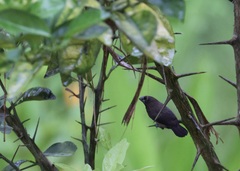

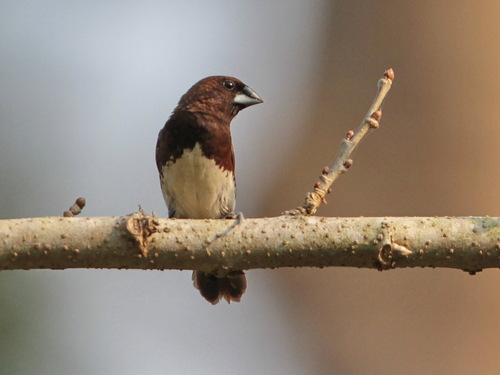
Dusky Munia

Dusky Munia

Lonchura fuscans

Silhouette: Ferran Sayol · PhyloPic

LCLeast ConcernNTVUENCR
Daily sighting probability ~30% · Possible
at Danum Valley Conservation Area

In 3 days ~70% in a week ~90%

470 Verified sightings at Danum Valley Conservation Area From 2019 to 2026
1,529 In all 6 parks
October Best month
🌅 Crepuscular When it's spotted

About the Dusky Munia

The dusky munia (Lonchura fuscans) is a species in the estrildid finch Family and is endemic to Borneo. It is also commonly referred to as the Dusky mannikin and the Bornean munia. It is in the genus Lonchura and is a monotypic species, so there are no subspecies.

The status of the species is evaluated as Least Concern. It is most commonly spotted on the Island Borneo, but can be found in Brunei, Indonesia, Malaysia, and the Philippines. It is also an introduced species in Natuna, Banggi, Cagayan and Sulu Islands. While the population size of the species is unknown, the population growth is stable, and virtually unthreatened. It is found in subtropical/ tropical lowland shrubland, forest and grassland habitat. Its habitat can vary widely, with sightings being recorded in the foothills of the island Borneo, grasslands, and agricultural fields such as rice paddy fields. They also tend to reside along riverbanks, reed-beds, secondary scrub and cultivated areas, from sea-level all the way up to 500 meters above ground. They are not migrants, and do not venture outside of their habitat during seasonal changes like many other species of birds. Wikipedia →

Sounds

Call0:34

Malaysia · 2008

© Hans Matheve · XC520310 · CC BY-NC-ND 4.0

Flight call0:12

Malaysia · 2022

© GABRIEL LEITE · XC730930 · CC BY-NC-SA 4.0

Call0:28

Malaysia · 2011

© Ding Li Yong · XC660627 · CC BY-NC-ND 4.0

Global Distribution

Parks Where Found

# Park Country Daily sighting probability
1 Danum Valley Conservation Area 🇲🇾 Malaysia
~30%
2 Sepilok 🇲🇾 Malaysia
~20%
3 Bako National Park 🇲🇾 Malaysia
~20%
4 Kinabatangan Wildlife Sanctuary 🇲🇾 Malaysia
~10%
5 Tanjung Puting National Park 🇮🇩 Indonesia
~10%
6 Kinabalu Park 🇲🇾 Malaysia
~10%

Cities Where Found

# City Country Daily sighting probability
1 Kuching 🇲🇾 Malaysia
~10%

Zoos & Centres Where Found

# Zoo / Centre Country
1 Zoo Pilsen 🇨🇿 Czechia In captivity

Before you go

What are the chances of seeing a Dusky Munia in Danum Valley Conservation Area?

Possible

About 30% of wildlife watchers report a Dusky Munia sighting in Danum Valley Conservation Area on a given day, based on 470 verified sightings from GBIF citizen-science data from 2019 to 2026. It is the 33rd most-seen of the 258 birds we can rate there. Over three days the chance rises to about 70%, and over a week to about 90%, if each day is a fresh chance.

When is the best time to see a Dusky Munia in Danum Valley Conservation Area?

April and September–October

In those months about 40% of wildlife watchers report a Dusky Munia in Danum Valley Conservation Area on a given day, against about 10% in November, the lowest month.

What time of day is best to see a Dusky Munia?

Between midnight and 3 am

Across all the parks we cover, that three-hour window holds the most Dusky Munia sightings with a recorded time, and about 7 in 10 of them come between 6 pm and 6 am: it is most active around dawn and dusk.

Is Danum Valley Conservation Area the best place to see a Dusky Munia?

Yes

Of the 6 parks where we can rate Dusky Munia sightings, Danum Valley Conservation Area has the highest daily chance: about 30%. Next come Sepilok (Malaysia, about 20%) and Bako National Park (Malaysia, about 20%).

Where does the Dusky Munia sighting chance come from?

GBIF citizen-science records

It is estimated from how often the Dusky Munia is recorded against all the birds logged in Danum Valley Conservation Area (470 verified sightings from 2019 to 2026), calibrated against known sighting rates. Figures are rounded to the nearest 10% because citizen-science data supports honest approximations, not decimals, and months with records from fewer than five people show "—". How it works.

← Back to Danum Valley Conservation Area