Red-bearded Bee-eater

Red-bearded Bee-eater

Nyctyornis amictus

Silhouette: Sheatherius · PhyloPic

LCLeast ConcernNTVUENCR
Daily sighting probability ~20% · Possible
at Danum Valley Conservation Area

In 3 days ~50% in a week ~80%

329 Verified sightings at Danum Valley Conservation Area From 2019 to 2026
1,649 In all 11 parks
October Best month
🌅 Crepuscular When it's spotted

About the Red-bearded Bee-eater

The red-bearded bee-eater (Nyctyornis amictus) is a large species of bee-eater found in southern Myanmar, the Thai-Malay Peninsula, Borneo, Sumatra and nearby smaller islands. This species is found in openings in patches of dense forest.

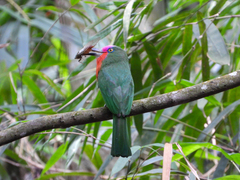
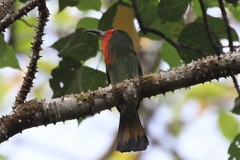
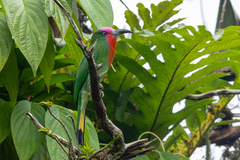
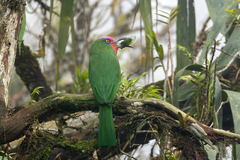
Like other bee-eaters, they are colourful birds with long tails, long decurved beaks and pointed wings. They are large bee-eaters, predominantly green, with a red colouration to face that extends on to the slightly hanging throat feathers to form the "beard". Their eyes are orange.

Like other bee-eaters, they predominantly eat insects, especially bees, wasps and hornets, which are caught in flight from perches concealed in foliage. They hunt alone or in pairs, rather than in flocks, and sit motionless for long periods before pursuing their prey.

Like other bee-eaters, they nest in burrows tunnelled into the side of sandy banks, but do not form colonies. The Hamlyn photographic guide to birds of the world, foreword by Christopher Perrins; general editor: Andrew Gosler, London : Hamlyn, 1991, ISBN 0-600-57239-0 Wikipedia →

Sounds

Song0:17

Malaysia · 2025

© Étienne Leroy · XC1076678 · CC BY-NC-SA 4.0

Uncertain0:13

Malaysia · 2025

© Nick Talbot · XC1039185 · CC BY-NC-SA 4.0

Call0:22

Malaysia · 2022

© Kim Chuah Lim · XC769007 · CC BY-NC-SA 4.0

Global Distribution

Parks Where Found

# Park Country Daily sighting probability
1 Khao Luang National Park 🇹🇭 Thailand
~20%
2 Danum Valley Conservation Area 🇲🇾 Malaysia
~20%
3 Way Kambas National Park 🇮🇩 Indonesia
~20%
4 Kaeng Krachan National Park 🇹🇭 Thailand
~20%
5 Khao Sok National Park 🇹🇭 Thailand
~10%
6 Gunung Leuser National Park 🇮🇩 Indonesia
~10%
7 Sepilok 🇲🇾 Malaysia
~10%
8 Taman Negara National Park 🇲🇾 Malaysia
~10%
9 Kerinci Seblat National Park 🇮🇩 Indonesia
<5%
10 Kinabalu Park 🇲🇾 Malaysia
<5%
11 Kinabatangan Wildlife Sanctuary 🇲🇾 Malaysia
<5%

Before you go

What are the chances of seeing a Red-bearded Bee-eater in Danum Valley Conservation Area?

Possible

About 20% of wildlife watchers report a Red-bearded Bee-eater sighting in Danum Valley Conservation Area on a given day, based on 329 verified sightings from GBIF citizen-science data from 2019 to 2026. It is the 72nd most-seen of the 258 birds we can rate there. Over three days the chance rises to about 50%, and over a week to about 80%, if each day is a fresh chance.

When is the best time to see a Red-bearded Bee-eater in Danum Valley Conservation Area?

October

In that month about 30% of wildlife watchers report a Red-bearded Bee-eater in Danum Valley Conservation Area on a given day, against about 10% in January and April–June, the lowest months.

What time of day is best to see a Red-bearded Bee-eater?

Between 4 and 7 am

Across all the parks we cover, that three-hour window holds the most Red-bearded Bee-eater sightings with a recorded time, and about 6 in 10 of them come between 6 pm and 6 am: it is most active around dawn and dusk.

Is Danum Valley Conservation Area the best place to see a Red-bearded Bee-eater?

Among the best

Of the 11 parks where we can rate Red-bearded Bee-eater sightings, Danum Valley Conservation Area ranks 2nd at about 20%, level with the leaders once rounded. The best odds are in Khao Luang National Park (Thailand, about 20%).

Where does the Red-bearded Bee-eater sighting chance come from?

GBIF citizen-science records

It is estimated from how often the Red-bearded Bee-eater is recorded against all the birds logged in Danum Valley Conservation Area (329 verified sightings from 2019 to 2026), calibrated against known sighting rates. Figures are rounded to the nearest 10% because citizen-science data supports honest approximations, not decimals, and months with records from fewer than five people show "—". How it works.

← Back to Danum Valley Conservation Area