Cape Crow

Cape Crow

Corvus capensis

Silhouette: Peileppe · PhyloPic

LCLeast ConcernNTVUENCR
Daily sighting probability ~50% · Likely
at De Hoop Nature Reserve

In 3 days ~80% in a week >90%

233 Verified sightings at De Hoop Nature Reserve From 2019 to 2026
3,494 In all 14 parks
April Best month
☀️ Diurnal When it's spotted

About the Cape Crow

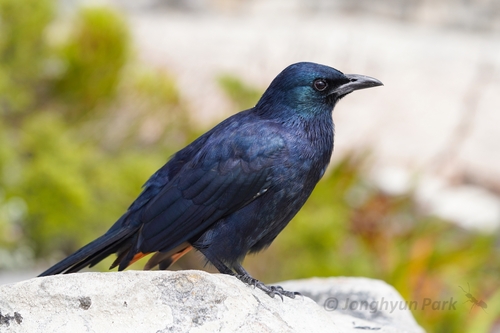
The Cape crow or black crow (Corvus capensis) is slightly larger (48–50 cm in length) than the carrion crow and is completely black with a slight gloss of purple in its feathers. It also has proportionately longer legs, wings, and tail, and has a much longer, slimmer bill that seems to be adapted for probing into the ground for invertebrates. The head feathers have a coppery-purple gloss and the throat feathers are quite long and fluffed out in some calls and displays.

This species occurs in two large separate regions of the African continent. One form ranges from the Cape at the southern tip of Africa north to southern Angola and across to the east coast of Mozambique. The other population occurs in a large area from South Sudan, Ethiopia, Tanzania, and Kenya in central East Africa. The more northern population is on average slightly smaller than the southern. It inhabits open grassland, moorland, and agricultural areas with some trees or woodland in the vicinity for nesting. It seems to thrive especially in agricultural areas.

It eats grain and other seeds, and invertebrates, which it digs for with powerful downward stabs of... Wikipedia →

Sounds

Uncertain1:21

South Africa · 2026

© JJSUN · XC1079091 · CC BY-NC-SA 4.0

Flight call0:15

Namibia · 2023

© Ehren Eksteen · XC793357 · CC BY-NC-SA 4.0

Call0:07

Kenya · 2022

© Lars Lachmann · XC752986 · CC BY-NC-SA 4.0

Global Distribution

Parks Where Found

# Park Country Daily sighting probability
1 Addo Elephant National Park 🇿🇦 South Africa
~60%
2 Etosha National Park 🇳🇦 Namibia
~50%
3 Bale Mountains National Park 🇪🇹 Ethiopia
~50%
4 Kgalagadi Transfrontier Park 🇿🇦 South Africa
~50%
5 De Hoop Nature Reserve 🇿🇦 South Africa
~50%
6 Golden Gate Highlands National Park 🇿🇦 South Africa
~40%
7 Namib-Naukluft National Park 🇳🇦 Namibia
~20%
8 Serengeti National Park 🇹🇿 Tanzania
~10%
9 Lake Nakuru National Park 🇰🇪 Kenya
~10%
10 Ngorongoro Conservation Area 🇹🇿 Tanzania
~10%
11 Garden Route National Park 🇿🇦 South Africa
~10%
12 Aberdare National Park 🇰🇪 Kenya
<5%
13 Samburu National Reserve 🇰🇪 Kenya
<5%
14 Kruger National Park 🇿🇦 South Africa
<5%

Cities Where Found

# City Country Daily sighting probability
1 Durban 🇿🇦 South Africa
<5%
2 Addis Ababa 🇪🇹 Ethiopia
<5%
3 Nairobi 🇰🇪 Kenya
<5%

Zoos & Centres Where Found

# Zoo / Centre Country
1 Giraffe House 🇿🇦 South Africa In captivity
2 World of Birds Wildlife Sanctuary and Monkey Park 🇿🇦 South Africa In captivity
3 Montecasino Bird Gardens 🇿🇦 South Africa In captivity

Before you go

What are the chances of seeing a Cape Crow in De Hoop Nature Reserve?

Likely

About 50% of wildlife watchers report a Cape Crow sighting in De Hoop Nature Reserve on a given day, based on 233 verified sightings from GBIF citizen-science data from 2019 to 2026. It is the 30th most-seen of the 189 birds we can rate there. Over three days the chance rises to about 80%, and over a week to over 90%, if each day is a fresh chance.

When is the best time to see a Cape Crow in De Hoop Nature Reserve?

February, April, September and November

In those months about 50% of wildlife watchers report a Cape Crow in De Hoop Nature Reserve on a given day, against about 40% in March, May, July–August, October and December–January, the lowest months. June has too few records to rate.

What time of day is best to see a Cape Crow?

Between 8 and 11 am

Across all the parks we cover, that three-hour window holds the most Cape Crow sightings with a recorded time, and nearly all of them come between 6 am and 6 pm: it is a daytime animal.

Which relatives of the Cape Crow live in De Hoop Nature Reserve?

Same genus: Corvus

The closest relatives of the Cape Crow that you can see in De Hoop Nature Reserve (genus Corvus, Crows and Ravens) are White-necked Raven (about 40%) and Pied Crow (about 10%), with each one's daily chance of a sighting.

Where does the Cape Crow sighting chance come from?

GBIF citizen-science records

It is estimated from how often the Cape Crow is recorded against all the birds logged in De Hoop Nature Reserve (233 verified sightings from 2019 to 2026), calibrated against known sighting rates. Figures are rounded to the nearest 10% because citizen-science data supports honest approximations, not decimals, and months with records from fewer than five people show "—". How it works.

← Back to De Hoop Nature Reserve