Cape Grysbok

Cape Grysbok

Raphicerus melanotis

Silhouette: [unknown] · PhyloPic

LCLeast ConcernNTVUENCR Endemic
Daily sighting probability ~30% · Possible
at De Hoop Nature Reserve

In 3 days ~70% in a week ~90%

14 Verified sightings at De Hoop Nature Reserve From 2019 to 2026
104 In all 4 parks
June Best month
☀️🌙 Day & Night When it's spotted

About the Cape Grysbok

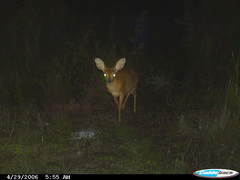
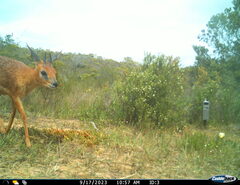
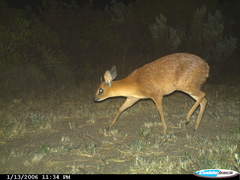
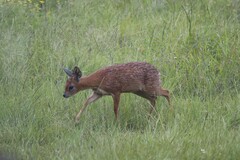
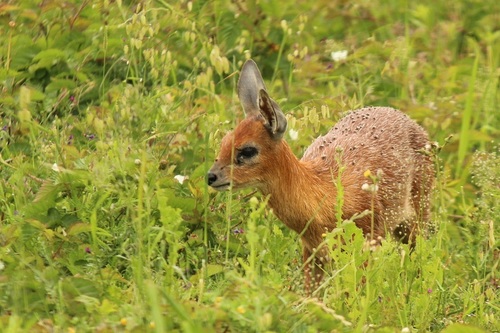
The Cape or southern grysbok (Raphicerus melanotis) is a small antelope that is endemic to the Western Cape region of South Africa between Albany and the Cederberg mountains. It has a rough, reddish sandy coat flecked in white. The head, neck and legs are less flecked and somewhat yellowish, while the inside of the ears, eye-rings, mouth area, throat and underside are white. There is a black "bridge" to the nose and a dark scent gland in front of the eye. It stands only 21" (45–55 cm) at the shoulder and weighs slightly more than 20 pounds (8–12 kg). The short tail of the Cape grysbok measures 4 to 8 cm and is almost invisible. Males have short, sharp and straight horns about 8 cm long, which are smooth. The Cape grysbok can fluff out the fur at its rear end to make itself look bigger.

The Cape grysbok's native habitat is the "Fynbos biome" (Cape Floristic Region), and it inhabits thick shrubland. It can sometimes be found browsing orchards and vineyards. In the Cape Peninsula the grysbok can be found in urban edges close to human activity. It may also be found in reed beds and along the riverbed of the southern Karoo.

The Cape grysbok is... Wikipedia →
Global Distribution

Parks Where Found

# Park Country Daily sighting probability
1 De Hoop Nature Reserve 🇿🇦 South Africa
~30%
2 Addo Elephant National Park 🇿🇦 South Africa
~10%
3 Table Mountain National Park 🇿🇦 South Africa
~10%
4 Garden Route National Park 🇿🇦 South Africa
~10%

Cities Where Found

# City Country Daily sighting probability
1 Cape Town 🇿🇦 South Africa
~10%

Zoos & Centres Where Found

# Zoo / Centre Country
1 Giraffe House 🇿🇦 South Africa In captivity
2 African Dawn Bird and Wildlife Sanctuary 🇿🇦 South Africa In captivity
3 Exotic Animal World 🇿🇦 South Africa In captivity

Before you go

What are the chances of seeing a Cape Grysbok in De Hoop Nature Reserve?

Possible

About 30% of wildlife watchers report a Cape Grysbok sighting in De Hoop Nature Reserve on a given day, based on 14 verified sightings from GBIF citizen-science data from 2019 to 2026. It is the 9th most-seen of the 18 mammals we can rate there. Over three days the chance rises to about 70%, and over a week to about 90%, if each day is a fresh chance.

When is the best time to see a Cape Grysbok in De Hoop Nature Reserve?

June

In that month about 50% of wildlife watchers report a Cape Grysbok in De Hoop Nature Reserve on a given day, against under 5% in January, March, May, July and November, the lowest months.

What time of day is best to see a Cape Grysbok?

Between 9 am and noon

Across all the parks we cover, that three-hour window holds the most Cape Grysbok sightings with a recorded time, and about 6 in 10 of them come between 6 am and 6 pm: it is seen both by day and at night.

Is De Hoop Nature Reserve the best place to see a Cape Grysbok?

Yes

Of the 4 parks where we can rate Cape Grysbok sightings, De Hoop Nature Reserve has the highest daily chance: about 30%. Next come Addo Elephant National Park (South Africa, about 10%) and Table Mountain National Park (South Africa, about 10%).

Where does the Cape Grysbok sighting chance come from?

GBIF citizen-science records

It is estimated from how often the Cape Grysbok is recorded against all the mammals logged in De Hoop Nature Reserve (14 verified sightings from 2019 to 2026), calibrated against known sighting rates. Figures are rounded to the nearest 10% because citizen-science data supports honest approximations, not decimals, and months with records from fewer than five people show "—". How it works.

← Back to De Hoop Nature Reserve