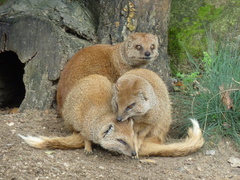
Yellow Mongoose

Yellow Mongoose

Cynictis penicillata

Silhouette: Margot Michaud · PhyloPic

LCLeast ConcernNTVUENCR
Daily sighting probability ~30% · Possible
at De Hoop Nature Reserve

In 3 days ~60% in a week ~90%

13 Verified sightings at De Hoop Nature Reserve From 2019 to 2026
413 In all 5 parks
March Best month
☀️ Diurnal When it's spotted

About the Yellow Mongoose

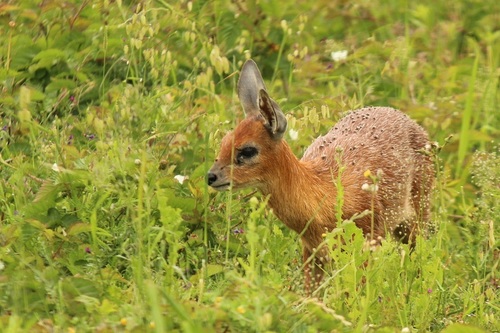
The yellow mongoose (Cynictis penicillata), sometimes referred to as the red meerkat, is a member of the mongoose family. It averages about 0.45 kg (1 lb) in weight and about 510 mm (20 in) in length. It lives in open country, semi-desert scrubland and grasslands in Angola, Botswana, South Africa, Namibia, and Zimbabwe. It is the only species in the genus Cynictis.

Herpestes penicillatus was the scientific name proposed by Georges Cuvier in 1829 for a mongoose specimen from the Cape. The generic name Cynictis was proposed by William Ogilby in 1833 for a specimen collected in Kaffraria.

The yellow mongoose is the only member of the genus Cynictis; 12 subspecies have been described, but their status is unclear. At least four subspecies have been recognised: Southern yellow mongoose (C. p. penicillata) In general, the yellow mongoose has lighter highlights on the underbelly and chin, a bushy tail, and a complete lack of sexual dimorphism. Southern yellow mongooses are larger, have yellow or reddish fur, longer fur, and a longer tail with a characteristic white tip. Northern... Wikipedia →

Sounds

Recording1:07

South Africa · 2024

© Marion Maclean · iNaturalist · CC BY-NC 4.0

Global Distribution

Parks Where Found

# Park Country Daily sighting probability
1 Kgalagadi Transfrontier Park 🇿🇦 South Africa
~40%
2 Addo Elephant National Park 🇿🇦 South Africa
~40%
3 Etosha National Park 🇳🇦 Namibia
~30%
4 De Hoop Nature Reserve 🇿🇦 South Africa
~30%
5 Chobe National Park 🇧🇼 Botswana
~10%

Cities Where Found

# City Country Daily sighting probability
1 Pretoria 🇿🇦 South Africa
~20%
2 Johannesburg 🇿🇦 South Africa
~10%

Zoos & Centres Where Found

# Zoo / Centre Country
1 Prague Zoo 🇨🇿 Czechia In captivity
2 Antwerp Zoo 🇧🇪 Belgium In captivity
3 Dvůr Králové Zoo 🇨🇿 Czechia In captivity
4 Zoo Pilsen 🇨🇿 Czechia In captivity
5 Karagandy Zoo 🇰🇿 Kazakhstan In captivity
6 Chester Zoo 🇬🇧 United Kingdom In captivity
7 Nuremberg Zoo 🇩🇪 Germany In captivity
8 Tiergarten Am Tiergarten 28 in Nürnberg 🇩🇪 Germany In captivity
9 Night Safari 🇸🇬 Singapore In captivity
10 Singapore Zoo 🇸🇬 Singapore In captivity
11 DierenPark Amersfoort 🇳🇱 Netherlands In captivity
12 Bioparque Municipal Vesty Pakos 🇧🇴 Bolivia In captivity
13 Hanover Zoo 🇩🇪 Germany In captivity
14 Zoologischer Garten Magdeburg 🇩🇪 Germany In captivity
15 Budapest Zoo & Botanical Garden 🇭🇺 Hungary In captivity
16 Krakow Zoo 🇵🇱 Poland In captivity
17 London Zoo 🇬🇧 United Kingdom In captivity
18 Ouwehands Dierenpark 🇳🇱 Netherlands In captivity
19 Reserva Zoológica Oasys MiniHollywood 🇪🇸 Spain In captivity
20 Kazan Zoo & Botanical Garden 🇷🇺 Russia In captivity
21 River Wonders 🇸🇬 Singapore In captivity
22 Leningrad Zoo 🇷🇺 Russia In captivity
23 Ménagerie du Jardin des Plantes 🇫🇷 France In captivity
24 Jardin zoologique de la ville de Lyon 🇫🇷 France In captivity
25 Drusillas Zoo Park 🇬🇧 United Kingdom In captivity
26 Cherkasy Zoo 🇺🇦 Ukraine In captivity
27 World of Birds Wildlife Sanctuary and Monkey Park 🇿🇦 South Africa In captivity
28 Планета обезьян 🇷🇺 Russia In captivity
29 Rákosův pavilon 🇨🇿 Czechia In captivity
30 Tiergarten Am Tiergarten 12 in Nürnberg 🇩🇪 Germany In captivity
31 Tiergarten Am Tiergarten 14 in Nürnberg 🇩🇪 Germany In captivity
32 Tiergarten Am Tiergarten 6 in Nürnberg 🇩🇪 Germany In captivity
33 Velemlokárium 🇨🇿 Czechia In captivity
34 Aquatopia 🇧🇪 Belgium In captivity
35 Parco Gallorose 🇮🇹 Italy In captivity

Before you go

What are the chances of seeing a Yellow Mongoose in De Hoop Nature Reserve?

Possible

About 30% of wildlife watchers report a Yellow Mongoose sighting in De Hoop Nature Reserve on a given day, based on 13 verified sightings from GBIF citizen-science data from 2019 to 2026. It is the 10th most-seen of the 18 mammals we can rate there. Over three days the chance rises to about 60%, and over a week to about 90%, if each day is a fresh chance.

When is the best time to see a Yellow Mongoose in De Hoop Nature Reserve?

March and August

In those months about 40% of wildlife watchers report a Yellow Mongoose in De Hoop Nature Reserve on a given day, against under 5% in April–June and December–February, the lowest months.

What time of day is best to see a Yellow Mongoose?

Between 10 am and 1 pm

Across all the parks we cover, that three-hour window holds the most Yellow Mongoose sightings with a recorded time, and about 9 in 10 of them come between 6 am and 6 pm: it is a daytime animal.

Where does the Yellow Mongoose sighting chance come from?

GBIF citizen-science records

It is estimated from how often the Yellow Mongoose is recorded against all the mammals logged in De Hoop Nature Reserve (13 verified sightings from 2019 to 2026), calibrated against known sighting rates. Figures are rounded to the nearest 10% because citizen-science data supports honest approximations, not decimals, and months with records from fewer than five people show "—". How it works.

← Back to De Hoop Nature Reserve