Steenbok

Steenbok

Raphicerus campestris

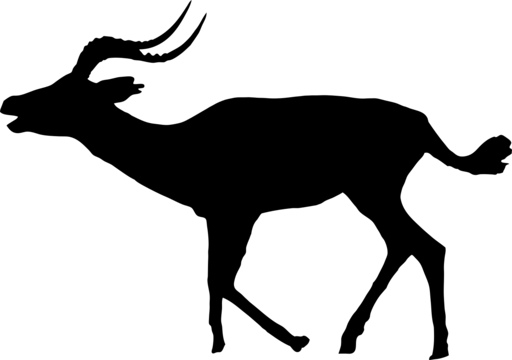
Silhouette: [unknown] · PhyloPic

LCLeast ConcernNTVUENCR
Daily sighting probability ~20% · Possible
at De Hoop Nature Reserve

In 3 days ~50% in a week ~80%

7 Verified sightings at De Hoop Nature Reserve From 2019 to 2026
1,396 In all 16 parks
March Best month
☀️ Diurnal When it's spotted

About the Steenbok

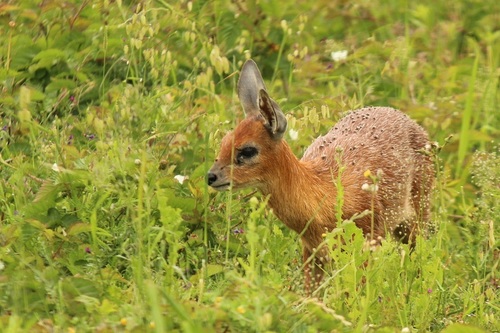
The steenbok (Raphicerus campestris) is a common small antelope of southern and eastern Africa. It is sometimes known as the steinbuck or steinbok. Steenbok resemble small oribi, standing 45–60 cm (16"–24") at the shoulder, and weigh 7–16 kg (15–35 lb). Their coat is any shade from fawn to rufous, typically rather orange. The underside, including chin and throat, is white, as is the ring around the eye. Ears are large with "finger-marks" on the inside. Males have straight, smooth, parallel horns 7–19 cm (2.8–7.5 in) long (see image left). There is a black crescent-shape between the ears, a long black bridge to the glossy black nose, and a black circular scent-gland in front of the eye. The tail is not usually visible, being only 4–6 cm (1.6–2.4 in) long.

There are two distinct clusters in steenbok distribution. In East Africa, it occurs in central and southern Kenya and northern Tanzania. It was formerly widespread in Uganda, but is now almost certainly extinct there. In Southern Africa, it occurs in Angola, Namibia, South Africa, Eswatini, Botswana, Mozambique, Zambia, Zimbabwe and probably Lesotho.

Steenbok live in a variety of... Wikipedia →

Global Distribution

Parks Where Found

# Park Country Daily sighting probability
1 West Coast National Park 🇿🇦 South Africa
~60%
2 Hwange National Park 🇿🇼 Zimbabwe
~50%
3 Etosha National Park 🇳🇦 Namibia
~50%
4 Kgalagadi Transfrontier Park 🇿🇦 South Africa
~40%
5 Kruger National Park 🇿🇦 South Africa
~40%
6 Pilanesberg National Park 🇿🇦 South Africa
~40%
7 Moremi Game Reserve 🇧🇼 Botswana
~30%
8 Chobe National Park 🇧🇼 Botswana
~30%
9 Gonarezhou National Park 🇿🇼 Zimbabwe
~30%
10 Masai Mara National Reserve 🇰🇪 Kenya
~20%
11 Tsavo East National Park 🇰🇪 Kenya
~20%
12 De Hoop Nature Reserve 🇿🇦 South Africa
~20%
13 Ngorongoro Conservation Area 🇹🇿 Tanzania
~20%
14 Serengeti National Park 🇹🇿 Tanzania
~20%
15 uMkhuze Game Reserve 🇿🇦 South Africa
~20%
16 Namib-Naukluft National Park 🇳🇦 Namibia
~10%

Cities Where Found

# City Country Daily sighting probability
1 Cape Town 🇿🇦 South Africa
<5%

Zoos & Centres Where Found

# Zoo / Centre Country
1 Abilene Zoological Gardens 🇺🇸 United States In captivity
2 San Diego Zoo Safari Park 🇺🇸 United States In captivity
3 The Abilene Zoo 🇺🇸 United States In captivity
4 African Dawn Bird and Wildlife Sanctuary 🇿🇦 South Africa In captivity
5 Ralph Perkins II Wildlife Center and Woods Garden 🇺🇸 United States In captivity

Before you go

What are the chances of seeing a Steenbok in De Hoop Nature Reserve?

Possible

About 20% of wildlife watchers report a Steenbok sighting in De Hoop Nature Reserve on a given day, based on 7 verified sightings from GBIF citizen-science data from 2019 to 2026. It is the 13th most-seen of the 18 mammals we can rate there. Over three days the chance rises to about 50%, and over a week to about 80%, if each day is a fresh chance.

When is the best time to see a Steenbok in De Hoop Nature Reserve?

March

In that month about 50% of wildlife watchers report a Steenbok in De Hoop Nature Reserve on a given day, against under 5% in April, June–October and December–January, the lowest months.

What time of day is best to see a Steenbok?

Between 3 and 6 pm

Across all the parks we cover, that three-hour window holds the most Steenbok sightings with a recorded time, and about 9 in 10 of them come between 6 am and 6 pm: it is a daytime animal.

Where does the Steenbok sighting chance come from?

GBIF citizen-science records

It is estimated from how often the Steenbok is recorded against all the mammals logged in De Hoop Nature Reserve (7 verified sightings from 2019 to 2026), calibrated against known sighting rates. Figures are rounded to the nearest 10% because citizen-science data supports honest approximations, not decimals, and months with records from fewer than five people show "—". How it works.

← Back to De Hoop Nature Reserve