Common Rhebok

Common Rhebok

Pelea capreolus

Silhouette: Ferran Sayol · PhyloPic

LCNTNear ThreatenedVUENCR
Daily sighting probability ~50% · Likely
at De Hoop Nature Reserve

In 3 days ~80% in a week >90%

52 Verified sightings at De Hoop Nature Reserve From 2019 to 2026
124 In all 3 parks
September Best month
☀️ Diurnal When it's spotted

About the Common Rhebok

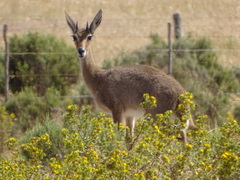
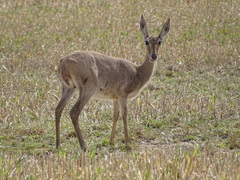
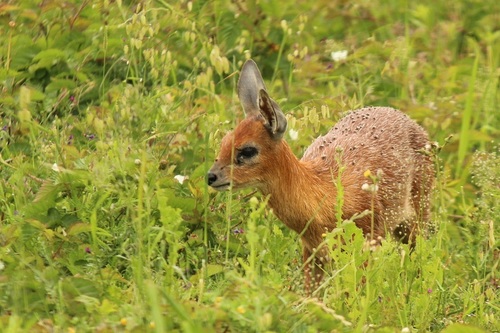
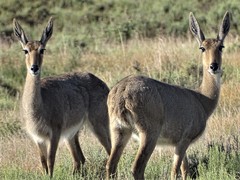
The grey rhebok (Pelea capreolus), locally known as the vaalribbok in Afrikaans, is a species of antelope native to South Africa, Lesotho, and Eswatini. The specific name capreolus is Latin for 'little goat'. The grey rhebok is a medium-sized antelope weighing 19–30 kilograms (42–66 lb) with a long neck and narrow ears. The coat is short and dense and coloured in various shades of grey. Only the males carry horns, which are straight, sharp, ringed at the base, and around 15–25 centimetres (5.9–9.8 in) long.

Generally confined to the higher areas of Southern Africa, they typically inhabit grassy, montane habitats - for example, sourveld - usually 1,000 metres (3,300 ft) above sea level, and carry a woolly grey coat to insulate them from the cold. They are not strictly limited to this habitat as they can be found in the coastal belt of the Cape, almost at sea level.

The grey rhebok is territorial and maintains its territory by urinating and defecating, standing or walking in an upright posture, and patrolling. Males become extremely aggressive during the breeding season. The grey rhebok usually aggregates... Wikipedia →

Sounds

Recording0:19

South Africa · 2020

© Sally Adam · iNaturalist · CC BY-NC 4.0

Global Distribution

Parks Where Found

# Park Country Daily sighting probability
1 De Hoop Nature Reserve 🇿🇦 South Africa
~50%
2 Golden Gate Highlands National Park 🇿🇦 South Africa
~40%
3 Table Mountain National Park 🇿🇦 South Africa
~10%

Before you go

What are the chances of seeing a Common Rhebok in De Hoop Nature Reserve?

Likely

About 50% of wildlife watchers report a Common Rhebok sighting in De Hoop Nature Reserve on a given day, based on 52 verified sightings from GBIF citizen-science data from 2019 to 2026. It is the 7th most-seen of the 18 mammals we can rate there. Over three days the chance rises to about 80%, and over a week to over 90%, if each day is a fresh chance.

When is the best time to see a Common Rhebok in De Hoop Nature Reserve?

May and September

In those months about 60% of wildlife watchers report a Common Rhebok in De Hoop Nature Reserve on a given day, against under 5% in December, the lowest month.

What time of day is best to see a Common Rhebok?

Between 9 am and noon

Across all the parks we cover, that three-hour window holds the most Common Rhebok sightings with a recorded time, and about 9 in 10 of them come between 6 am and 6 pm: it is a daytime animal.

Is De Hoop Nature Reserve the best place to see a Common Rhebok?

Yes

Of the 3 parks where we can rate Common Rhebok sightings, De Hoop Nature Reserve has the highest daily chance: about 50%. Next come Golden Gate Highlands National Park (South Africa, about 40%) and Table Mountain National Park (South Africa, about 10%).

Which relatives of the Common Rhebok live in De Hoop Nature Reserve?

Same family: Bovidae

The closest relatives of the Common Rhebok that you can see in De Hoop Nature Reserve (family Bovidae, Bovids) are Bontebok/Blesbok (about 80%), Common Eland (about 80%) and Cape Grysbok (about 30%), with each one's daily chance of a sighting.

Where does the Common Rhebok sighting chance come from?

GBIF citizen-science records

It is estimated from how often the Common Rhebok is recorded against all the mammals logged in De Hoop Nature Reserve (52 verified sightings from 2019 to 2026), calibrated against known sighting rates. Figures are rounded to the nearest 10% because citizen-science data supports honest approximations, not decimals, and months with records from fewer than five people show "—". How it works.

← Back to De Hoop Nature Reserve