Plain-backed Pipit

Plain-backed Pipit

Anthus leucophrys

Silhouette: Susan Murphy (original photograph), T. Michael Keesey (vectorization) · PhyloPic

LCLeast ConcernNTVUENCR
Daily sighting probability <5% · Rare
at De Hoop Nature Reserve

In 3 days ~10% in a week ~20%

12 Verified sightings at De Hoop Nature Reserve From 2019 to 2026
3,417 In all 24 parks
January Best month
☀️ Diurnal When it's spotted

About the Plain-backed Pipit

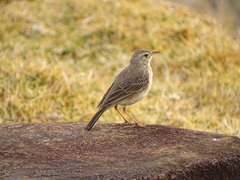
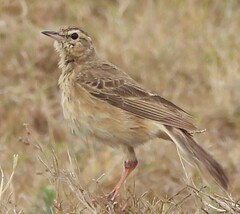
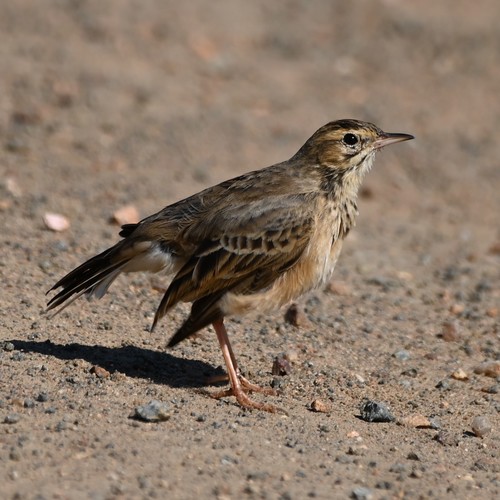
The plain-backed pipit or plain pipit (Anthus leucophrys) is a medium-sized passerine bird which is a resident breeder in Africa south of the Sahara Desert. It is found in open habitats, especially short grassland and cultivation. It builds its cup-shaped nest on the ground and usually lays three eggs. Like other pipits, this species is insectivorous.

The plain-backed pipit is a large pipit at 17 cm, but is otherwise an undistinguished looking species, faintly streaked grey-brown above and pale below with light breast streaking. It has a strong white supercilium, and dark moustachial stripes. It has long legs and tail, and a long dark bill. Sexes are similar, but juveniles have warmer brown upperparts.

Some care must be taken to distinguish this species from wintering tawny pipits, Anthus campestris. The plain-backed pipit is sturdier and darker than the Tawny, and stands more upright. Perhaps the best distinction is the characteristic "ssissik" call, quite different from the tawny pipit's "tchilip".

Birds of The Gambia by Barlow, Wacher and Disley, ISBN 1-873403-32-1 Plain-backed pipit - Species text in The Atlas of Southern African Birds. Wikipedia →

Sounds

Song1:17

Uganda · 2022

© Peter Boesman · XC739385 · CC BY-NC-ND 4.0

Call0:12

Ethiopia · 2015

© Hans Matheve · XC306605 · CC BY-NC-ND 4.0

Flight call0:06

Nigeria · 2019

© Paweł Szymański · XC517596 · CC BY-NC-SA 4.0

Global Distribution

Parks Where Found

# Park Country Daily sighting probability
1 Kidepo Valley National Park 🇺🇬 Uganda
~40%
2 Masai Mara National Reserve 🇰🇪 Kenya
~30%
3 Lake Nakuru National Park 🇰🇪 Kenya
~20%
4 Akagera National Park 🇷🇼 Rwanda
~20%
5 Queen Elizabeth National Park 🇺🇬 Uganda
~20%
6 Lake Mburo National Park 🇺🇬 Uganda
~20%
7 Serengeti National Park 🇹🇿 Tanzania
~20%
8 Moremi Game Reserve 🇧🇼 Botswana
~10%
9 Kafue National Park 🇿🇲 Zambia
~10%
10 Ngorongoro Conservation Area 🇹🇿 Tanzania
~10%
11 Virunga National Park 🇨🇩 Democratic Republic of the Congo
<5%
12 Chobe National Park 🇧🇼 Botswana
<5%
13 Table Mountain National Park 🇿🇦 South Africa
<5%
14 De Hoop Nature Reserve 🇿🇦 South Africa
<5%
15 Semuliki National Park 🇺🇬 Uganda
<5%
16 Addo Elephant National Park 🇿🇦 South Africa
<5%
17 Murchison Falls National Park 🇺🇬 Uganda
<5%
18 Nyungwe National Park 🇷🇼 Rwanda
<5%
19 Pilanesberg National Park 🇿🇦 South Africa
<5%
20 Etosha National Park 🇳🇦 Namibia
<5%
21 Garden Route National Park 🇿🇦 South Africa
<5%
22 Kruger National Park 🇿🇦 South Africa
<5%
23 iSimangaliso Wetland Park 🇿🇦 South Africa
<5%
24 Kibale National Park 🇺🇬 Uganda
<5%

Cities Where Found

# City Country Daily sighting probability
1 Accra 🇬🇭 Ghana
<5%
2 Kigali 🇷🇼 Rwanda
<5%
3 Kampala 🇺🇬 Uganda
<5%
4 Cape Town 🇿🇦 South Africa
<5%

Before you go

What are the chances of seeing a Plain-backed Pipit in De Hoop Nature Reserve?

Rare

Under 5% of wildlife watchers report a Plain-backed Pipit sighting in De Hoop Nature Reserve on a given day, based on 12 verified sightings from GBIF citizen-science data from 2019 to 2026. It is the 160th most-seen of the 189 birds we can rate there. Over three days the chance rises to about 10%, and over a week to about 20%, if each day is a fresh chance.

When is the best time to see a Plain-backed Pipit in De Hoop Nature Reserve?

January and November

In those months about 10% of wildlife watchers report a Plain-backed Pipit in De Hoop Nature Reserve on a given day, against under 5% in February–May, July–October and December, the lowest months. June has too few records to rate.

What time of day is best to see a Plain-backed Pipit?

Between 8 and 11 am

Across all the parks we cover, that three-hour window holds the most Plain-backed Pipit sightings with a recorded time, and about 8 in 10 of them come between 6 am and 6 pm: it is a daytime animal.

Where does the Plain-backed Pipit sighting chance come from?

GBIF citizen-science records

It is estimated from how often the Plain-backed Pipit is recorded against all the birds logged in De Hoop Nature Reserve (12 verified sightings from 2019 to 2026), calibrated against known sighting rates. Figures are rounded to the nearest 10% because citizen-science data supports honest approximations, not decimals, and months with records from fewer than five people show "—". How it works.

← Back to De Hoop Nature Reserve