Pinyon Jay

Pinyon Jay

Gymnorhinus cyanocephalus

Silhouette: Sheatherius · PhyloPic

LCNTVUVulnerableENCR
Daily sighting probability <5% · Rare
at Death Valley National Park

In 3 days ~10% in a week ~20%

46 Verified sightings at Death Valley National Park From 2019 to 2026
921 In all 7 parks
June Best month
☀️ Diurnal When it's spotted

About the Pinyon Jay

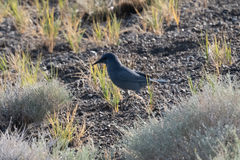
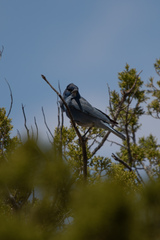
The pinyon jay (Gymnorhinus cyanocephalus) is a species of jay, and is the only member of the genus Gymnorhinus. Native to Western North America, the species ranges from central Oregon to northern Baja California, and eastward as far as western Oklahoma, though wanderers are often sighted beyond this range. It is typically found within foothills, especially where pinyon pines (Pinus edulis and Pinus monophylla) occur.

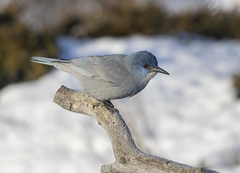
The pinyon jay is a bluish-grey coloured bird with deeper head colouring and whitish throat with black bill, legs and feet. Roughly intermediate between the blue jay and the Eurasian jay in size, its overall proportions are similar to Clark's nutcracker (Nucifraga columbiana) and this can be seen as convergent evolution, as both birds fill similar ecological niches. They were once known as "blue crows".

The pinyon jay was first collected, recorded, and first described as a species from a specimen shot along the Marias River in what is now northern Montana during the Prince Maximilian of Wied-Neuwied expedition to the interior of North America in 1833. A historical marker at LaHood Park on the Jefferson river in Montana, however, claims... Wikipedia →

Sounds

Flight call0:13

United States · 2024

© Matt Wistrand · XC915540 · CC BY-NC-SA 4.0

Call1:06

United States · 2020

© Thomas Magarian · XC602304 · CC BY-NC-SA 4.0

Begging call1:07

United States · 2013

© Andrew Spencer · XC153394 · CC BY-NC-SA 3.0

Global Distribution

Parks Where Found

# Park Country Daily sighting probability
1 Grand Canyon National Park 🇺🇸 United States
~10%
2 Joshua Tree National Park 🇺🇸 United States
~10%
3 Zion National Park 🇺🇸 United States
~10%
4 Death Valley National Park 🇺🇸 United States
<5%
5 Yellowstone National Park 🇺🇸 United States
<5%
6 Yosemite National Park 🇺🇸 United States
<5%
7 Rocky Mountain National Park 🇺🇸 United States
<5%

Cities Where Found

# City Country Daily sighting probability
1 Vancouver 🇨🇦 Canada
<5%

Before you go

What are the chances of seeing a Pinyon Jay in Death Valley National Park?

Rare

Under 5% of wildlife watchers report a Pinyon Jay sighting in Death Valley National Park on a given day, based on 46 verified sightings from GBIF citizen-science data from 2019 to 2026. It is the 133rd most-seen of the 213 birds we can rate there. Over three days the chance rises to about 10%, and over a week to about 20%, if each day is a fresh chance.

When is the best time to see a Pinyon Jay in Death Valley National Park?

May and June

In those months about 10% of wildlife watchers report a Pinyon Jay in Death Valley National Park on a given day, against under 5% in July to April, the lowest months.

What time of day is best to see a Pinyon Jay?

Between 10 am and 1 pm

Across all the parks we cover, that three-hour window holds the most Pinyon Jay sightings with a recorded time, and about 8 in 10 of them come between 6 am and 6 pm: it is a daytime animal.

Is Death Valley National Park the best place to see a Pinyon Jay?

4th of 7

Of the 7 parks where we can rate Pinyon Jay sightings, Death Valley National Park ranks 4th at under 5%. The best odds are in Grand Canyon National Park (United States, about 10%), Joshua Tree National Park (United States, about 10%) and Zion National Park (United States, about 10%).

Where does the Pinyon Jay sighting chance come from?

GBIF citizen-science records

It is estimated from how often the Pinyon Jay is recorded against all the birds logged in Death Valley National Park (46 verified sightings from 2019 to 2026), calibrated against known sighting rates. Figures are rounded to the nearest 10% because citizen-science data supports honest approximations, not decimals, and months with records from fewer than five people show "—". How it works.

← Back to Death Valley National Park