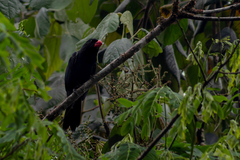
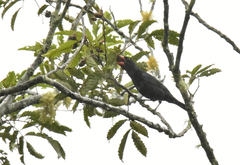
Black-throated Grosbeak

Black-throated Grosbeak

Saltator fuliginosus

Silhouette: Sheatherius · PhyloPic

LCLeast ConcernNTVUENCR
Daily sighting probability <5% · Rare
at Iguaçu National Park

In 3 days <5% in a week ~10%

57 Verified sightings at Iguaçu National Park From 2019 to 2026
315 In all 5 parks
February Best month
☀️ Diurnal When it's spotted

About the Black-throated Grosbeak

The black-throated grosbeak (Saltator fuliginosus) is a species of bird in the family Thraupidae, the tanagers and allies. It is found in Argentina, Brazil, and Paraguay. The black-throated grosbeak was formally described in 1800 with the binomial Loxia fuliginosa. For a time it and the slate-colored grosbeak (S. grossus) were placed in the genus Pitylus, and some authors treated them as conspecific. They are sister species and some authors consider them a superspecies.

The black-throated grosbeak is monotypic. The black-throated grosbeak is 20 cm (7.9 in) to 22 cm (8.7 in) long. The species is sexually dimorphic though the sexes are similar. Adult males are mostly deep slate-blue. Their lores, face, ear coverts, throat, and upper breast are black. Their wings are black with deep slate blue feather edges and their tail is uniformly black. Their underwing coverts are white. Adult females are overall duller than males with less blue in their upperparts and less of a contrast between the upper and lower breast. Both sexes have a dark brown iris, a bright coral-red bill, and dark gray legs and feet. Juveniles are duller and less blue than... Wikipedia →

Sounds

Call0:58

Argentina · 2024

© Faustino Hollmann · XC1176828 · CC BY-NC-SA 4.0

Song0:27

Brazil · 2025

© Miguel Angelo Biz · XC987923 · CC BY-NC-SA 4.0

Chamado0:53

Brazil · 2016

© Caio Brito · XC427912 · CC BY-NC-SA 4.0

Global Distribution

Parks Where Found

# Park Country Daily sighting probability
1 Itatiaia National Park 🇧🇷 Brazil
~10%
2 Serra dos Órgãos National Park 🇧🇷 Brazil
<5%
3 Iguaçu National Park 🇧🇷 Brazil
<5%
4 Iguazú National Park 🇦🇷 Argentina
<5%
5 Tijuca National Park 🇧🇷 Brazil
<5%

Zoos & Centres Where Found

# Zoo / Centre Country
1 Zoobotanic Park of Brusque 🇧🇷 Brazil In captivity

Before you go

What are the chances of seeing a Black-throated Grosbeak in Iguaçu National Park?

Rare

Under 5% of wildlife watchers report a Black-throated Grosbeak sighting in Iguaçu National Park on a given day, based on 57 verified sightings from GBIF citizen-science data from 2019 to 2026. It is the 227th most-seen of the 346 birds we can rate there. Over three days the chance rises to under 5%, and over a week to about 10%, if each day is a fresh chance.

When is the best time to see a Black-throated Grosbeak in Iguaçu National Park?

Any time of year

In every month with enough records, under 5% of wildlife watchers report a Black-throated Grosbeak in Iguaçu National Park on a given day, so our monthly data shows no clear season.

What time of day is best to see a Black-throated Grosbeak?

Between 7 and 10 am

Across all the parks we cover, that three-hour window holds the most Black-throated Grosbeak sightings with a recorded time, and about 9 in 10 of them come between 6 am and 6 pm: it is a daytime animal.

Is Iguaçu National Park the best place to see a Black-throated Grosbeak?

3rd of 5

Of the 5 parks where we can rate Black-throated Grosbeak sightings, Iguaçu National Park ranks 3rd at under 5%. The best odds are in Itatiaia National Park (Brazil, about 10%) and Serra dos Órgãos National Park (Brazil, under 5%).

Where does the Black-throated Grosbeak sighting chance come from?

GBIF citizen-science records

It is estimated from how often the Black-throated Grosbeak is recorded against all the birds logged in Iguaçu National Park (57 verified sightings from 2019 to 2026), calibrated against known sighting rates. Figures are rounded to the nearest 10% because citizen-science data supports honest approximations, not decimals, and months with records from fewer than five people show "—". How it works.

← Back to Iguaçu National Park