Blackish-blue Seedeater

Blackish-blue Seedeater

Amaurospiza moesta

Silhouette: Sheatherius · PhyloPic

LCLeast ConcernNTVUENCR
Daily sighting probability <5% · Rare
at Iguaçu National Park

In 3 days ~10% in a week ~20%

82 Verified sightings at Iguaçu National Park From 2019 to 2026
205 In all 3 parks
May Best month
☀️ Diurnal When it's spotted

About the Blackish-blue Seedeater

The blackish-blue seedeater (Amaurospiza moesta) is a species of bird in the family Cardinalidae, the cardinals or cardinal grosbeaks. It is found in Argentina, Brazil, and Paraguay. The blackish-blue seedeater is monotypic.

It and the other members of genus Amaurospiza were traditionally placed in family Emberizidae. (At that time, the family included the New World sparrows, which are now in their own family Passerellidae.) Since approximately 2008 they have been placed in their current family.

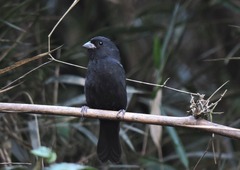
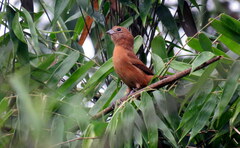
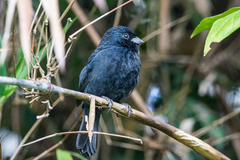
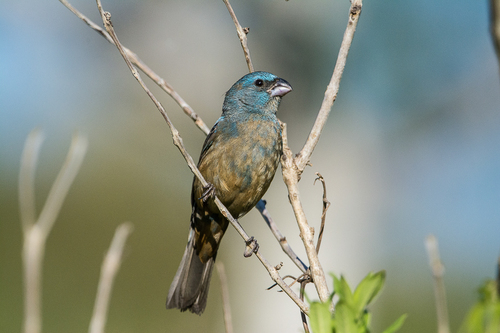
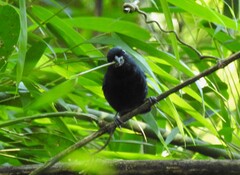
The blackish-blue seedeater is 12 to 12.5 cm (4.7 to 4.9 in) long and weighs 12.5 to 14 g (0.44 to 0.49 oz). The male is entirely dark slaty blue that is darker on the face and underparts. The female is tawny brown, with the underparts paler than the upperparts.

The blackish-blue seedeater is primarily found in southeastern Brazil and adjoining eastern Paraguay and northeastern Argentina. However, there are also scattered records further north in Brazil. It inhabits the undergrowth and edges of woodland and is especially partial to Chusquea and Guadua bamboo. In elevation it ranges from sea level to 1,600 m (5,200... Wikipedia →

Sounds

Song0:34

Argentina · 2026

© Marcos E. Sosa · XC1156753 · CC BY-NC-SA 4.0

Call0:14

Brazil · 2022

© JAYRSON ARAUJO DE OLIVEIRA · XC732923 · CC BY-NC-SA 4.0

Automolus leucophtalmus0:57

Argentina · 2020

© Elvis Alberto Ramirez · XC602882 · CC BY-NC-SA 4.0

Global Distribution

Parks Where Found

# Park Country Daily sighting probability
1 Iguazú National Park 🇦🇷 Argentina
<5%
2 Iguaçu National Park 🇧🇷 Brazil
<5%
3 Serra dos Órgãos National Park 🇧🇷 Brazil
<5%

Before you go

What are the chances of seeing a Blackish-blue Seedeater in Iguaçu National Park?

Rare

Under 5% of wildlife watchers report a Blackish-blue Seedeater sighting in Iguaçu National Park on a given day, based on 82 verified sightings from GBIF citizen-science data from 2019 to 2026. It is the 205th most-seen of the 346 birds we can rate there. Over three days the chance rises to about 10%, and over a week to about 20%, if each day is a fresh chance.

When is the best time to see a Blackish-blue Seedeater in Iguaçu National Park?

Any time of year

In every month with enough records, under 5% of wildlife watchers report a Blackish-blue Seedeater in Iguaçu National Park on a given day, so our monthly data shows no clear season.

What time of day is best to see a Blackish-blue Seedeater?

Between 8 and 11 am

Across all the parks we cover, that three-hour window holds the most Blackish-blue Seedeater sightings with a recorded time, and about 9 in 10 of them come between 6 am and 6 pm: it is a daytime animal.

Is Iguaçu National Park the best place to see a Blackish-blue Seedeater?

Among the best

Of the 3 parks where we can rate Blackish-blue Seedeater sightings, Iguaçu National Park ranks 2nd at under 5%, level with the leaders once rounded. The best odds are in Iguazú National Park (Argentina, under 5%).

Where does the Blackish-blue Seedeater sighting chance come from?

GBIF citizen-science records

It is estimated from how often the Blackish-blue Seedeater is recorded against all the birds logged in Iguaçu National Park (82 verified sightings from 2019 to 2026), calibrated against known sighting rates. Figures are rounded to the nearest 10% because citizen-science data supports honest approximations, not decimals, and months with records from fewer than five people show "—". How it works.

← Back to Iguaçu National Park