
Dusky-tailed Antbird

Dusky-tailed Antbird

Drymophila malura

Silhouette: Sheatherius · PhyloPic

LCLeast ConcernNTVUENCR
Daily sighting probability <5% · Rare
at Iguaçu National Park

In 3 days <5%

6 Verified sightings at Iguaçu National Park From 2019 to 2026
68 In all 4 parks
July Best month
☀️ Diurnal When it's spotted

About the Dusky-tailed Antbird

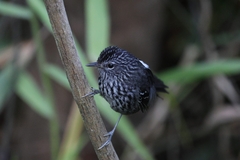
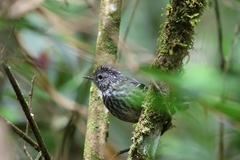
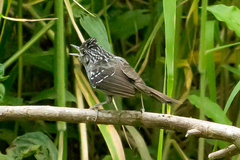
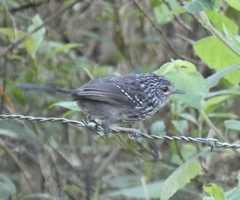
The dusky-tailed antbird (Drymophila malura) is an insectivorous bird in subfamily Thamnophilinae of family Thamnophilidae, the "typical antbirds". It is found in Argentina, Brazil, and Paraguay. The dusky-tailed antbird was described by the Dutch zoologist Coenraad Jacob Temminck in 1825 and given the binomial name Myiothera malura. The specific epithet malura is from the Ancient Greek malos "soft" or "weak". It is now placed in the genus Drymophila which was introduced by the English naturalist William Swainson in 1824.

The dusky-tailed antbird is monotypic. The dusky-tailed antbird is 13 to 14.5 cm (5.1 to 5.7 in) long and weighs 11 to 13 g (0.39 to 0.46 oz). Adult males' head and neck are streaked with black and whitish gray. Their upperparts are gray with a white patch between the scapulars; the white feathers have black tips. Their flight feathers are brownish and their wing coverts blackish with white tips. Their tail is brownish gray. Their throat and breast are streaked black and white and their flanks and crissum are olive-brown. Females' crown, nape, and sides of the neck have heavy dark brown and buff to olive-brown streaks... Wikipedia →

Sounds

Song0:07

Argentina · 2024

© Faustino Hollmann · XC1176810 · CC BY-NC-SA 4.0

Call0:48

Brazil · 2026

© Marcelo J Feliti · XC1119998 · CC BY-NC-SA 4.0

Duet0:29

Paraguay · 2025

© Guillermo Menéndez (gmmv80) · XC1006468 · CC BY-NC-SA 4.0

Global Distribution

Parks Where Found

# Park Country Daily sighting probability
1 Serra dos Órgãos National Park 🇧🇷 Brazil
<5%
2 Itatiaia National Park 🇧🇷 Brazil
<5%
3 Iguazú National Park 🇦🇷 Argentina
<5%
4 Iguaçu National Park 🇧🇷 Brazil
<5%

Before you go

What are the chances of seeing a Dusky-tailed Antbird in Iguaçu National Park?

Rare

Under 5% of wildlife watchers report a Dusky-tailed Antbird sighting in Iguaçu National Park on a given day, based on 6 verified sightings from GBIF citizen-science data from 2019 to 2026. It is the 331st most-seen of the 346 birds we can rate there. Over three days the chance rises to under 5%, if each day is a fresh chance.

When is the best time to see a Dusky-tailed Antbird in Iguaçu National Park?

Any time of year

In every month with enough records, under 5% of wildlife watchers report a Dusky-tailed Antbird in Iguaçu National Park on a given day, so our monthly data shows no clear season.

What time of day is best to see a Dusky-tailed Antbird?

Between 7 and 10 am

Across all the parks we cover, that three-hour window holds the most Dusky-tailed Antbird sightings with a recorded time, and about 7 in 10 of them come between 6 am and 6 pm: it is a daytime animal.

Is Iguaçu National Park the best place to see a Dusky-tailed Antbird?

Among the best

Of the 4 parks where we can rate Dusky-tailed Antbird sightings, Iguaçu National Park ranks 4th at under 5%, level with the leaders once rounded. The best odds are in Serra dos Órgãos National Park (Brazil, under 5%), Itatiaia National Park (Brazil, under 5%) and Iguazú National Park (Argentina, under 5%).

Where does the Dusky-tailed Antbird sighting chance come from?

GBIF citizen-science records

It is estimated from how often the Dusky-tailed Antbird is recorded against all the birds logged in Iguaçu National Park (6 verified sightings from 2019 to 2026), calibrated against known sighting rates. Figures are rounded to the nearest 10% because citizen-science data supports honest approximations, not decimals, and months with records from fewer than five people show "—". How it works.

← Back to Iguaçu National Park