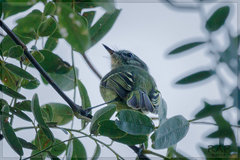
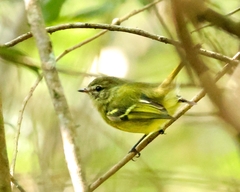

Mottle-cheeked Tyrannulet

Mottle-cheeked Tyrannulet

Phylloscartes ventralis

Silhouette: Emily Willoughby · PhyloPic

LCLeast ConcernNTVUENCR
Daily sighting probability <5% · Rare
at Iguaçu National Park

In 3 days ~10%

71 Verified sightings at Iguaçu National Park From 2019 to 2026
584 In all 6 parks
May Best month
☀️ Diurnal When it's spotted

About the Mottle-cheeked Tyrannulet

The mottle-cheeked tyrannulet (Phylloscartes ventralis) is a generally common, small species of bird in the family Tyrannidae, the tyrant flycatchers. It is found in Argentina, Bolivia, Brazil, Paraguay, Peru, and Uruguay.

Some early twentieth century authors considered the mottle-cheeked tyrannulet and what are now the Panama tyrannulet (P. flavovirens) and olive-green tyrannulet (P. virescens) as conspecific. The three are now treated by many authors as a superspecies.

Some authors believe that the "recognition of subspecies may be unwarranted". The mottle-cheeked tyrannulet is about 12 cm (4.7 in) long and weighs about 9 g (0.32 oz). The sexes have the same plumage, and the subspecies also have essentially the same plumage as well. Adults have a short thin whitish supercilium, an indistinct broken whitish eye-ring, a dusky line through the eye, a wide whitish and dusky crescent below the eye, a dusky "moustache", and the eponymous whitish and... Wikipedia →

Sounds

Call0:13

Brazil · 2025

© JAYRSON ARAUJO DE OLIVEIRA · XC1053023 · CC BY-NC-SA 4.0

Song0:04

Argentina · 2022

© Marcos E. Sosa · XC1013669 · CC BY-NC-SA 4.0

Subsong0:22

Argentina · 2021

© Guillermo Treboux · XC632438 · CC BY-NC-SA 4.0

Global Distribution

Parks Where Found

# Park Country Daily sighting probability
1 Itatiaia National Park 🇧🇷 Brazil
~20%
2 Serra dos Órgãos National Park 🇧🇷 Brazil
~10%
3 El Palmar National Park 🇦🇷 Argentina
~10%
4 Amboró National Park 🇧🇴 Bolivia
<5%
5 Iguazú National Park 🇦🇷 Argentina
<5%
6 Iguaçu National Park 🇧🇷 Brazil
<5%

Cities Where Found

# City Country Daily sighting probability
1 Buenos Aires 🇦🇷 Argentina
<5%
2 Curitiba 🇧🇷 Brazil
<5%
3 Montevideo 🇺🇾 Uruguay
<5%
4 Porto Alegre 🇧🇷 Brazil
<5%
5 São Paulo 🇧🇷 Brazil
<5%

Before you go

What are the chances of seeing a Mottle-cheeked Tyrannulet in Iguaçu National Park?

Rare

Under 5% of wildlife watchers report a Mottle-cheeked Tyrannulet sighting in Iguaçu National Park on a given day, based on 71 verified sightings from GBIF citizen-science data from 2019 to 2026. It is the 217th most-seen of the 346 birds we can rate there. Over three days the chance rises to about 10%, if each day is a fresh chance.

When is the best time to see a Mottle-cheeked Tyrannulet in Iguaçu National Park?

Any time of year

In every month with enough records, under 5% of wildlife watchers report a Mottle-cheeked Tyrannulet in Iguaçu National Park on a given day, so our monthly data shows no clear season.

What time of day is best to see a Mottle-cheeked Tyrannulet?

Between 9 am and noon

Across all the parks we cover, that three-hour window holds the most Mottle-cheeked Tyrannulet sightings with a recorded time, and about 9 in 10 of them come between 6 am and 6 pm: it is a daytime animal.

Where does the Mottle-cheeked Tyrannulet sighting chance come from?

GBIF citizen-science records

It is estimated from how often the Mottle-cheeked Tyrannulet is recorded against all the birds logged in Iguaçu National Park (71 verified sightings from 2019 to 2026), calibrated against known sighting rates. Figures are rounded to the nearest 10% because citizen-science data supports honest approximations, not decimals, and months with records from fewer than five people show "—". How it works.

← Back to Iguaçu National Park