
Purple-crowned Plovercrest

Purple-crowned Plovercrest

Stephanoxis loddigesii

Silhouette: Ferran Sayol · PhyloPic

LCLeast ConcernNTVUENCR
Daily sighting probability <5% · Rare
at Iguaçu National Park

In 3 days <5% in a week ~10%

64 Verified sightings at Iguaçu National Park From 2019 to 2026
158 In all 2 parks
March Best month
☀️ Diurnal When it's spotted

About the Purple-crowned Plovercrest

The purple-crowned plovercrest, or violet-crowned plovercrest, (Stephanoxis loddigesii) is a species of hummingbird in the "emeralds", tribe Trochilini of subfamily Trochilinae. It is found in Argentina, Brazil, and Paraguay.

The purple-crowned plovercrest and green-crowned plovercrest (Stephanoxis lalandi) were originally treated as separate species but in the mid-1900s were combined under the name "plovercrest" with the binomial S. lalandi. A study published in 2014 provided evidence that the original two-species treatment was correct. Taxonomists worldwide agreed and the two taxa were restored to species status. They are the only members of the genus and are monotypic.

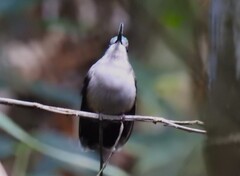
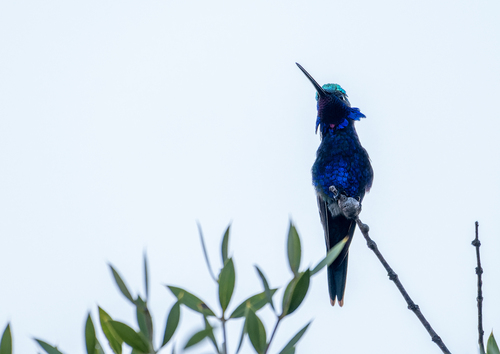
The purple-crowned plovercrest is 8.5 to 9.5 cm (3.3 to 3.7 in) long. Males weigh about 3.7 g (0.13 oz). Both sexes have a shortish, straight, black bill. Adult males have a shaggy violet-blue crest. Their face, chin, and throat are brownish with a white spot behind the eye. Their upperparts yellowish green. Their lower throat to upper belly is blackish violet-blue and the rest of the underparts are gray. Their central two pairs of tail feathers are green and the rest... Wikipedia →

Sounds

Song1:14

Brazil · 2025

© Joost van Bruggen · XC1050542 · CC BY-NC-ND 4.0

Call0:28

Brazil · 2022

© Glauco Kohler · XC749134 · CC BY-NC-SA 4.0

Recording0:42

Brazil · 2007

© Eduardo Patrial · XC18172 · CC BY-NC-ND 2.5

Global Distribution

Parks Where Found

# Park Country Daily sighting probability
1 Iguazú National Park 🇦🇷 Argentina
<5%
2 Iguaçu National Park 🇧🇷 Brazil
<5%

Cities Where Found

# City Country Daily sighting probability
1 Curitiba 🇧🇷 Brazil
<5%

Before you go

What are the chances of seeing a Purple-crowned Plovercrest in Iguaçu National Park?

Rare

Under 5% of wildlife watchers report a Purple-crowned Plovercrest sighting in Iguaçu National Park on a given day, based on 64 verified sightings from GBIF citizen-science data from 2019 to 2026. It is the 227th most-seen of the 346 birds we can rate there. Over three days the chance rises to under 5%, and over a week to about 10%, if each day is a fresh chance.

When is the best time to see a Purple-crowned Plovercrest in Iguaçu National Park?

Any time of year

In every month with enough records, under 5% of wildlife watchers report a Purple-crowned Plovercrest in Iguaçu National Park on a given day, so our monthly data shows no clear season.

What time of day is best to see a Purple-crowned Plovercrest?

Between 9 am and noon

Across all the parks we cover, that three-hour window holds the most Purple-crowned Plovercrest sightings with a recorded time, and about 9 in 10 of them come between 6 am and 6 pm: it is a daytime animal.

Is Iguaçu National Park the best place to see a Purple-crowned Plovercrest?

Among the best

Of the 2 parks where we can rate Purple-crowned Plovercrest sightings, Iguaçu National Park ranks 2nd at under 5%, level with the leaders once rounded. The best odds are in Iguazú National Park (Argentina, under 5%).

Which relatives of the Purple-crowned Plovercrest live in Iguaçu National Park?

Same family: Trochilidae

The closest relatives of the Purple-crowned Plovercrest that you can see in Iguaçu National Park (family Trochilidae, Hummingbirds) are Violet-capped Woodnymph (about 20%), Scale-throated Hermit (about 10%) and Versicolored Emerald (about 10%), with each one's daily chance of a sighting.

Where does the Purple-crowned Plovercrest sighting chance come from?

GBIF citizen-science records

It is estimated from how often the Purple-crowned Plovercrest is recorded against all the birds logged in Iguaçu National Park (64 verified sightings from 2019 to 2026), calibrated against known sighting rates. Figures are rounded to the nearest 10% because citizen-science data supports honest approximations, not decimals, and months with records from fewer than five people show "—". How it works.

← Back to Iguaçu National Park