
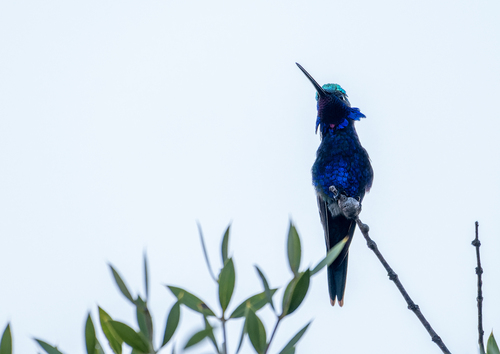
Swallow-tailed Hummingbird

Swallow-tailed Hummingbird

Eupetomena macroura

Silhouette: Ferran Sayol · PhyloPic

LCLeast ConcernNTVUENCR
Daily sighting probability <5% · Rare
at Iguaçu National Park

In 3 days <5% in a week ~10%

46 Verified sightings at Iguaçu National Park From 2019 to 2026
2,846 In all 9 parks
May Best month
☀️ Diurnal When it's spotted

About the Swallow-tailed Hummingbird

The swallow-tailed hummingbird (Eupetomena macroura) is a species in the hummingbird family (Trochilidae), found mainly in east-central South America. Most authorities place it in the genus Eupetomena, although some place it in Campylopterus based on song and the thick shafts of the males' first primaries. Its common name and specific epithet (which means "large-tailed") both refer to the long, deeply forked, somewhat swallow-like tail.

The swallow-tailed hummingbird was formally described in 1788 by the German naturalist Johann Friedrich Gmelin in his revised and expanded edition of Carl Linnaeus's Systema Naturae. He placed it with all the other hummingbirds in the genus Trochilus, coined the binomial name Trochilus macrourus and specified the type locality as Jamaica. Gmelin cited earlier authors including Hans Sloane who in 1725 had described and illustrated a humming bird from Jamaica and Mathurin Jacques Brisson who in 1760, had described and illustrated a hummingbird from Cayenne, French Guiana. In 1929 Carl Eduard Hellmayr argued that Gmelin conflated two different species and that his diagnosis applied to Brisson's specimen from Cayenne; Sloane's Jamaican bird... Wikipedia →

Sounds

Call0:11

Brazil · 2026

© JAYRSON ARAUJO DE OLIVEIRA · XC1136839 · CC BY-NC-SA 4.0

Song0:34

Brazil · 2024

© Ricardo José Mitidieri · XC953336 · CC BY-NC-SA 4.0

Dawn song0:45

Brazil · 2006

© Dante Buzzetti · XC643160 · CC BY-NC-SA 4.0

Global Distribution

Parks Where Found

# Park Country Daily sighting probability
1 Tijuca National Park 🇧🇷 Brazil
~60%
2 Serra dos Órgãos National Park 🇧🇷 Brazil
~40%
3 Emas National Park 🇧🇷 Brazil
~30%
4 Serra da Canastra National Park 🇧🇷 Brazil
~30%
5 Chapada Diamantina National Park 🇧🇷 Brazil
~20%
6 Chapada dos Guimarães National Park 🇧🇷 Brazil
~20%
7 Iguazú National Park 🇦🇷 Argentina
~10%
8 Itatiaia National Park 🇧🇷 Brazil
<5%
9 Iguaçu National Park 🇧🇷 Brazil
<5%

Cities Where Found

# City Country Daily sighting probability
1 Belo Horizonte 🇧🇷 Brazil
~60%
2 Niterói 🇧🇷 Brazil
~60%
3 Rio de Janeiro 🇧🇷 Brazil
~60%
4 Santos 🇧🇷 Brazil
~50%
5 Brasilia 🇧🇷 Brazil
~50%
6 São Paulo 🇧🇷 Brazil
~50%
7 Salvador 🇧🇷 Brazil
~40%
8 Vitória 🇧🇷 Brazil
~40%
9 Campinas 🇧🇷 Brazil
~30%
10 Fortaleza 🇧🇷 Brazil
~30%

Zoos & Centres Where Found

# Zoo / Centre Country
1 Parque das Aves 🇧🇷 Brazil In captivity

Before you go

What are the chances of seeing a Swallow-tailed Hummingbird in Iguaçu National Park?

Rare

Under 5% of wildlife watchers report a Swallow-tailed Hummingbird sighting in Iguaçu National Park on a given day, based on 46 verified sightings from GBIF citizen-science data from 2019 to 2026. It is the 246th most-seen of the 346 birds we can rate there. Over three days the chance rises to under 5%, and over a week to about 10%, if each day is a fresh chance.

When is the best time to see a Swallow-tailed Hummingbird in Iguaçu National Park?

Any time of year

In every month with enough records, under 5% of wildlife watchers report a Swallow-tailed Hummingbird in Iguaçu National Park on a given day, so our monthly data shows no clear season.

What time of day is best to see a Swallow-tailed Hummingbird?

Between 3 and 6 pm

Across all the parks we cover, that three-hour window holds the most Swallow-tailed Hummingbird sightings with a recorded time, and about 9 in 10 of them come between 6 am and 6 pm: it is a daytime animal.

Which relatives of the Swallow-tailed Hummingbird live in Iguaçu National Park?

Same family: Trochilidae

The closest relatives of the Swallow-tailed Hummingbird that you can see in Iguaçu National Park (family Trochilidae, Hummingbirds) are Violet-capped Woodnymph (about 20%), Scale-throated Hermit (about 10%) and Versicolored Emerald (about 10%), with each one's daily chance of a sighting.

Where does the Swallow-tailed Hummingbird sighting chance come from?

GBIF citizen-science records

It is estimated from how often the Swallow-tailed Hummingbird is recorded against all the birds logged in Iguaçu National Park (46 verified sightings from 2019 to 2026), calibrated against known sighting rates. Figures are rounded to the nearest 10% because citizen-science data supports honest approximations, not decimals, and months with records from fewer than five people show "—". How it works.

← Back to Iguaçu National Park