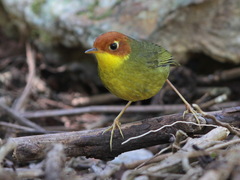
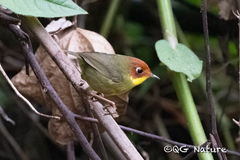
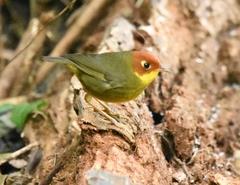
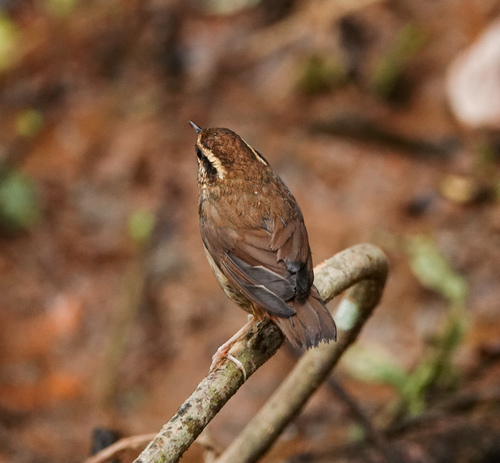
Chestnut-headed Tesia

Chestnut-headed Tesia

Cettia castaneocoronata

Silhouette: Jiekun He · PhyloPic

LCLeast ConcernNTVUENCR
Daily sighting probability <5% · Rare
at Doi Inthanon National Park

In 3 days <5%

10 Verified sightings at Doi Inthanon National Park From 2019 to 2026
335 In all 6 parks
February Best month
☀️ Diurnal When it's spotted

About the Chestnut-headed Tesia

The chestnut-headed tesia (Cettia castaneocoronata) is a small insectivorous songbird formerly of the "Old World warbler" family but nowadays placed in the bush warbler family (Cettiidae). It is found in Bangladesh, Bhutan, China, India, Laos, Myanmar, Nepal, Thailand, and Vietnam. Its natural habitats are subtropical or tropical moist lowland forest and subtropical or tropical moist montane forest.

The chestnut-headed tesia was formally described by the English army officer and zoologist Edward Burton in 1836 under the binomial name Sylvia castaneocoronata. The specific epithet combines the Latin castaneus meaning "chestnut-coloured" and coronatus meaning "crowned". Formerly placed in the genus Tesia, a molecular phylogenetic study published in 2011 found that the chestnut-headed tesia was embedded in a clade containing members of the genus Cettia.

The phylogenetic relationships among the Cettia species are shown below, based on the data by the Cornell Lab of Ornithology. It split from the Chestnut-crowned bush warbler about 5 million years ago. Wikipedia →

Sounds

Song0:14

China · 2021

© JJSUN · XC1079682 · CC BY-NC-SA 4.0

Call0:38

Thailand · 2014

© Jelle Scharringa · XC1026356 · CC BY-NC-SA 4.0

Alarm call0:57

China · 2024

© Dave GUO · XC971908 · CC BY-NC-SA 4.0

Global Distribution

Parks Where Found

# Park Country Daily sighting probability
1 Langtang National Park 🇳🇵 Nepal
~10%
2 Royal Manas National Park 🇧🇹 Bhutan
~10%
3 Namdapha National Park 🇮🇳 India
~10%
4 Jim Corbett National Park 🇮🇳 India
<5%
5 Manas National Park 🇮🇳 India
<5%
6 Doi Inthanon National Park 🇹🇭 Thailand
<5%

Cities Where Found

# City Country Daily sighting probability
1 Dehradun 🇮🇳 India
<5%
2 Kathmandu 🇳🇵 Nepal
<5%

Before you go

What are the chances of seeing a Chestnut-headed Tesia in Doi Inthanon National Park?

Rare

Under 5% of wildlife watchers report a Chestnut-headed Tesia sighting in Doi Inthanon National Park on a given day, based on 10 verified sightings from GBIF citizen-science data from 2019 to 2026. It is the 334th most-seen of the 367 birds we can rate there. Over three days the chance rises to under 5%, if each day is a fresh chance.

When is the best time to see a Chestnut-headed Tesia in Doi Inthanon National Park?

Any time of year

In every month with enough records, under 5% of wildlife watchers report a Chestnut-headed Tesia in Doi Inthanon National Park on a given day, so our monthly data shows no clear season.

What time of day is best to see a Chestnut-headed Tesia?

Between 9 am and noon

Across all the parks we cover, that three-hour window holds the most Chestnut-headed Tesia sightings with a recorded time, and about 9 in 10 of them come between 6 am and 6 pm: it is a daytime animal.

Is Doi Inthanon National Park the best place to see a Chestnut-headed Tesia?

6th of 6

Of the 6 parks where we can rate Chestnut-headed Tesia sightings, Doi Inthanon National Park ranks 6th at under 5%. The best odds are in Langtang National Park (Nepal, about 10%), Royal Manas National Park (Bhutan, about 10%) and Namdapha National Park (India, about 10%).

Which relatives of the Chestnut-headed Tesia live in Doi Inthanon National Park?

Same family: Cettiidae

The closest relatives of the Chestnut-headed Tesia that you can see in Doi Inthanon National Park (family Cettiidae, Bush Warblers and Allies) are Slaty-bellied Tesia (about 40%) and Mountain Tailorbird (about 30%), with each one's daily chance of a sighting.

Where does the Chestnut-headed Tesia sighting chance come from?

GBIF citizen-science records

It is estimated from how often the Chestnut-headed Tesia is recorded against all the birds logged in Doi Inthanon National Park (10 verified sightings from 2019 to 2026), calibrated against known sighting rates. Figures are rounded to the nearest 10% because citizen-science data supports honest approximations, not decimals, and months with records from fewer than five people show "—". How it works.

← Back to Doi Inthanon National Park