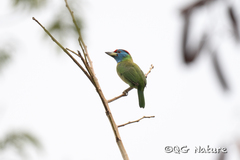
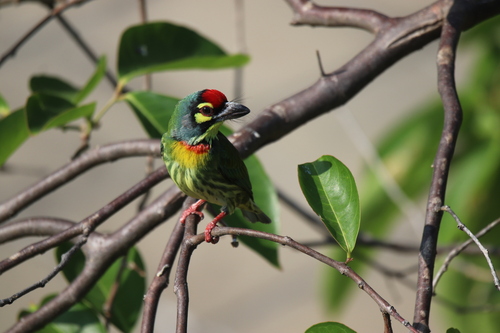
Blue-throated Barbet

Blue-throated Barbet

Psilopogon asiaticus

Silhouette: Vijay Cavale (photo), John E. McCormack, Michael G. Harvey, Brant C. Faircloth, Nicholas G. Crawford, Travis C. Glenn, Robb T. Brumfield & T. Michael Keesey · PhyloPic

LCLeast ConcernNTVUENCR
Daily sighting probability ~30% · Possible
at Doi Inthanon National Park

In 3 days ~60% in a week ~90%

1,073 Verified sightings at Doi Inthanon National Park From 2019 to 2026
7,641 In all 10 parks
February Best month
☀️ Diurnal When it's spotted

About the Blue-throated Barbet

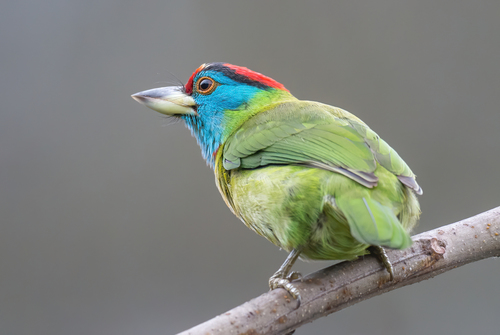
The blue-throated barbet (Psilopogon asiaticus) is a green Asian barbet native to the foothills of the Himalayas and Southeast Asia. It inhabits lowland and montane forests at elevations of 200–2,000 m (660–6,560 ft), frequenting fruiting trees. Due to its green colour, it is difficult to spot but is easily located by its continual loud calls. Sexes are similar in most respects and share domestic duties.

The Blue-throated Barbet was originally placed in the genus Cyanops by Latham in 1790. This was subsequently synonymized with Megalaima. In 2013, phylogenetic studies indicated that Psilopogon is embedded within Megalaima. Psilopogon has priority, hence the genus Megalaima was subsumed into Psilopogon. The Blue-throated Barbet has previously been considered conspecific with the Turquoise-throated Barbet (Psilopogon chersonesus) and the Mountain Barbet (Psilopogon monticola) (11), but molecular data confirm that these are distinct species.

Psilopogon asiaticus has two sub-species: Red-crowned blue-throated barbet P.a. asiaticus (Latham, 1790) is resident from NE Pakistan to W, N Myanmar and SW Yunnan Blue-crowned blue-throated barbet P.a. davisoni (Hume, 1877... Wikipedia →
Sounds

Song0:36

China · 2026

© Bo Shunqi 薄顺奇 · XC1094804 · CC BY-NC-SA 4.0

Call1:02

Nepal · 2017

© Mike Dooher · XC390009 · CC BY-NC-SA 4.0

Song0:19

Nepal · 2023

© Bram Piot · XC836598 · CC BY-NC-SA 4.0

Global Distribution

Parks Where Found

# Park Country Daily sighting probability
1 Royal Manas National Park 🇧🇹 Bhutan
~70%
2 Namdapha National Park 🇮🇳 India
~60%
3 Manas National Park 🇮🇳 India
~50%
4 Kaziranga National Park 🇮🇳 India
~30%
5 Jim Corbett National Park 🇮🇳 India
~30%
6 Doi Inthanon National Park 🇹🇭 Thailand
~30%
7 Kaeng Krachan National Park 🇹🇭 Thailand
~20%
8 Chitwan National Park 🇳🇵 Nepal
~10%
9 Sundarbans National Park 🇮🇳 India
~10%
10 Royal Bardia National Park 🇳🇵 Nepal
<5%

Cities Where Found

# City Country Daily sighting probability
1 Guwahati 🇮🇳 India
~70%
2 Berhampore 🇮🇳 India
~50%
3 Kathmandu 🇳🇵 Nepal
~50%
4 Islamabad 🇵🇰 Pakistan
~40%
5 Kolkata 🇮🇳 India
~40%
6 Tamluk 🇮🇳 India
~30%
7 Dehradun 🇮🇳 India
<5%
8 Guangzhou 🇨🇳 China
<5%
9 Dhaka 🇧🇩 Bangladesh
<5%

Before you go

What are the chances of seeing a Blue-throated Barbet in Doi Inthanon National Park?

Possible

About 30% of wildlife watchers report a Blue-throated Barbet sighting in Doi Inthanon National Park on a given day, based on 1,073 verified sightings from GBIF citizen-science data from 2019 to 2026. It is the 33rd most-seen of the 367 birds we can rate there. Over three days the chance rises to about 60%, and over a week to about 90%, if each day is a fresh chance.

When is the best time to see a Blue-throated Barbet in Doi Inthanon National Park?

February and May–June

In those months about 40% of wildlife watchers report a Blue-throated Barbet in Doi Inthanon National Park on a given day, against about 20% in March–April and August–December, the lowest months.

What time of day is best to see a Blue-throated Barbet?

Between 7 and 10 am

Across all the parks we cover, that three-hour window holds the most Blue-throated Barbet sightings with a recorded time, and about 9 in 10 of them come between 6 am and 6 pm: it is a daytime animal.

Which relatives of the Blue-throated Barbet live in Doi Inthanon National Park?

Same genus: Psilopogon

The closest relatives of the Blue-throated Barbet that you can see in Doi Inthanon National Park (genus Psilopogon, Typical Asian Barbets) are Golden-throated Barbet (about 50%), Lineated Barbet (about 20%) and Great Barbet (about 20%), with each one's daily chance of a sighting.

Where does the Blue-throated Barbet sighting chance come from?

GBIF citizen-science records

It is estimated from how often the Blue-throated Barbet is recorded against all the birds logged in Doi Inthanon National Park (1,073 verified sightings from 2019 to 2026), calibrated against known sighting rates. Figures are rounded to the nearest 10% because citizen-science data supports honest approximations, not decimals, and months with records from fewer than five people show "—". How it works.

← Back to Doi Inthanon National Park