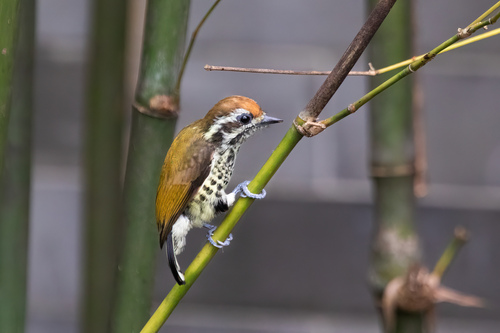
Black-eared Barbet

Black-eared Barbet

Psilopogon duvaucelii

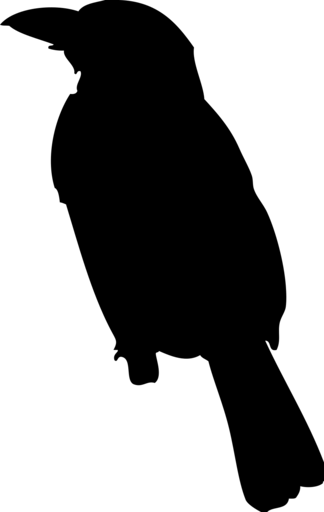
Silhouette: Vijay Cavale (photo), John E. McCormack, Michael G. Harvey, Brant C. Faircloth, Nicholas G. Crawford, Travis C. Glenn, Robb T. Brumfield & T. Michael Keesey · PhyloPic

LCLeast ConcernNTVUENCR
Daily sighting probability <5% · Rare
at Doi Inthanon National Park

In 3 days <5%

17 Verified sightings at Doi Inthanon National Park From 2019 to 2026
9,108 In all 20 parks
April Best month
🌅 Crepuscular When it's spotted

About the Black-eared Barbet

The black-eared barbet (Psilopogon duvaucelii) is a barbet in the family Megalaimidae native to Peninsular Malaysia, Sumatra and Borneo. It inhabits shrubland and forest up to an altitude of 1,200 m (3,900 ft). Because of its large range it is listed as least concern on the IUCN Red List.

The black-eared barbet has olive-green plumage, a blue throat and nape, a black beak and a large black streak between the eyes. Below the eyes it has red spots encircled by black. It is 16–17 cm (6.3–6.7 in) long and weighs 26.3–37 g (0.93–1.31 oz).

Bucco duvaucelii was the scientific name proposed by René Lesson in 1830 who described a barbet from Sumatra. The generic name Psilopogon was proposed by Salomon Müller in 1836, initially for a fire-tufted barbet (P. pyrolophus) from Sumatra.

In subsequent decades, about 19 generic names were proposed for barbet species, including Megalaima by John Edward Gray in 1849 and Mezobucco by George Ernest Shelley in 1889. Taxonomists used different generic names when describing barbets in collections of natural history museums.

Mezzobucco duvaucelii gigantorhinus was proposed by Harry C. Oberholser in 1912 for an adult male... Wikipedia →

Sounds

Call0:19

Malaysia · 2024

© Lim Ying Hien · XC950717 · CC BY-NC-ND 4.0

Song0:23

Malaysia · 2024

© Joost van Bruggen · XC935279 · CC BY-NC-ND 4.0

Uncertain0:41

Indonesia · 2020

© Prayitno Goenarto · XC594321 · CC BY-NC-ND 4.0

Global Distribution

Parks Where Found

# Park Country Daily sighting probability
1 Khao Luang National Park 🇹🇭 Thailand
~50%
2 Cat Tien National Park 🇻🇳 Vietnam
~50%
3 Khao Sok National Park 🇹🇭 Thailand
~50%
4 Sepilok 🇲🇾 Malaysia
~50%
5 Gunung Leuser National Park 🇮🇩 Indonesia
~40%
6 Kaeng Krachan National Park 🇹🇭 Thailand
~40%
7 Khao Yai National Park 🇹🇭 Thailand
~40%
8 Kinabatangan Wildlife Sanctuary 🇲🇾 Malaysia
~40%
9 Tanjung Puting National Park 🇮🇩 Indonesia
~40%
10 Danum Valley Conservation Area 🇲🇾 Malaysia
~40%
11 Taman Negara National Park 🇲🇾 Malaysia
~20%
12 Way Kambas National Park 🇮🇩 Indonesia
~20%
13 Manas National Park 🇮🇳 India
~10%
14 Namdapha National Park 🇮🇳 India
~10%
15 Royal Manas National Park 🇧🇹 Bhutan
~10%
16 Kaziranga National Park 🇮🇳 India
~10%
17 Bako National Park 🇲🇾 Malaysia
~10%
18 Kerinci Seblat National Park 🇮🇩 Indonesia
~10%
19 Kinabalu Park 🇲🇾 Malaysia
<5%
20 Doi Inthanon National Park 🇹🇭 Thailand
<5%

Cities Where Found

# City Country Daily sighting probability
1 Kuala Lumpur 🇲🇾 Malaysia
~10%
2 Kuching 🇲🇾 Malaysia
<5%
3 Guwahati 🇮🇳 India
<5%

Before you go

What are the chances of seeing a Black-eared Barbet in Doi Inthanon National Park?

Rare

Under 5% of wildlife watchers report a Black-eared Barbet sighting in Doi Inthanon National Park on a given day, based on 17 verified sightings from GBIF citizen-science data from 2019 to 2026. It is the 306th most-seen of the 367 birds we can rate there. Over three days the chance rises to under 5%, if each day is a fresh chance.

When is the best time to see a Black-eared Barbet in Doi Inthanon National Park?

Any time of year

In every month with enough records, under 5% of wildlife watchers report a Black-eared Barbet in Doi Inthanon National Park on a given day, so our monthly data shows no clear season.

What time of day is best to see a Black-eared Barbet?

Between 1 and 4 am

Across all the parks we cover, that three-hour window holds the most Black-eared Barbet sightings with a recorded time, and about 6 in 10 of them come between 6 pm and 6 am: it is most active around dawn and dusk.

Which relatives of the Black-eared Barbet live in Doi Inthanon National Park?

Same genus: Psilopogon

The closest relatives of the Black-eared Barbet that you can see in Doi Inthanon National Park (genus Psilopogon, Typical Asian Barbets) are Golden-throated Barbet (about 50%), Blue-throated Barbet (about 30%) and Lineated Barbet (about 20%), with each one's daily chance of a sighting.

Where does the Black-eared Barbet sighting chance come from?

GBIF citizen-science records

It is estimated from how often the Black-eared Barbet is recorded against all the birds logged in Doi Inthanon National Park (17 verified sightings from 2019 to 2026), calibrated against known sighting rates. Figures are rounded to the nearest 10% because citizen-science data supports honest approximations, not decimals, and months with records from fewer than five people show "—". How it works.

← Back to Doi Inthanon National Park