Southern Three-banded Armadillo

Southern Three-banded Armadillo

Tolypeutes matacus

Silhouette: Celeste Luna · PhyloPic

LCNTNear ThreatenedVUENCR
Daily sighting probability ~50% · Likely
at El Impenetrable National Park

In 3 days ~80% in a week >90%

18 Verified sightings at El Impenetrable National Park From 2019 to 2026
18 In 1 park
July Best month
☀️🌙 Day & Night When it's spotted

About the Southern Three-banded Armadillo

The southern three-banded armadillo (Tolypeutes matacus), also known as La Plata three-banded armadillo or Azara's domed armadillo, is an armadillo species from South America. It is found in parts of northern Argentina, southwestern Brazil, Paraguay and Bolivia, at elevations from sea level to 770 m (2,530 ft).

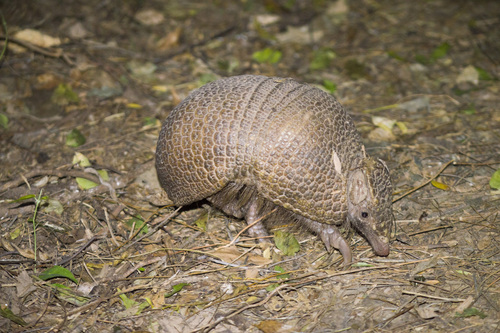
The southern three-banded armadillo and the other member of the genus Tolypeutes, the Brazilian three-banded armadillo, are the only species of armadillos capable of rolling into a complete ball to defend themselves. The three characteristic bands that cover the back of the animal allow it enough flexibility to fit its tail and head together, allowing it to protect its underbelly, limbs, eyes, nose and ears from predators. The shell covering its body is armored and the outer layer is made out of keratin, the same protein that builds human fingernails. They are typically a yellow or brownish color. They are among the smaller armadillos, with a head-and-body length of about 22 to 27 cm (8.7 to 10.6 in) and a weight between 1 and 1.6 kg (2.2 and 3.5 lb). Unlike most armadillos, they are not fossorial, but will use abandoned giant anteater burrows.

The three-banded armadillo has a long, sticky, straw-like pink tongue that allows it to gather up and eat many different species of insects, typically ants and termites. In captivity, armadillos also eat foods such as fruits and vegetables.

The species is threatened by habitat destruction from conversion of its native Dry Chaco to farmland, and from hunting for food and the pet trade. Wikipedia →
Global Distribution

Parks Where Found

# Park Country Daily sighting probability
1 El Impenetrable National Park 🇦🇷 Argentina
~50%

More parks will be added in future updates.

Zoos & Centres Where Found

# Zoo / Centre Country
1 National Zoological Park 🇺🇸 United States In captivity
2 ZooParc de Beauval 🇫🇷 France In captivity
3 Copenhagen Zoo 🇩🇰 Denmark In captivity
4 Zoo Pilsen 🇨🇿 Czechia In captivity
5 San Diego Zoo Safari Park 🇺🇸 United States In captivity
6 Minnesota Zoo 🇺🇸 United States In captivity
7 Omaha’s Henry Doorly Zoo and Aquarium 🇺🇸 United States In captivity
8 Milwaukee County Zoo 🇺🇸 United States In captivity
9 Toledo Zoo 🇺🇸 United States In captivity
10 Louisville Zoo 🇺🇸 United States In captivity
11 Caldwell Zoo 🇺🇸 United States In captivity
12 Edinburgh Zoo 🇬🇧 United Kingdom In captivity
13 Almaty Zoo 🇰🇿 Kazakhstan In captivity
14 Edmonton Valley Zoo 🇨🇦 Canada In captivity
15 Mesker Park Zoo and Botanic Garden 🇺🇸 United States In captivity
16 Akron Zoo 🇺🇸 United States In captivity
17 Faunia 🇪🇸 Spain In captivity
18 Rosamond Gifford Zoo 🇺🇸 United States In captivity
19 Rivne Zoo 🇺🇦 Ukraine In captivity
20 Northeastern Wisconsin Zoo 🇺🇸 United States In captivity
21 The Living Planet Aquarium 🇺🇸 United States In captivity
22 Glen Echo Park Aquarium 🇺🇸 United States In captivity

Before you go

What are the chances of seeing a Southern Three-banded Armadillo in El Impenetrable National Park?

Likely

About 50% of wildlife watchers report a Southern Three-banded Armadillo sighting in El Impenetrable National Park on a given day, based on 18 verified sightings from GBIF citizen-science data from 2019 to 2026. It is the 3rd most-seen of the 13 mammals we can rate there. Over three days the chance rises to about 80%, and over a week to over 90%, if each day is a fresh chance.

When is the best time to see a Southern Three-banded Armadillo in El Impenetrable National Park?

June and July

In those months about 70% of wildlife watchers report a Southern Three-banded Armadillo in El Impenetrable National Park on a given day, against under 5% in November, the lowest month. Those are among El Impenetrable National Park's driest months, with about 30 mm of rain a month against 120 mm in March.

What time of day is best to see a Southern Three-banded Armadillo?

Between 5 and 8 pm

Across all the parks we cover, that three-hour window holds the most Southern Three-banded Armadillo sightings with a recorded time, and about half of them come between 6 am and 6 pm: it is seen both by day and at night.

Where else can you see a Southern Three-banded Armadillo?

Only El Impenetrable National Park, in our data

El Impenetrable National Park is the only park on Wallace's Line with enough records to rate Southern Three-banded Armadillo sightings: about 50% of wildlife watchers there report one on a given day.

Where does the Southern Three-banded Armadillo sighting chance come from?

GBIF citizen-science records

It is estimated from how often the Southern Three-banded Armadillo is recorded against all the mammals logged in El Impenetrable National Park (18 verified sightings from 2019 to 2026), calibrated against known sighting rates. Figures are rounded to the nearest 10% because citizen-science data supports honest approximations, not decimals, and months with records from fewer than five people show "—". How it works.

← Back to El Impenetrable National Park