


Completed



Mountain Lion
Puma concolor
Silhouette: An Ignorant Atheist · PhyloPic
- KingdomAnimalia (Animals)
- PhylumChordata (Chordates)
- ClassMammalia (Mammals)
- OrderCarnivora (Carnivorans)
- FamilyFelidae (Felids)
- GenusPuma (Mountain Lions)
- SpeciesPuma concolor (Mountain Lion)
In 3 days ~60% in a week ~90%
5 Verified sightings at El Impenetrable National Park From 2019 to 2026
540 In all 22 parks
October Best month
☀️🌙 Day & Night When it's spotted


Completed




Completed
About the Mountain Lion
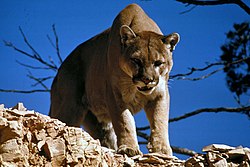
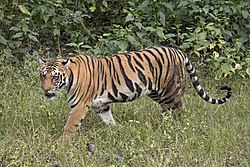
The cougar ( KOO-gər; Puma concolor), also called puma, mountain lion, catamount, and panther, is a large feline native to the Americas. It inhabits North, Central and South America, making it the most widely distributed wild, terrestrial mammal in the Western Hemisphere, and one of the most widespread in the world. Its range spans Yukon, British Columbia and Alberta in Canada, the Rocky Mountains and areas in the western United States. Further south, its range extends through Mexico to the Amazon rainforest and the southern Andes Mountains in Patagonia. It is an adaptable generalist species, occurring in most American habitat types. It prefers habitats with dense underbrush and rocky areas for stalking but also lives in open areas.
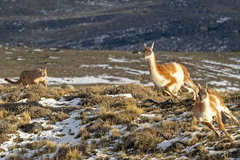
The cougar is largely solitary. Its activity pattern varies from diurnality and cathemerality to crepuscularity and nocturnality between protected and non-protected areas, and is apparently correlated with the presence of other predators, prey species, livestock and humans. It is an ambush predator that pursues a wide variety of prey. Ungulates, particularly deer, are its primary prey, but it also hunts rodents. It is territorial and lives at low population densities. Individual home ranges depend on terrain, vegetation and abundance of prey. While large, it is not always the dominant apex predator in its range, yielding prey to other predators. It is reclusive and mostly avoids people. Fatal attacks on humans are rare but increased in North America as more people entered cougar habitat and built farms.
The cougar is listed as Least Concern on the IUCN Red List. Intensive hunting following European colonization of the Americas and ongoing human development into cougar habitat has caused populations to decline in most parts of its historical range. In particular, the eastern cougar population is considered to be mostly locally extinct in eastern North America since the early 20th century, with the exception of the isolated Florida panther subpopulation. Wikipedia →
Sounds
Recording0:19
United States · 2025
© Raja Bisharat · iNaturalist · CC BY-NC 4.0
Recording0:06
Mexico · 2023
© Alex Lamoreaux · iNaturalist · CC BY-NC 4.0
Recording0:30
United States · 2025
© Colin Croft · iNaturalist · CC BY 4.0
Recent sightings of Mountain Lion in El Impenetrable National Park
LIVEiNaturalistGlobal Distribution
Parks Where Found
| # | Park | Country | Daily sighting probability |
|---|---|---|---|
| 1 | Torres del Paine National Park | 🇨🇱 Chile | |
| 2 | El Impenetrable National Park | 🇦🇷 Argentina | |
| 3 | Big Cypress National Preserve | 🇺🇸 United States | |
| 4 | Serra dos Órgãos National Park | 🇧🇷 Brazil | |
| 5 | Corcovado National Park | 🇨🇷 Costa Rica | |
| 6 | Piedras Blancas National Park | 🇨🇷 Costa Rica | |
| 7 | Tambopata National Reserve | 🇵🇪 Peru | |
| 8 | Zion National Park | 🇺🇸 United States | |
| 9 | Sequoia and Kings Canyon National Parks | 🇺🇸 United States | |
| 10 | Saguaro National Park | 🇺🇸 United States | |
| 11 | Redwood National Park | 🇺🇸 United States | |
| 12 | Yasuní National Park | 🇪🇨 Ecuador | |
| 13 | Olympic National Park | 🇺🇸 United States | |
| 14 | Iguaçu National Park | 🇧🇷 Brazil | |
| 15 | Iguazú National Park | 🇦🇷 Argentina | |
| 16 | Big Bend National Park | 🇺🇸 United States | |
| 17 | Cumbres de Monterrey National Park | 🇲🇽 Mexico | |
| 18 | Yosemite National Park | 🇺🇸 United States | |
| 19 | Manu National Park | 🇵🇪 Peru | |
| 20 | Arenal Volcano National Park | 🇨🇷 Costa Rica | |
| 21 | Chagres National Park | 🇵🇦 Panama | |
| 22 | Everglades National Park | 🇺🇸 United States |
Cities Where Found
| # | City | Country | Daily sighting probability |
|---|---|---|---|
| 1 | Los Angeles | 🇺🇸 United States | |
| 2 | San Francisco | 🇺🇸 United States |
Zoos & Centres Where Found
Closest Relatives at El Impenetrable National Park




Before you go
What are the chances of seeing a Mountain Lion in El Impenetrable National Park?
Possible
About 30% of wildlife watchers report a Mountain Lion sighting in El Impenetrable National Park on a given day, based on 5 verified sightings from GBIF citizen-science data from 2019 to 2026. It is the 13th most-seen of the 13 mammals we can rate there. Over three days the chance rises to about 60%, and over a week to about 90%, if each day is a fresh chance.
When is the best time to see a Mountain Lion in El Impenetrable National Park?
October
In that month about 50% of wildlife watchers report a Mountain Lion in El Impenetrable National Park on a given day, against under 5% in January, June–July and September, the lowest months.
What time of day is best to see a Mountain Lion?
Between 9 am and noon
Across all the parks we cover, that three-hour window holds the most Mountain Lion sightings with a recorded time, and about 7 in 10 of them come between 6 am and 6 pm: it is seen both by day and at night.
Is El Impenetrable National Park the best place to see a Mountain Lion?
2nd of 22
Of the 22 parks where we can rate Mountain Lion sightings, El Impenetrable National Park ranks 2nd at about 30%. The best odds are in Torres del Paine National Park (Chile, about 60%). All parks ranked.
Where does the Mountain Lion sighting chance come from?
GBIF citizen-science records
It is estimated from how often the Mountain Lion is recorded against all the mammals logged in El Impenetrable National Park (5 verified sightings from 2019 to 2026), calibrated against known sighting rates. Figures are rounded to the nearest 10% because citizen-science data supports honest approximations, not decimals, and months with records from fewer than five people show "—". How it works.
