Cabasu

Cabasu

Cabassous unicinctus

Silhouette: Celeste Luna · PhyloPic

LCLeast ConcernNTVUENCR
Daily sighting probability ~20% · Possible
at Emas National Park

In 3 days ~50% in a week ~80%

8 Verified sightings at Emas National Park From 2019 to 2026
8 In 1 park
December Best month
🌙 Nocturnal When it's spotted

About the Cabasu

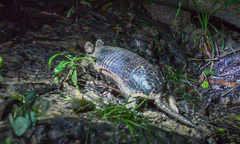
The southern naked-tailed armadillo (Cabassous unicinctus) is a species of small armadillo from South America. Smaller than some other armadillos, males measure an average of 36 cm (14 in) in head-body length, and weigh around 3.0 kg (6.6 lb), while females are larger, measuring 38 cm (15 in) and weighing 3.8 kg (8.4 lb). The tail measures around 16 cm (6.3 in) in both sexes, and has only tiny scales in its skin, unlike the larger scutes found in most other armadillo species.

The upper body is covered by a dark grey bony carapace of squarish scutes. In the mid part of the body, this carapace is divided into a series of ten to thirteen mobile rings, giving the animal some degree of flexibility. Although there are some bristly hairs around the margins of the scutes, the tail and underside of the animal are hairless. The armour covers the back of the neck and extends onto the head between the ears. Smaller and thinner scales are also found on the cheeks and the outer surface of the ears. The snout is relatively short, and the ears large and funnel-like. There are five clawed toes on each foot, with the middle claws on the forefeet being particularly large. Wikipedia →

Sounds

Recording0:15

Colombia · 2025

© Núcleo Palmero Aceites Morichal S.A.S. · iNaturalist · CC BY-NC 4.0

Global Distribution

Parks Where Found

# Park Country Daily sighting probability
1 Emas National Park 🇧🇷 Brazil
~20%

More parks will be added in future updates.

Before you go

What are the chances of seeing a Cabasu in Emas National Park?

Possible

About 20% of wildlife watchers report a Cabasu sighting in Emas National Park on a given day, based on 8 verified sightings from GBIF citizen-science data from 2019 to 2026. It is the 13th most-seen of the 15 mammals we can rate there. Over three days the chance rises to about 50%, and over a week to about 80%, if each day is a fresh chance.

When is the best time to see a Cabasu in Emas National Park?

August and December

In those months about 50% of wildlife watchers report a Cabasu in Emas National Park on a given day, against under 5% in January–July and October, the lowest months.

What time of day is best to see a Cabasu?

Between 2 and 5 am

Across all the parks we cover, that three-hour window holds the most Cabasu sightings with a recorded time, and about 8 in 10 of them come between 6 pm and 6 am: it is mostly seen at night.

Where else can you see a Cabasu?

Only Emas National Park, in our data

Emas National Park is the only park on Wallace's Line with enough records to rate Cabasu sightings: about 20% of wildlife watchers there report one on a given day.

Which relatives of the Cabasu live in Emas National Park?

Same family: Dasypodidae

The closest relatives of the Cabasu that you can see in Emas National Park (family Dasypodidae, Long-nosed Armadillos) are Six-banded Armadillo (about 40%) and Lesser Long-nosed Armadillo (about 30%), with each one's daily chance of a sighting.

Where does the Cabasu sighting chance come from?

GBIF citizen-science records

It is estimated from how often the Cabasu is recorded against all the mammals logged in Emas National Park (8 verified sightings from 2019 to 2026), calibrated against known sighting rates. Figures are rounded to the nearest 10% because citizen-science data supports honest approximations, not decimals, and months with records from fewer than five people show "—". How it works.

← Back to Emas National Park