


Large-billed Antwren

Large-billed Antwren

Herpsilochmus longirostris

Silhouette: Sheatherius · PhyloPic

LCLeast ConcernNTVUENCR
Daily sighting probability ~30% · Possible
at Emas National Park

In 3 days ~70% in a week ~90%

75 Verified sightings at Emas National Park From 2019 to 2026
257 In all 3 parks
May Best month
☀️ Diurnal When it's spotted

About the Large-billed Antwren

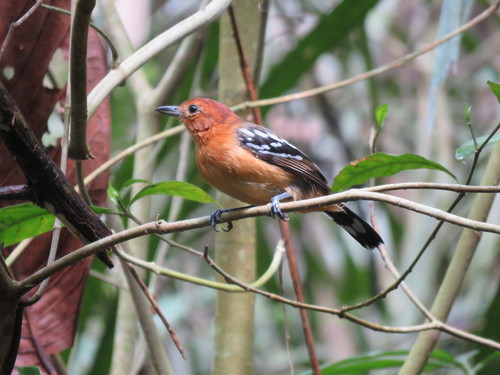
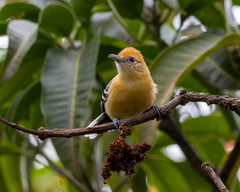
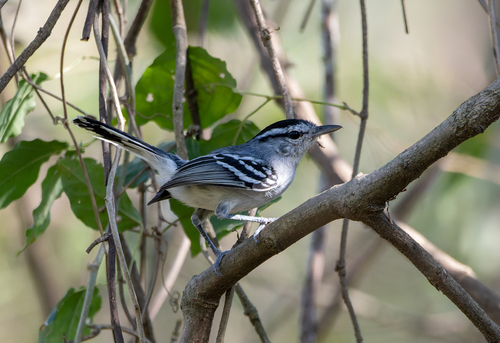
The large-billed antwren (Herpsilochmus longirostris) is a species of bird in subfamily Thamnophilinae of family Thamnophilidae, the "typical antbirds". It is found in Bolivia and Brazil. The large-billed antwren was described by the Austrian ornithologist August von Pelzeln in 1868 and given its current binomial name Herpsilochmus longirostris. Its relationship to others of its genus is unclear but it apparently is most closely related to the pectoral antwren (H. pectoralis), and at least one author has considered them to form a superspecies.

The large-billed antwren is monotypic. The large-billed antwren is 12 to 13 cm (4.7 to 5.1 in) long and weighs 12 to 14 g (0.42 to 0.49 oz). As its English name and specific epithet imply, its bill is heavier than those of most other Herpsilochmus antwrens. Adult males have a black crown and nape, a long whitish supercilium, a narrow black streak through the eye, and grayish ear coverts. Their back and rump are gray with a black and white patch between the scapulars and white-tipped black uppertail coverts. Their wings are black with white-tipped coverts and flight feathers with white edges towards... Wikipedia →

Sounds

Canto1:08

Brazil · 2016

© Caio Brito · XC427473 · CC BY-NC-SA 4.0

Call0:50

Brazil · 2005

© Peter Boesman · XC224144 · CC BY-NC-ND 4.0

Song0:43

Brazil · 1996

© Niels Poul Dreyer · XC206815 · CC BY-NC-SA 4.0

Global Distribution

Parks Where Found

# Park Country Daily sighting probability
1 Emas National Park 🇧🇷 Brazil
~30%
2 Chapada dos Guimarães National Park 🇧🇷 Brazil
~20%
3 Parque Estadual Encontro das Águas 🇧🇷 Brazil
<5%

Cities Where Found

# City Country Daily sighting probability
1 Campo Grande 🇧🇷 Brazil
~30%
2 Goiânia 🇧🇷 Brazil
~10%
3 Brasilia 🇧🇷 Brazil
<5%

Before you go

What are the chances of seeing a Large-billed Antwren in Emas National Park?

Possible

About 30% of wildlife watchers report a Large-billed Antwren sighting in Emas National Park on a given day, based on 75 verified sightings from GBIF citizen-science data from 2019 to 2026. It is the 56th most-seen of the 187 birds we can rate there. Over three days the chance rises to about 70%, and over a week to about 90%, if each day is a fresh chance.

When is the best time to see a Large-billed Antwren in Emas National Park?

May

In that month about 50% of wildlife watchers report a Large-billed Antwren in Emas National Park on a given day, against about 20% in March and August, the lowest months. That is one of Emas National Park's driest months, with about 30 mm of rain against 190 mm in January. April and December–February have too few records to rate.

What time of day is best to see a Large-billed Antwren?

Between 8 and 11 am

Across all the parks we cover, that three-hour window holds the most Large-billed Antwren sightings with a recorded time, and about 9 in 10 of them come between 6 am and 6 pm: it is a daytime animal.

Where does the Large-billed Antwren sighting chance come from?

GBIF citizen-science records

It is estimated from how often the Large-billed Antwren is recorded against all the birds logged in Emas National Park (75 verified sightings from 2019 to 2026), calibrated against known sighting rates. Figures are rounded to the nearest 10% because citizen-science data supports honest approximations, not decimals, and months with records from fewer than five people show "—". How it works.

← Back to Emas National Park