



Completed


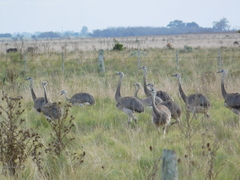



Greater Rhea
Rhea americana
Silhouette: Darren Naish (vectorized by T. Michael Keesey) · PhyloPic
- KingdomAnimalia (Animals)
- PhylumChordata (Chordates)
- ClassAves (Birds)
- OrderRheiformes (Rheas)
- FamilyRheidae (Rheas)
- GenusRhea (Rheas)
- SpeciesRhea americana (Greater Rhea)
In 3 days <5%
7 Verified sightings at Parque Estadual Encontro das Águas From 2019 to 2026
775 In all 6 parks
June Best month
☀️ Diurnal When it's spotted
About the Greater Rhea
The greater rhea (Rhea americana) is a species of flightless bird native to eastern South America. Other names for the greater rhea include the grey, common, or American rhea; ema (Portuguese); or ñandú (Guaraní and Spanish). One of two species in the genus Rhea, in the family Rheidae, it inhabits a variety of open areas, such as grasslands, savanna or grassy wetlands. Weighing 20–27 kilograms (44–60 lb), the greater rhea is the largest native bird in the Americas. In the wild, the greater rhea has a life expectancy of 10.5 years. It is also notable for its reproductive habits, and for the fact that a population has established itself in Northern Germany in the 2000s and 2010s. The species is listed as Near Threatened by the IUCN.
The greater rhea was formally described in 1758 by the Swedish naturalist Carl Linnaeus in the tenth edition of his Systema Naturae. He placed it with the ostriches in the genus Struthio and coined the binomial name Struthio americanus. Linnaeus based his account on the "Nhanduguaçú" that had been described in 1648 by the German naturalist Georg Marcgrave in his book Historia Naturalis Brasiliae. Linnaeus designated the type locality as South... Wikipedia →
Recent sightings of Greater Rhea in Parque Estadual Encontro das Águas
LIVEiNaturalistGlobal Distribution
Parks Where Found
| # | Park | Country | Daily sighting probability |
|---|---|---|---|
| 1 | Emas National Park | 🇧🇷 Brazil | |
| 2 | El Palmar National Park | 🇦🇷 Argentina | |
| 3 | Iberá National Park | 🇦🇷 Argentina | |
| 4 | Serra da Canastra National Park | 🇧🇷 Brazil | |
| 5 | Chapada dos Guimarães National Park | 🇧🇷 Brazil | |
| 6 | Parque Estadual Encontro das Águas | 🇧🇷 Brazil |
Cities Where Found
| # | City | Country | Daily sighting probability |
|---|---|---|---|
| 1 | Campo Grande | 🇧🇷 Brazil |
Zoos & Centres Where Found
Closest Relatives at Parque Estadual Encontro das Águas
No species of the same family or order lives in Parque Estadual Encontro das Águas, so these are its closest relatives here: other birds.






Before you go
What are the chances of seeing a Greater Rhea in Parque Estadual Encontro das Águas?
Rare
Under 5% of wildlife watchers report a Greater Rhea sighting in Parque Estadual Encontro das Águas on a given day, based on 7 verified sightings from GBIF citizen-science data from 2019 to 2026. It is the 288th most-seen of the 308 birds we can rate there. Over three days the chance rises to under 5%, if each day is a fresh chance.
When is the best time to see a Greater Rhea in Parque Estadual Encontro das Águas?
Any time of year
In every month with enough records, under 5% of wildlife watchers report a Greater Rhea in Parque Estadual Encontro das Águas on a given day, so our monthly data shows no clear season. January to April have too few records to rate.
What time of day is best to see a Greater Rhea?
Between 9 am and noon
Across all the parks we cover, that three-hour window holds the most Greater Rhea sightings with a recorded time, and about 9 in 10 of them come between 6 am and 6 pm: it is a daytime animal.
Is Parque Estadual Encontro das Águas the best place to see a Greater Rhea?
6th of 6
Of the 6 parks where we can rate Greater Rhea sightings, Parque Estadual Encontro das Águas ranks 6th at under 5%. The best odds are in Emas National Park (Brazil, about 50%), El Palmar National Park (Argentina, about 20%) and Iberá National Park (Argentina, about 20%).
Where does the Greater Rhea sighting chance come from?
GBIF citizen-science records
It is estimated from how often the Greater Rhea is recorded against all the birds logged in Parque Estadual Encontro das Águas (7 verified sightings from 2019 to 2026), calibrated against known sighting rates. Figures are rounded to the nearest 10% because citizen-science data supports honest approximations, not decimals, and months with records from fewer than five people show "—". How it works.
