White-banded Mockingbird

White-banded Mockingbird

Mimus triurus

Silhouette: Andy Wilson · PhyloPic

LCLeast ConcernNTVUENCR
Daily sighting probability <5% · Rare
at Parque Estadual Encontro das Águas

In 3 days <5%

7 Verified sightings at Parque Estadual Encontro das Águas From 2019 to 2026
180 In all 4 parks
August Best month
☀️ Diurnal When it's spotted

About the White-banded Mockingbird

The white-banded mockingbird (Mimus triurus) is a species of bird in the family Mimidae. It is found in Argentina, Bolivia, Brazil, Chile, Paraguay, and Uruguay. The white-banded mockingbird and the brown-backed mockingbird (Mimus dorsalis) are sister species. Both are monotypic.

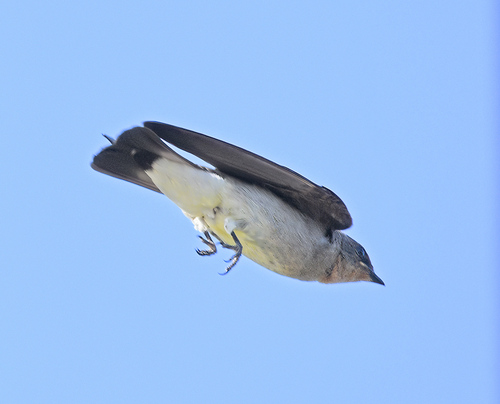
The white-banded mockingbird is 20 to 23.5 cm (7.9 to 9.3 in) long and weighs 49 to 54 g (1.7 to 1.9 oz). The male is slightly larger than the female. Adults have a grayish crown, a white supercilium, a blackish line through the eye, and speckled cheeks. Their upperparts are smoky gray blending to reddish cinnamon on the rump. The central third of the tail is black and the outer feathers white. The folded wing shows a broad white band; the rest of the wing is blackish. The white on the wings and tail are conspicuous in flight. The adults are mostly whitish below; the sides and flanks have a cinnamon wash and the vent area is buffy. The juvenile is similar but with a spotted breast and less white in the wing.

The white-banded mockingbird breeds primarily in central Argentina. In the non-breeding season it apparently withdraws from... Wikipedia →

Sounds

Alarm call0:42

Uruguay · 2025

© Luciano Buck · XC996008 · CC BY-NC-SA 4.0

Call0:43

Argentina · 2024

© Guillermo Treboux · XC902349 · CC BY-NC-SA 4.0

Song1:07

Argentina · 2022

© Franco Vushurovich · XC751035 · CC BY-NC-SA 4.0

Global Distribution

Parks Where Found

# Park Country Daily sighting probability
1 El Impenetrable National Park 🇦🇷 Argentina
~20%
2 Península Valdés 🇦🇷 Argentina
~10%
3 Iberá National Park 🇦🇷 Argentina
<5%
4 Parque Estadual Encontro das Águas 🇧🇷 Brazil
<5%

Cities Where Found

# City Country Daily sighting probability
1 Rosario 🇦🇷 Argentina
~30%
2 Cordoba 🇦🇷 Argentina
~20%
3 Asuncion 🇵🇾 Paraguay
~10%
4 Mendoza 🇦🇷 Argentina
<5%
5 Buenos Aires 🇦🇷 Argentina
<5%
6 Montevideo 🇺🇾 Uruguay
<5%
7 Santa Cruz de la Sierra 🇧🇴 Bolivia
<5%
8 Santiago 🇨🇱 Chile
<5%

Before you go

What are the chances of seeing a White-banded Mockingbird in Parque Estadual Encontro das Águas?

Rare

Under 5% of wildlife watchers report a White-banded Mockingbird sighting in Parque Estadual Encontro das Águas on a given day, based on 7 verified sightings from GBIF citizen-science data from 2019 to 2026. It is the 288th most-seen of the 308 birds we can rate there. Over three days the chance rises to under 5%, if each day is a fresh chance.

When is the best time to see a White-banded Mockingbird in Parque Estadual Encontro das Águas?

Any time of year

In every month with enough records, under 5% of wildlife watchers report a White-banded Mockingbird in Parque Estadual Encontro das Águas on a given day, so our monthly data shows no clear season. January to April have too few records to rate.

What time of day is best to see a White-banded Mockingbird?

Between 9 am and noon

Across all the parks we cover, that three-hour window holds the most White-banded Mockingbird sightings with a recorded time, and nearly all of them come between 6 am and 6 pm: it is a daytime animal.

Is Parque Estadual Encontro das Águas the best place to see a White-banded Mockingbird?

4th of 4

Of the 4 parks where we can rate White-banded Mockingbird sightings, Parque Estadual Encontro das Águas ranks 4th at under 5%. The best odds are in El Impenetrable National Park (Argentina, about 20%), Península Valdés (Argentina, about 10%) and Iberá National Park (Argentina, under 5%).

Where does the White-banded Mockingbird sighting chance come from?

GBIF citizen-science records

It is estimated from how often the White-banded Mockingbird is recorded against all the birds logged in Parque Estadual Encontro das Águas (7 verified sightings from 2019 to 2026), calibrated against known sighting rates. Figures are rounded to the nearest 10% because citizen-science data supports honest approximations, not decimals, and months with records from fewer than five people show "—". How it works.

← Back to Parque Estadual Encontro das Águas