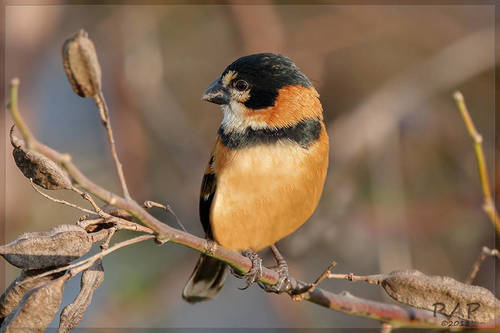
Silver-beaked Tanager

Silver-beaked Tanager

Ramphocelus carbo

Silhouette: Sheatherius · PhyloPic

LCLeast ConcernNTVUENCR
Daily sighting probability ~50% · Likely
at Parque Estadual Encontro das Águas

In 3 days ~90% in a week >90%

1,057 Verified sightings at Parque Estadual Encontro das Águas From 2019 to 2026
7,899 In all 16 parks
August Best month
☀️ Diurnal When it's spotted

About the Silver-beaked Tanager

The silver-beaked tanager (Ramphocelus carbo) is a medium-sized passerine bird. This tanager is a resident breeder in South America from eastern Colombia and Venezuela south to Paraguay and central Brazil, Peru and on Trinidad. It is common and conspicuous.

Silver-beaked tanagers are 18 centimetres (7 in) long and weigh 25 grams (0.88 oz). Adult males are velvety crimson black with a deep crimson throat and breast. The upper mandible of the bill is black, but the enlarged lower mandible is bright silver in appearance. The bill is pointed upwards in display. The female is much duller, with brownish upperparts, reddish brown underparts and a black bill.

There is considerable plumage variation between the various subspecies, differing mainly in the degree of contrast between the upperparts and the throat and breast. It occurs in light woodland and cultivated areas. The bulky cup nest is usually built in a bush, and the normal clutch is two green-blue eggs blotched with black-brown. The female incubates the eggs for 11–13 days before they hatch. The chicks fledge after another 11–12 days.

Individuals may live at least 11 years in the wild. These are social birds which eat mainly fruit, but vines, nectar, short grass and insects are also taken. The silver-beaked tanager is often seen in groups of six to ten, frequently giving a call described as cheeng. Its song is a slow thin kick-wick.

The silver-beaked tanager was first described by the German naturalist Peter Simon Pallas in 1764 and given the binomial name Lanius carbo. Wikipedia →

Sounds

Dawn song0:42

Ecuador · 2024

© Manuel Sánchez-Nivicela · XC1178846 · CC BY-NC-ND 4.0

Call0:12

French Guiana · 2024

© Tristan Guillebot de Nerville · XC1143101 · CC BY-NC-SA 4.0

Song1:00

Brazil · 2023

© Franciel da Silva Lima · XC1138048 · CC BY-NC-ND 4.0

Global Distribution

Parks Where Found

# Park Country Daily sighting probability
1 Amacayacu National Natural Park 🇨🇴 Colombia
~50%
2 Manu National Park 🇵🇪 Peru
~50%
3 Parque Estadual Encontro das Águas 🇧🇷 Brazil
~50%
4 Sierra de la Macarena National Park 🇨🇴 Colombia
~40%
5 Anavilhanas National Park 🇧🇷 Brazil
~40%
6 Brownsberg Nature Park 🇸🇷 Suriname
~40%
7 Tambopata National Reserve 🇵🇪 Peru
~40%
8 Henri Pittier National Park 🇻🇪 Venezuela
~30%
9 Chapada dos Guimarães National Park 🇧🇷 Brazil
~30%
10 Yasuní National Park 🇪🇨 Ecuador
~20%
11 Amboró National Park 🇧🇴 Bolivia
~20%
12 Podocarpus National Park 🇪🇨 Ecuador
~20%
13 Cuyabeno Wildlife Reserve 🇪🇨 Ecuador
~10%
14 Chingaza National Natural Park 🇨🇴 Colombia
<5%
15 Iguaçu National Park 🇧🇷 Brazil
<5%
16 Iguazú National Park 🇦🇷 Argentina
<5%

Cities Where Found

# City Country Daily sighting probability
1 São Luís 🇧🇷 Brazil
~40%
2 Belém 🇧🇷 Brazil
~40%
3 Valencia 🇻🇪 Venezuela
~10%
4 Caracas 🇻🇪 Venezuela
~10%
5 Santa Cruz de la Sierra 🇧🇴 Bolivia
<5%
6 Manaus 🇧🇷 Brazil
<5%
7 Belo Horizonte 🇧🇷 Brazil
<5%
8 São Paulo 🇧🇷 Brazil
<5%
9 Miami 🇺🇸 United States
<5%

Zoos & Centres Where Found

# Zoo / Centre Country
1 California Academy of Sciences 🇺🇸 United States In captivity
2 Zoo Miami 🇺🇸 United States In captivity
3 San Diego Zoo Safari Park 🇺🇸 United States In captivity
4 Memphis Zoo 🇺🇸 United States In captivity
5 Houston Zoo 🇺🇸 United States In captivity
6 Bird Paradise 🇸🇬 Singapore In captivity
7 Rainforest Wild Asia 🇸🇬 Singapore In captivity
8 National Aviary 🇺🇸 United States In captivity
9 Dallas World Aquarium 🇺🇸 United States In captivity

Before you go

What are the chances of seeing a Silver-beaked Tanager in Parque Estadual Encontro das Águas?

Likely

About 50% of wildlife watchers report a Silver-beaked Tanager sighting in Parque Estadual Encontro das Águas on a given day, based on 1,057 verified sightings from GBIF citizen-science data from 2019 to 2026. It is the 45th most-seen of the 308 birds we can rate there. Over three days the chance rises to about 90%, and over a week to over 90%, if each day is a fresh chance.

When is the best time to see a Silver-beaked Tanager in Parque Estadual Encontro das Águas?

August and October

In those months about 60% of wildlife watchers report a Silver-beaked Tanager in Parque Estadual Encontro das Águas on a given day, against about 40% in May–July and November, the lowest months. Those are among Parque Estadual Encontro das Águas's driest months, with about 45 mm of rain a month against 190 mm in January. January to April have too few records to rate.

What time of day is best to see a Silver-beaked Tanager?

Between 6 and 9 am

Across all the parks we cover, that three-hour window holds the most Silver-beaked Tanager sightings with a recorded time, and about 9 in 10 of them come between 6 am and 6 pm: it is a daytime animal.

Is Parque Estadual Encontro das Águas the best place to see a Silver-beaked Tanager?

Among the best

Of the 16 parks where we can rate Silver-beaked Tanager sightings, Parque Estadual Encontro das Águas ranks 3rd at about 50%, level with the leaders once rounded. The best odds are in Amacayacu National Natural Park (Colombia, about 50%) and Manu National Park (Peru, about 50%). All parks ranked.

Which relatives of the Silver-beaked Tanager live in Parque Estadual Encontro das Águas?

Same family: Thraupidae

The closest relatives of the Silver-beaked Tanager that you can see in Parque Estadual Encontro das Águas (family Thraupidae, Tanagers and Allies) are Yellow-billed Cardinal (about 70%), Blue-gray Saltator (about 40%) and Sayaca Tanager (about 20%), with each one's daily chance of a sighting.

Where does the Silver-beaked Tanager sighting chance come from?

GBIF citizen-science records

It is estimated from how often the Silver-beaked Tanager is recorded against all the birds logged in Parque Estadual Encontro das Águas (1,057 verified sightings from 2019 to 2026), calibrated against known sighting rates. Figures are rounded to the nearest 10% because citizen-science data supports honest approximations, not decimals, and months with records from fewer than five people show "—". How it works.

← Back to Parque Estadual Encontro das Águas