Blyth's Swift

Blyth's Swift

Apus leuconyx

Silhouette: Ferran Sayol · PhyloPic

Daily sighting probability <5% · Rare
at Eravikulam National Park

In 3 days <5% in a week ~10%

5 Verified sightings at Eravikulam National Park From 2019 to 2026
73 In all 4 parks
February Best month
☀️ Diurnal When it's spotted

About the Blyth's Swift

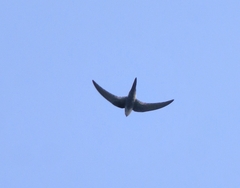
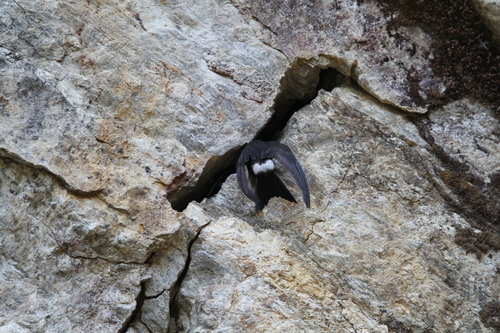
Blyth's swift (Apus leuconyx) is a small species of bird. It is superficially similar to a house martin, but completely unrelated to those passerine species, as swifts are in the order Apodiformes. The resemblances between the groups are due to convergent evolution reflecting similar life styles.

The common name commemorates Edward Blyth (1810–1873), English zoologist and Curator of the Museum of the Asiatic Society of Bengal. The scientific name comes from the Greek απους, apous, meaning "without feet". A 2011 study has many taxonomists splitting this species from the fork-tailed swift complex.

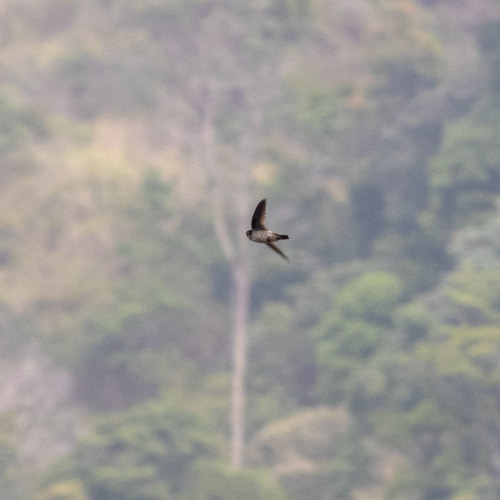
Blyth's swifts are similar in size to common swift, and they are black except for a white rump. They can be distinguished from a partially leucistic common swift by the deeper tail fork, longer wings, bigger head and larger white throat patch.

Blyth's swifts breeds from the outer Himalayas through the Assam hills. This species is migratory, and winters in India and Sri Lanka. Blyth's swifts have very short legs which they use only for clinging to vertical surfaces. They never settle voluntarily on... Wikipedia →
Sounds

Call0:18

Bhutan · 2005

© David Farrow · XC19674 · CC BY-NC-SA 3.0

Global Distribution

Parks Where Found

# Park Country Daily sighting probability
1 Royal Manas National Park 🇧🇹 Bhutan
<5%
2 Langtang National Park 🇳🇵 Nepal
<5%
3 Eravikulam National Park 🇮🇳 India
<5%
4 Periyar National Park 🇮🇳 India
<5%

Cities Where Found

# City Country Daily sighting probability
1 Colombo [Sri Jayawardenepura Kotte] 🇱🇰 Sri Lanka
<5%

Before you go

What are the chances of seeing a Blyth's Swift in Eravikulam National Park?

Rare

Under 5% of wildlife watchers report a Blyth's Swift sighting in Eravikulam National Park on a given day, based on 5 verified sightings from GBIF citizen-science data from 2019 to 2026. It is the 108th most-seen of the 116 birds we can rate there. Over three days the chance rises to under 5%, and over a week to about 10%, if each day is a fresh chance.

When is the best time to see a Blyth's Swift in Eravikulam National Park?

February

In that month about 10% of wildlife watchers report a Blyth's Swift in Eravikulam National Park on a given day, against under 5% in March to January, the lowest months. That is one of Eravikulam National Park's driest months, with about 25 mm of rain against 450 mm in July.

What time of day is best to see a Blyth's Swift?

Between 7 and 10 am

Across all the parks we cover, that three-hour window holds the most Blyth's Swift sightings with a recorded time, and about 9 in 10 of them come between 6 am and 6 pm: it is a daytime animal.

Is Eravikulam National Park the best place to see a Blyth's Swift?

Among the best

Of the 4 parks where we can rate Blyth's Swift sightings, Eravikulam National Park ranks 3rd at under 5%, level with the leaders once rounded. The best odds are in Royal Manas National Park (Bhutan, under 5%) and Langtang National Park (Nepal, under 5%).

Where does the Blyth's Swift sighting chance come from?

GBIF citizen-science records

It is estimated from how often the Blyth's Swift is recorded against all the birds logged in Eravikulam National Park (5 verified sightings from 2019 to 2026), calibrated against known sighting rates. Figures are rounded to the nearest 10% because citizen-science data supports honest approximations, not decimals, and months with records from fewer than five people show "—". How it works.

← Back to Eravikulam National Park