
Broad-tailed Grassbird

Broad-tailed Grassbird

Schoenicola platyurus

Silhouette: Sheatherius · PhyloPic

LCNTNear ThreatenedVUENCR
Daily sighting probability <5% · Rare
at Eravikulam National Park

In 3 days ~10% in a week ~20%

18 Verified sightings at Eravikulam National Park From 2019 to 2026
18 In 1 park
April Best month
☀️ Diurnal When it's spotted

About the Broad-tailed Grassbird

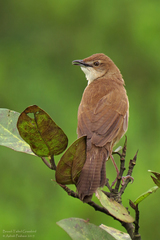
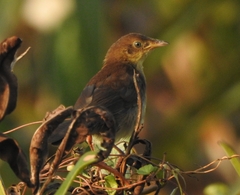
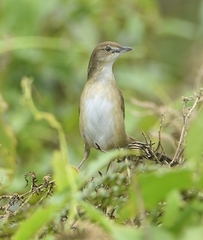
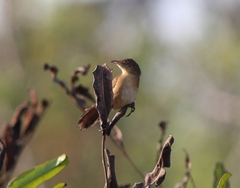
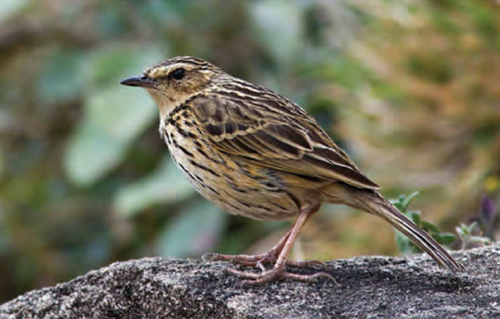
The broad-tailed grassbird (Schoenicola platyurus) is a species of Old World warbler in the family Locustellidae. It is endemic to the Western Ghats of India with a possibility of occurrence in Sri Lanka. A small, mostly brown bird, it has a broad rounded and graduated tail. It is found only on the higher altitude grassy hills where it usually skulks, except during the breeding season when males fly up into the air to sing in their display. The species is believed to be a resident although it is possible that they make local movements.

The uniform brown upperparts with a broad, round-tipped and long graduated tail are distinctive features of this bird. The species has a buff supercilium and the brown tail has thin dark bars. The underside of the tail is very dark and the feathers are tipped with white. Males and females are indistinguishable in plumage. The call of the male during breeding is a lark-like and repeated trill that is accompanied by fanned tail and a fluttering flight. Other calls include a chack and a zink note. The gape colour is black and visible in singing males but is brown in females. In the non-breeding season, it is a skulker moving rapidly between... Wikipedia →

Sounds

Call0:04

India · 2024

© Sreekumar Chirukandoth · XC911717 · CC BY-NC-SA 4.0

Recording0:35

India · 2023

© dbeadle · iNaturalist · CC BY-NC 4.0

Global Distribution

Parks Where Found

# Park Country Daily sighting probability
1 Eravikulam National Park 🇮🇳 India
<5%

More parks will be added in future updates.

Cities Where Found

# City Country Daily sighting probability
1 Coimbatore 🇮🇳 India
<5%

Before you go

What are the chances of seeing a Broad-tailed Grassbird in Eravikulam National Park?

Rare

Under 5% of wildlife watchers report a Broad-tailed Grassbird sighting in Eravikulam National Park on a given day, based on 18 verified sightings from GBIF citizen-science data from 2019 to 2026. It is the 78th most-seen of the 116 birds we can rate there. Over three days the chance rises to about 10%, and over a week to about 20%, if each day is a fresh chance.

When is the best time to see a Broad-tailed Grassbird in Eravikulam National Park?

April and May

In those months about 20% of wildlife watchers report a Broad-tailed Grassbird in Eravikulam National Park on a given day, against under 5% in June and September–March, the lowest months.

What time of day is best to see a Broad-tailed Grassbird?

Between 6 and 9 am

Across all the parks we cover, that three-hour window holds the most Broad-tailed Grassbird sightings with a recorded time, and about 9 in 10 of them come between 6 am and 6 pm: it is a daytime animal.

Where else can you see a Broad-tailed Grassbird?

Only Eravikulam National Park, in our data

Eravikulam National Park is the only park on Wallace's Line with enough records to rate Broad-tailed Grassbird sightings: under 5% of wildlife watchers there report one on a given day.

Which relatives of the Broad-tailed Grassbird live in Eravikulam National Park?

Same order: Passeriformes

The closest relatives of the Broad-tailed Grassbird that you can see in Eravikulam National Park (order Passeriformes, Perching Birds) are Palani Laughingthrush (about 90%), Red-whiskered Bulbul (about 80%) and Pied Bushchat (about 70%), with each one's daily chance of a sighting.

Where does the Broad-tailed Grassbird sighting chance come from?

GBIF citizen-science records

It is estimated from how often the Broad-tailed Grassbird is recorded against all the birds logged in Eravikulam National Park (18 verified sightings from 2019 to 2026), calibrated against known sighting rates. Figures are rounded to the nearest 10% because citizen-science data supports honest approximations, not decimals, and months with records from fewer than five people show "—". How it works.

← Back to Eravikulam National Park