
Malabar Parakeet

Malabar Parakeet

Psittacula columboides

Silhouette: Farelli (photo), John E. McCormack, Michael G. Harvey, Brant C. Faircloth, Nicholas G. Crawford, Travis C. Glenn, Robb T. Brumfield & T. Michael Keesey · PhyloPic

Endemic
Daily sighting probability <5% · Rare
at Eravikulam National Park

In 3 days ~10% in a week ~20%

15 Verified sightings at Eravikulam National Park From 2019 to 2026
6,151 In all 5 parks
June Best month
🌅 Crepuscular When it's spotted

About the Malabar Parakeet

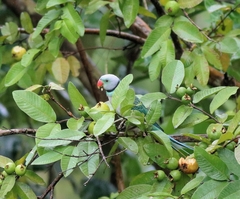
The blue-winged parakeet (Psittacula columboides), also known as the Malabar parakeet, is a species of parakeet endemic to the Western Ghats of southern India. Found in small flocks, they fly rapidly in forest clearings while making screeching calls that differ from those of other parakeet species within their distribution range. Their long blue tails tipped in yellow and the dark wings with blue contrast with the dull grey of their head and body. Adult males and females can be easily told apart from the colour of their beak.

The blue-winged parakeet is bluish grey with a long yellow-tipped tail. The black neck ring is complete in both males and females. The male has a bluish-green lower edge to the black collar and the upper mandible is red with a white tip while the female has an all black bill and has only the black collar. The female looks similar to the female of the plum-headed parakeet which however can be told apart by its broad yellow collar. Flocks move through the forest while calling out in a series of screeching keek-keek-keek calls.

They breed in the dry season after the northeast Monsoon and the chicks fledge before the southwest Monsoon in June. They... Wikipedia →

Sounds

Call0:27

India · 2023

© JISHNU KIZHAKKILLAM · XC785362 · CC BY-NC-SA 4.0

Flight call0:10

India · 2016

© Frank Lambert · XC473507 · CC BY-NC-ND 4.0

Song0:25

India · 2015

© Sudipto Roy · XC217787 · CC BY-NC-SA 4.0

Global Distribution

Parks Where Found

# Park Country Daily sighting probability
1 Periyar National Park 🇮🇳 India
~80%
2 Mudumalai National Park 🇮🇳 India
~40%
3 Nagarhole National Park 🇮🇳 India
~30%
4 Bandipur National Park 🇮🇳 India
~20%
5 Eravikulam National Park 🇮🇳 India
<5%

Cities Where Found

# City Country Daily sighting probability
1 Kozhikode 🇮🇳 India
<5%

Zoos & Centres Where Found

# Zoo / Centre Country
1 Loro Parque 🇪🇸 Spain In captivity
2 Adelaide Zoo 🇦🇺 Australia In captivity
3 Birds of Eden 🇿🇦 South Africa In captivity
4 CuriOdyssey 🇺🇸 United States In captivity
5 Ostrich Farm 🇨🇼 Curaçao In captivity

Before you go

What are the chances of seeing a Malabar Parakeet in Eravikulam National Park?

Rare

Under 5% of wildlife watchers report a Malabar Parakeet sighting in Eravikulam National Park on a given day, based on 15 verified sightings from GBIF citizen-science data from 2019 to 2026. It is the 80th most-seen of the 116 birds we can rate there. Over three days the chance rises to about 10%, and over a week to about 20%, if each day is a fresh chance.

When is the best time to see a Malabar Parakeet in Eravikulam National Park?

February, May–June and August–October

In those months about 10% of wildlife watchers report a Malabar Parakeet in Eravikulam National Park on a given day, against under 5% in March–April, July and November–January, the lowest months.

What time of day is best to see a Malabar Parakeet?

Between 3 and 6 am

Across all the parks we cover, that three-hour window holds the most Malabar Parakeet sightings with a recorded time, and about half of them come between 6 am and 6 pm: it is most active around dawn and dusk.

Where does the Malabar Parakeet sighting chance come from?

GBIF citizen-science records

It is estimated from how often the Malabar Parakeet is recorded against all the birds logged in Eravikulam National Park (15 verified sightings from 2019 to 2026), calibrated against known sighting rates. Figures are rounded to the nearest 10% because citizen-science data supports honest approximations, not decimals, and months with records from fewer than five people show "—". How it works.

← Back to Eravikulam National Park