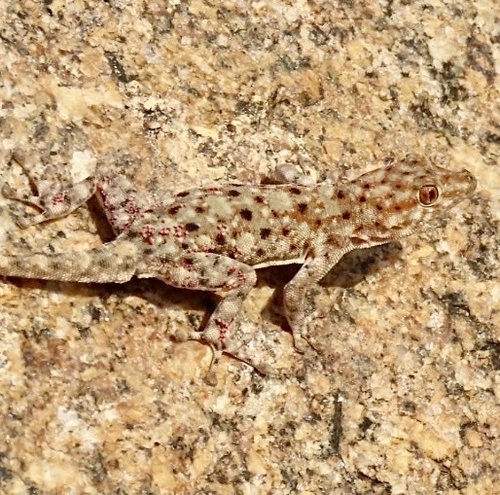
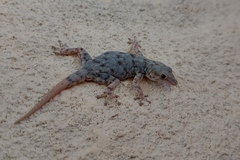

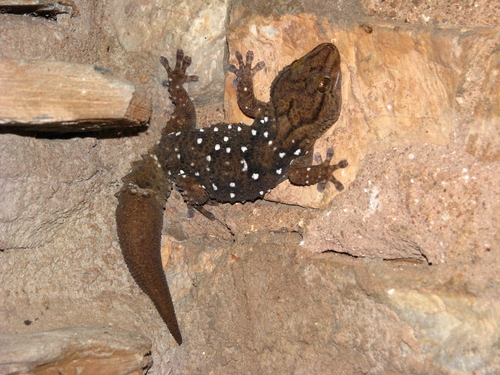
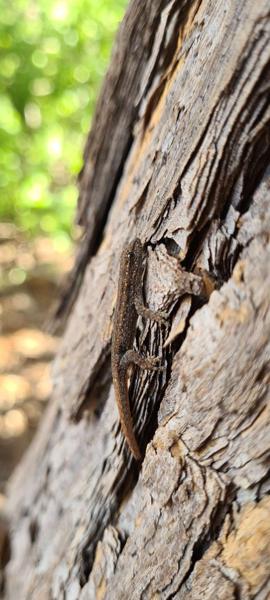
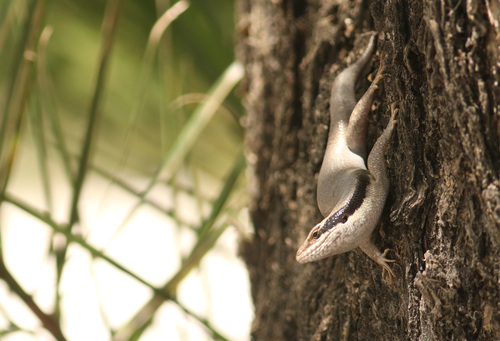
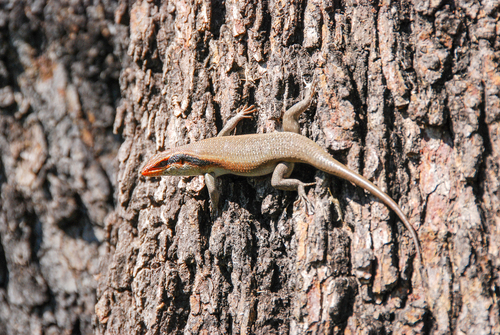
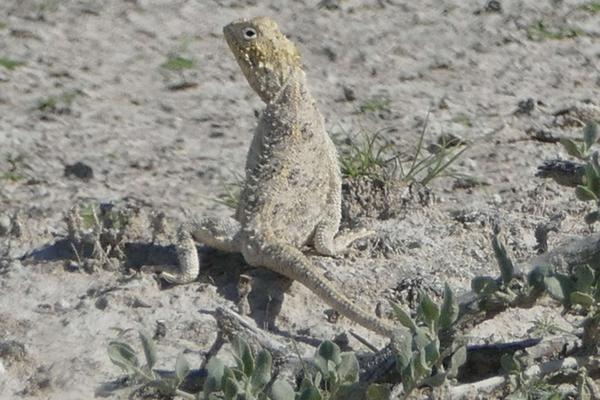
Barnard's Namib Day Gecko

Barnard's Namib Day Gecko

Rhoptropus barnardi

Silhouette: SeismicShrimp · PhyloPic

LCLeast ConcernNTVUENCR
Daily sighting probability ~10% · With luck
at Etosha National Park

In 3 days ~20% in a week ~50%

6 Verified sightings at Etosha National Park From 2019 to 2026
19 In all 2 parks
January Best month
☀️ Diurnal When it's spotted

About the Barnard's Namib Day Gecko

Barnard's Namib day gecko (Rhoptropus barnardi), also known commonly as Barnard's slender gecko, is a species of lizard in the family Gekkonidae. The species is native to southern Africa. The specific name, barnardi, is in honor of South African zoologist Keppel Harcourt Barnard.

R. barnardi is found in Angola and Namibia. The preferred natural habitats of R. barnardi are savanna and rocky areas, at altitudes of 200–1,900 m (660–6,230 ft). R. barnardi is the smallest species in its genus. Adults usually have a snout-to-vent length (SVL) of 3.0–4.5 cm (1.2–1.8 in). The maximum recorded SVL is 4.9 cm (1.9 in).

R. barnardi is oviparous. Clutch size is two eggs. Each egg measures on average 11.5 mm × 9.5 mm (0.45 in × 0.37 in). Communal nesting sites may contain as many as 200 eggs. Goldberg SR (2009). "Rhoptropus barnardi. Reproduction". African Herp News (48): 15–16.

Hewitt J (1926). "Descriptions of... Wikipedia →

Global Distribution

Parks Where Found

# Park Country Daily sighting probability
1 Namib-Naukluft National Park 🇳🇦 Namibia
~10%
2 Etosha National Park 🇳🇦 Namibia
~10%

Before you go

What are the chances of seeing a Barnard's Namib Day Gecko in Etosha National Park?

With luck

About 10% of wildlife watchers report a Barnard's Namib Day Gecko sighting in Etosha National Park on a given day, based on 6 verified sightings from GBIF citizen-science data from 2019 to 2026. It is the 16th most-seen of the 22 reptiles we can rate there. Over three days the chance rises to about 20%, and over a week to about 50%, if each day is a fresh chance.

When is the best time to see a Barnard's Namib Day Gecko in Etosha National Park?

January, March–April and October

In those months about 20% of wildlife watchers report a Barnard's Namib Day Gecko in Etosha National Park on a given day, against under 5% in February, May, July–September and November–December, the lowest months. Those are among Etosha National Park's wettest months, with about 40 mm of rain a month against almost none in June.

What time of day is best to see a Barnard's Namib Day Gecko?

Between 10 am and 1 pm

Across all the parks we cover, that three-hour window holds the most Barnard's Namib Day Gecko sightings with a recorded time, and about 8 in 10 of them come between 6 am and 6 pm: it is a daytime animal.

Is Etosha National Park the best place to see a Barnard's Namib Day Gecko?

Among the best

Of the 2 parks where we can rate Barnard's Namib Day Gecko sightings, Etosha National Park ranks 2nd at about 10%, level with the leaders once rounded. The best odds are in Namib-Naukluft National Park (Namibia, about 10%).

Where does the Barnard's Namib Day Gecko sighting chance come from?

GBIF citizen-science records

It is estimated from how often the Barnard's Namib Day Gecko is recorded against all the reptiles logged in Etosha National Park (6 verified sightings from 2019 to 2026), calibrated against known sighting rates. Figures are rounded to the nearest 10% because citizen-science data supports honest approximations, not decimals, and months with records from fewer than five people show "—". How it works.

← Back to Etosha National Park