Scarlet Milksnake

Scarlet Milksnake

Lampropeltis elapsoides

Silhouette: Andy Wilson · PhyloPic

LCLeast ConcernNTVUENCR Endemic
Daily sighting probability ~10% · With luck
at Everglades National Park

In 3 days ~20% in a week ~40%

21 Verified sightings at Everglades National Park From 2019 to 2026
54 In all 2 parks
May Best month
☀️🌙 Day & Night When it's spotted

About the Scarlet Milksnake

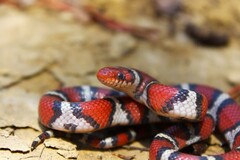
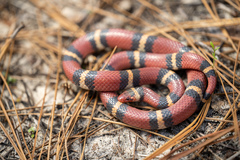
The scarlet kingsnake (Lampropeltis elapsoides) is a species of kingsnake found in the southeastern and eastern portions of the United States. Like all kingsnakes, they are nonvenomous. They are found in pine flatwoods, hydric hammocks, pine savannas, mesic pine-oak forests, prairies, cultivated fields, and a variety of suburban habitats; not unusually, people find scarlet kingsnakes in their swimming pools, especially during the spring.

Until recently, and for much of the 20th century, scarlet kingsnakes were considered a subspecies of the milk snake; however, Pyron and Bubrink demonstrated the phylogenetic distinction of this species and its closer relationship to the mountain kingsnakes of the southwestern United States.

These largely fossorial snakes are the smallest of all the species within the genus Lampropeltis, usually ranging from 40 to 50 cm (16 to 20 in) at maturity. The maximum recorded length is in Jonesboro, AR 76.2 cm (30.0 in). Hatchlings range in size from 8 to 18 cm (3.1 to 7.1 in).

The generic name, Lampropeltis, is derived from the Ancient Greek lamprós (λαμπρος) meaning "shiny" and peltas (πελτας) meaning "shield", after the sheen of their scales... Wikipedia →

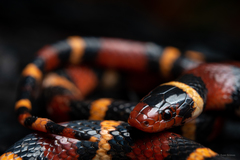
Global Distribution

Parks Where Found

# Park Country Daily sighting probability
1 Everglades National Park 🇺🇸 United States
~10%
2 Merritt Island National Wildlife Refuge 🇺🇸 United States
~10%

Zoos & Centres Where Found

# Zoo / Centre Country
1 Moscow Zoo 🇷🇺 Russia In captivity
2 North Carolina Zoo 🇺🇸 United States In captivity
3 ZooTampa 🇺🇸 United States In captivity
4 North Carolina Aquarium on Roanoke Island 🇺🇸 United States In captivity
5 La Aurora Zoo 🇬🇹 Guatemala In captivity
6 Тульский экзотариум (новая экспозиция) 🇷🇺 Russia In captivity

Before you go

What are the chances of seeing a Scarlet Milksnake in Everglades National Park?

With luck

About 10% of wildlife watchers report a Scarlet Milksnake sighting in Everglades National Park on a given day, based on 21 verified sightings from GBIF citizen-science data from 2019 to 2026. It is the 43rd most-seen of the 54 reptiles we can rate there. Over three days the chance rises to about 20%, and over a week to about 40%, if each day is a fresh chance.

When is the best time to see a Scarlet Milksnake in Everglades National Park?

May and June

In those months about 20% of wildlife watchers report a Scarlet Milksnake in Everglades National Park on a given day, against under 5% in August–September and November–February, the lowest months. Those are among Everglades National Park's wettest months, with about 190 mm of rain a month against 40 mm in March.

What time of day is best to see a Scarlet Milksnake?

Between 7 and 10 pm

Across all the parks we cover, that three-hour window holds the most Scarlet Milksnake sightings with a recorded time, and about 6 in 10 of them come between 6 pm and 6 am: it is seen both by day and at night.

Is Everglades National Park the best place to see a Scarlet Milksnake?

Yes

Of the 2 parks where we can rate Scarlet Milksnake sightings, Everglades National Park has the highest daily chance: about 10%. Next come Merritt Island National Wildlife Refuge (United States, about 10%).

Where does the Scarlet Milksnake sighting chance come from?

GBIF citizen-science records

It is estimated from how often the Scarlet Milksnake is recorded against all the reptiles logged in Everglades National Park (21 verified sightings from 2019 to 2026), calibrated against known sighting rates. Figures are rounded to the nearest 10% because citizen-science data supports honest approximations, not decimals, and months with records from fewer than five people show "—". How it works.

← Back to Everglades National Park