Blue-tailed Trogon

Blue-tailed Trogon

Trogon comptus

Silhouette: Keith Murdock (photo), John E. McCormack, Michael G. Harvey, Brant C. Faircloth, Nicholas G. Crawford, Travis C. Glenn, Robb T. Brumfield & T. Michael Keesey · PhyloPic

LCLeast ConcernNTVUENCR
Daily sighting probability <5% · Rare
at Farallones de Cali National Natural Park

In 3 days ~10% in a week ~20%

101 Verified sightings at Farallones de Cali National Natural Park From 2019 to 2026
101 In 1 park
June Best month
☀️ Diurnal When it's spotted

About the Blue-tailed Trogon

The Chocó trogon (Trogon comptus), also known as the white-eyed trogon or blue-tailed trogon, is a species of bird in the family Trogonidae, the quetzals and trogons. It is found in Colombia and Ecuador. The Chocó trogon is monotypic.

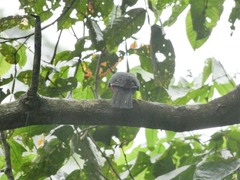
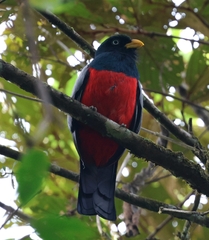
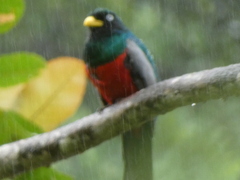
The Chocó trogon is about 28 cm (11 in) long and weighs about 104 g (3.7 oz). The male has a yellow bill, a black face and throat, and a white eye. Its crown, back, and breast are green with a bluish tinge, the rump purplish blue, and the belly and vent area red. The upperside of the tail is purplish blue with a broad black tip and the underside is slaty. The folded wing is gray with vermiculation. The female differs in having a slaty maxilla and gray head, back, breast, and upper belly.

The Chocó trogon is found from Colombia's northern Antioquia and northeastern Chocó Departments south into northwestern Ecuador's Pichincha Province. It inhabits the interior and edges of humid and wet forest. It favors hilly terrain from sea level to 1,800 m (5,900 ft) of elevation.

Nothing is known about the Chocó trogon's foraging behavior or diet. Evidence... Wikipedia →

Sounds

Song0:32

Ecuador · 2026

© Daan van der Hoeven · XC1165275 · CC BY-NC-SA 4.0

Uncertain0:08

Ecuador · 2022

© Paul Bourdin · XC750703 · CC BY-NC-SA 4.0

Disturbance notes0:14

Ecuador · 2001

© Patricio Mena Valenzuela · XC275276 · CC BY-NC-SA 4.0

Global Distribution

Parks Where Found

# Park Country Daily sighting probability
1 Farallones de Cali National Natural Park 🇨🇴 Colombia
<5%

More parks will be added in future updates.

Before you go

What are the chances of seeing a Blue-tailed Trogon in Farallones de Cali National Natural Park?

Rare

Under 5% of wildlife watchers report a Blue-tailed Trogon sighting in Farallones de Cali National Natural Park on a given day, based on 101 verified sightings from GBIF citizen-science data from 2019 to 2026. It is the 271st most-seen of the 542 birds we can rate there. Over three days the chance rises to about 10%, and over a week to about 20%, if each day is a fresh chance.

When is the best time to see a Blue-tailed Trogon in Farallones de Cali National Natural Park?

May to July

In those months about 10% of wildlife watchers report a Blue-tailed Trogon in Farallones de Cali National Natural Park on a given day, against under 5% in August to April, the lowest months.

What time of day is best to see a Blue-tailed Trogon?

Between 9 am and noon

Across all the parks we cover, that three-hour window holds the most Blue-tailed Trogon sightings with a recorded time, and about 9 in 10 of them come between 6 am and 6 pm: it is a daytime animal.

Where else can you see a Blue-tailed Trogon?

Only Farallones de Cali National Natural Park, in our data

Farallones de Cali National Natural Park is the only park on Wallace's Line with enough records to rate Blue-tailed Trogon sightings: under 5% of wildlife watchers there report one on a given day.

Which relatives of the Blue-tailed Trogon live in Farallones de Cali National Natural Park?

Same genus: Trogon

The closest relatives of the Blue-tailed Trogon that you can see in Farallones de Cali National Natural Park (genus Trogon, New World Trogons) are Collared Trogon (about 10%) and Masked Trogon (about 10%), with each one's daily chance of a sighting.

Where does the Blue-tailed Trogon sighting chance come from?

GBIF citizen-science records

It is estimated from how often the Blue-tailed Trogon is recorded against all the birds logged in Farallones de Cali National Natural Park (101 verified sightings from 2019 to 2026), calibrated against known sighting rates. Figures are rounded to the nearest 10% because citizen-science data supports honest approximations, not decimals, and months with records from fewer than five people show "—". How it works.

← Back to Farallones de Cali National Natural Park