Masked Trogon

Masked Trogon

Trogon personatus

Silhouette: Keith Murdock (photo), John E. McCormack, Michael G. Harvey, Brant C. Faircloth, Nicholas G. Crawford, Travis C. Glenn, Robb T. Brumfield & T. Michael Keesey · PhyloPic

LCLeast ConcernNTVUENCR
Daily sighting probability ~10% · With luck
at Farallones de Cali National Natural Park

In 3 days ~20% in a week ~30%

191 Verified sightings at Farallones de Cali National Natural Park From 2019 to 2026
1,144 In all 5 parks
January Best month
☀️ Diurnal When it's spotted

About the Masked Trogon

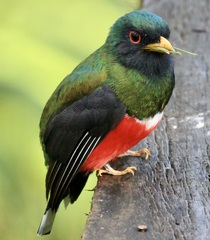
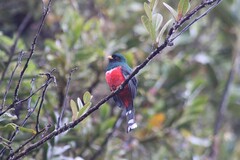
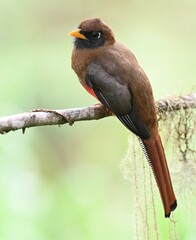
The masked trogon (Trogon personatus) is a species of bird in the family Trogonidae. It is fairly common in humid highland forests in South America, mainly the Andes and tepuis, and is resident in Bolivia, Brazil, Colombia, Ecuador, Guyana, Peru and Venezuela.

There are eight recognized subspecies of masked trogon: T. p. assimilis is found in the subtropics of the west Andean slope in Ecuador. T. p. duidae is found on cerro Duida in the tepui region of southern Venezuela; males of this subspecies are reddish-bronze on the back.

T. p. personatus is found in the subtropical Andes of Venezuela, central and east Andean slopes in Colombia, and east Andean slopes in Ecuador and Peru; males of this subspecies are glossy green above. T. p. ptaritepui is found in the tepui region of southern Venezuela; males of this subspecies are golden-green on the back.

T. p. roraimae is found on Auyantepui and Monte Roraima, on the border between Venezuela, Guyana and Brazil. T. p. sanctamartae is found in the Santa Marta Mountains of northeastern Colombia. T. p. submontanus is found in the Andean foothills in Bolivia.

T. p. temperatus, sometimes considered to be a separate species, the... Wikipedia →

Sounds

Call0:11

Ecuador · 2026

© Daan van der Hoeven · XC1137836 · CC BY-NC-SA 4.0

Song0:34

Ecuador · 2020

© Nunes-de-Almeida · XC544758 · CC BY-NC-SA 4.0

Alarm call0:56

Colombia · 2016

© Ottavio Janni · XC347842 · CC BY-NC-SA 4.0

Global Distribution

Parks Where Found

# Park Country Daily sighting probability
1 Los Nevados National Natural Park 🇨🇴 Colombia
~10%
2 Podocarpus National Park 🇪🇨 Ecuador
~10%
3 Amboró National Park 🇧🇴 Bolivia
~10%
4 Farallones de Cali National Natural Park 🇨🇴 Colombia
~10%
5 Chingaza National Natural Park 🇨🇴 Colombia
<5%

Before you go

What are the chances of seeing a Masked Trogon in Farallones de Cali National Natural Park?

With luck

About 10% of wildlife watchers report a Masked Trogon sighting in Farallones de Cali National Natural Park on a given day, based on 191 verified sightings from GBIF citizen-science data from 2019 to 2026. It is the 178th most-seen of the 542 birds we can rate there. Over three days the chance rises to about 20%, and over a week to about 30%, if each day is a fresh chance.

When is the best time to see a Masked Trogon in Farallones de Cali National Natural Park?

May, July, October and December–March

In those months about 10% of wildlife watchers report a Masked Trogon in Farallones de Cali National Natural Park on a given day, against under 5% in April, June, August–September and November, the lowest months.

What time of day is best to see a Masked Trogon?

Between 6 and 9 am

Across all the parks we cover, that three-hour window holds the most Masked Trogon sightings with a recorded time, and about 9 in 10 of them come between 6 am and 6 pm: it is a daytime animal.

Is Farallones de Cali National Natural Park the best place to see a Masked Trogon?

Among the best

Of the 5 parks where we can rate Masked Trogon sightings, Farallones de Cali National Natural Park ranks 4th at about 10%, level with the leaders once rounded. The best odds are in Los Nevados National Natural Park (Colombia, about 10%), Podocarpus National Park (Ecuador, about 10%) and Amboró National Park (Bolivia, about 10%).

Where does the Masked Trogon sighting chance come from?

GBIF citizen-science records

It is estimated from how often the Masked Trogon is recorded against all the birds logged in Farallones de Cali National Natural Park (191 verified sightings from 2019 to 2026), calibrated against known sighting rates. Figures are rounded to the nearest 10% because citizen-science data supports honest approximations, not decimals, and months with records from fewer than five people show "—". How it works.

← Back to Farallones de Cali National Natural Park