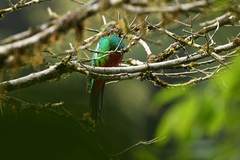
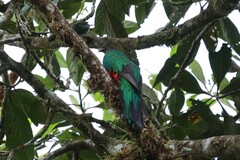
Golden-headed Quetzal

Golden-headed Quetzal

Pharomachrus auriceps

Silhouette: Jamie Whitehouse · PhyloPic

LCLeast ConcernNTVUENCR
Daily sighting probability <5% · Rare
at Farallones de Cali National Natural Park

In 3 days ~10% in a week ~30%

188 Verified sightings at Farallones de Cali National Natural Park From 2019 to 2026
406 In all 3 parks
April Best month
☀️ Diurnal When it's spotted

About the Golden-headed Quetzal

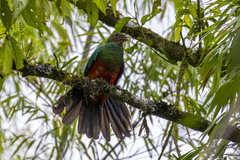
The golden-headed quetzal or corequenque (Pharomachrus auriceps) is a strikingly coloured bird in the genus Pharomachrus. It is found in moist mid-elevation forests from eastern Panama to northern Bolivia. The golden-headed quetzal is known for its iridescent green colour, which it shares with other quetzals, and its distinctive golden head. The female of the species is less brightly coloured, displaying more brown tones than the male. The golden-headed quetzal's diet consists mainly of fruit, and occasionally insects. It is generally a solitary and quiet bird unless it is breeding season, when the male and female become a monogamous pair and create a cavity nest in an old tree. During breeding season both sexes share brooding and feeding duties for 25–30 days until the chick is ready to fledge. The golden-headed quetzal is fairly common and considered a species of least concern.

The golden-headed quetzal, also known by the Spanish name pilco real, was first described by John Gould in the 2nd edition of A Monograph of the Trogonidae or family of Trogons published in 1875. It is one of five birds in the genus Pharomachrus, known as quetzals, and is included in the family... Wikipedia →

Sounds

Call0:05

Ecuador · 2026

© Daan van der Hoeven · XC1137837 · CC BY-NC-SA 4.0

Alarm call0:31

Ecuador · 2023

© rudy gelis · XC829186 · CC BY-NC-SA 4.0

Song0:23

Colombia · 2022

© Rolf A. de By · XC726034 · CC BY-NC-ND 4.0

Global Distribution

Parks Where Found

# Park Country Daily sighting probability
1 Farallones de Cali National Natural Park 🇨🇴 Colombia
<5%
2 Los Nevados National Natural Park 🇨🇴 Colombia
<5%
3 Podocarpus National Park 🇪🇨 Ecuador
<5%

Zoos & Centres Where Found

# Zoo / Centre Country
1 San Diego Zoo 🇺🇸 United States In captivity
2 Bronx Zoo 🇺🇸 United States In captivity
3 Sedgwick County Zoo 🇺🇸 United States In captivity
4 Houston Zoo 🇺🇸 United States In captivity
5 Dallas World Aquarium 🇺🇸 United States In captivity

Before you go

What are the chances of seeing a Golden-headed Quetzal in Farallones de Cali National Natural Park?

Rare

Under 5% of wildlife watchers report a Golden-headed Quetzal sighting in Farallones de Cali National Natural Park on a given day, based on 188 verified sightings from GBIF citizen-science data from 2019 to 2026. It is the 203rd most-seen of the 542 birds we can rate there. Over three days the chance rises to about 10%, and over a week to about 30%, if each day is a fresh chance.

When is the best time to see a Golden-headed Quetzal in Farallones de Cali National Natural Park?

January, April–May, August and October

In those months about 10% of wildlife watchers report a Golden-headed Quetzal in Farallones de Cali National Natural Park on a given day, against under 5% in February–March, June–July, September and November–December, the lowest months.

What time of day is best to see a Golden-headed Quetzal?

Between 7 and 10 am

Across all the parks we cover, that three-hour window holds the most Golden-headed Quetzal sightings with a recorded time, and about 9 in 10 of them come between 6 am and 6 pm: it is a daytime animal.

Is Farallones de Cali National Natural Park the best place to see a Golden-headed Quetzal?

Yes

Of the 3 parks where we can rate Golden-headed Quetzal sightings, Farallones de Cali National Natural Park has the highest daily chance: under 5%. Next come Los Nevados National Natural Park (Colombia, under 5%) and Podocarpus National Park (Ecuador, under 5%).

Which relatives of the Golden-headed Quetzal live in Farallones de Cali National Natural Park?

Same family: Trogonidae

The closest relatives of the Golden-headed Quetzal that you can see in Farallones de Cali National Natural Park (family Trogonidae, Trogons) are Collared Trogon (about 10%) and Masked Trogon (about 10%), with each one's daily chance of a sighting.

Where does the Golden-headed Quetzal sighting chance come from?

GBIF citizen-science records

It is estimated from how often the Golden-headed Quetzal is recorded against all the birds logged in Farallones de Cali National Natural Park (188 verified sightings from 2019 to 2026), calibrated against known sighting rates. Figures are rounded to the nearest 10% because citizen-science data supports honest approximations, not decimals, and months with records from fewer than five people show "—". How it works.

← Back to Farallones de Cali National Natural Park